



Key Insights
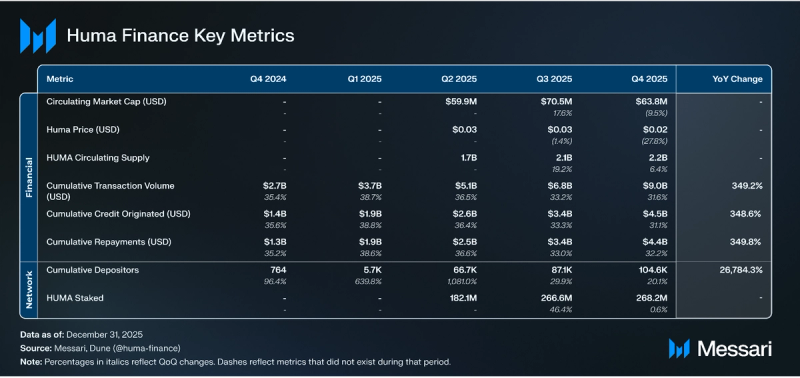
- In This fall, Huma processed $2.2 billion in transaction quantity, a 26.9% QoQ improve from $1.7 billion in Q3, whereas credit score originations rose 24.4% QoQ from $860.6 million to $1.1 billion.
- As of Dec. 31, customers staked 268.2 million HUMA ($6.6 million), up 0.6% QoQ from 266.6 million on Sept. 30. This represents 14.9% of the 1.8 billion HUMA eligible for staking.
- On Jan. 8, Huma launched Huma Prime, a yield product the place customers deposit USDC to earn yield from Huma PayFi exercise, which Huma then borrows towards on Jupiter Lend and redeploys the borrowed USDC into Huma swimming pools to amplify whole returns.
- As of Dec. 31, Huma 2.0 held $123.8 million in deposits, an 18.3% QoQ lower from $151.6 million on Sept. 30.
- As of Dec. 31, HUMA’s circulating market cap was $63.8 million, a 9.5% QoQ lower from $70.4 million on Sept. 30, whereas HUMA token worth decreased 27.8% QoQ from $0.034 to $0.025.
Primer
Huma Finance (HUMA) is a PayFi protocol that provides settlement liquidity for cross-border transactions, cost service suppliers, and bank card settlements by connecting liquidity suppliers (LPs) to debtors via sensible contracts. It operates two merchandise, Huma Institutional and Huma 2.0 (Permissionless), throughout 11 lively lending swimming pools, which generate yield from borrower charges.
Huma Institutional is a permissioned lending product for accredited traders in non-restricted nations with KYC/KYB and operates on Solana, Stellar, Polygon, and Celo.
Launched in April 2025, Huma 2.0 is a Solana-based lending product for customers to deposit USDC and mint any of:
- PayFi Technique Tokens (PST) in Basic Mode, which earns USDC yield (at the moment 8% APY) from settlement liquidity provisioning plus Huma Feather rewards that customers can change for HUMA tokens, or
- PST in Prime Mode, which earns the identical base USDC yield as Basic Mode (8% APY), further yield from borrowing towards preliminary deposits on Jupiter Lend and redeploying USDC into Huma lending swimming pools, plus Huma Feather rewards, or
- Maxi PayFi Technique Tokens (mPST) in Maxi Mode, which forgoes USDC yield in change for less than elevated Huma Feather rewards.
In February 2023, Huma raised $8.3 million in a seed spherical. Thereafter, in April 2024, it merged with Arf, a cross-border funds liquidity supplier, and in September 2024, raised a $38 million Sequence A led by Distributed International. For an entire primer on Huma Finance, check with our Initiation of Protection report.
Web site / X / Discord
Key Metrics
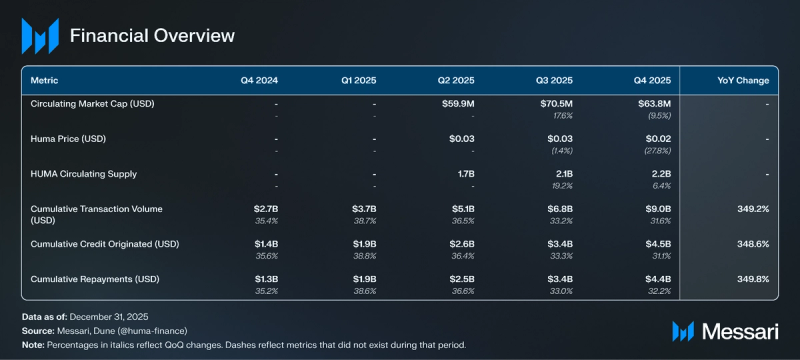
Monetary Evaluation
Market Cap
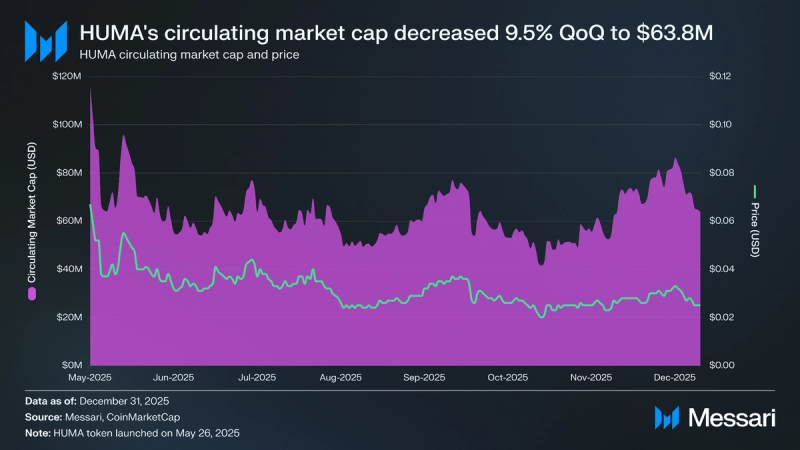
The HUMA token’s circulating market cap decreased 9.5% QoQ from $70.4 million on Sept. 30 to $63.8 million on Dec. 31 regardless of 321.6 million HUMA tokens unlocked throughout This fall. The HUMA token worth decreased 27.8% QoQ from $0.034 to $0.025.
Huma Finance launched HUMA on Could 26, 2025, as a utility and governance token with a complete provide of 10 billion tokens to reward LPs, group contributors, and ecosystem companions (i.e., Huma-integrated protocols). Token holders can stake HUMA to earn staking rewards, enhance LP rewards, and vote on incentive allocations and protocol parameter modifications. Longer staking durations improve voting energy, and Huma plans to publish governance course of particulars in 2026.
Transaction Quantity
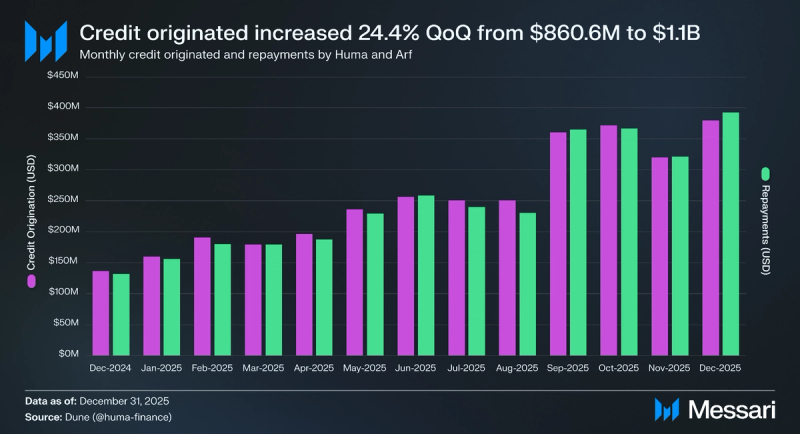
Credit score origination refers back to the worth of loans issued via lively lending swimming pools, whereas credit score reimbursement is the principal repaid by debtors. In This fall, originations via Huma swimming pools totaled $1.1 billion, up 24.4% QoQ from $860.6 million. Credit score repayments elevated 29.5% QoQ from $835.1 million to $1.1 billion. Transaction quantity throughout all swimming pools, together with originations and repayments, grew 26.9% QoQ from $1.7 billion to $2.2 billion over the identical interval. This improve displays extra institutional use of different cost financing options and rising curiosity in onchain settlement and credit score origination.
After closing 2025 with $9.0 billion in cumulative transaction quantity (up 31.6% QoQ), Huma surpassed $10 billion in transaction quantity on Feb. 4, reaching a milestone initially focused by the top of 2025.
Huma 2.0
Huma 2.0 is a Solana-based lending product that enables customers to deposit USDC and select between Basic Mode, which mints a PayFi Technique Token (PST) incomes USDC yield (at the moment 8% APY) from cost financing exercise plus HUMA token rewards, or Maxi Mode, which mints a Maxi PayFi Technique Token (mPST) that forgoes USDC yield for elevated HUMA token rewards.
Each modes share the identical underlying pool mechanics, with about 80% of capital deployed into Huma PayFi swimming pools and about 20% into liquid DeFi methods, together with Kamino Lend (lending), Jupiter Lend (lending), Aave (lending), and Pendle (yield buying and selling). Depositors can select from no-lockup, three-month, or six-month commitments, with longer lockups incomes increased rewards.
PST liquidity is offered on Orca (change), Meteora (change), Jupiter (change aggregator), and Kamino Finance (change). Moreover, on Could 12, RateX built-in with Huma 2.0, enabling customers to separate PST into yield tokens (YT-PST) for amplified returns or principal tokens (PT-PST) for mounted returns.
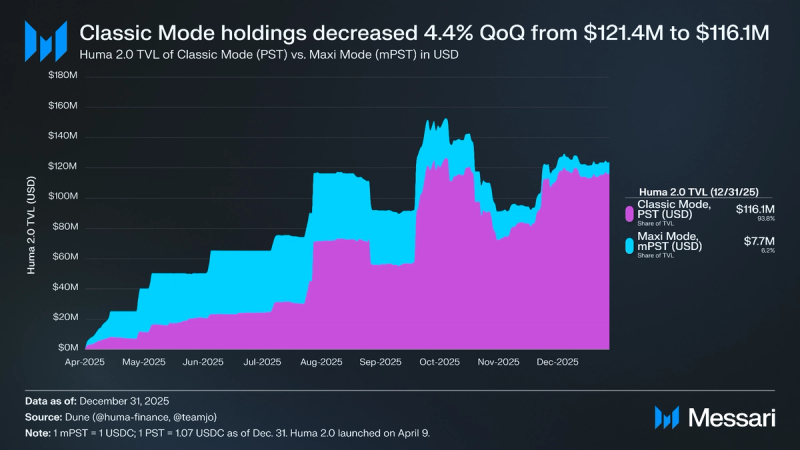
As of Dec. 31, Huma 2.0 held $123.8 million in deposits, an 18.3% QoQ lower from $151.6 million. Over the identical interval, Basic Mode holdings fell 4.4% QoQ from $121.4 million to $116.1 million (93.8% share), and Maxi Mode holdings decreased 74.5% QoQ from $30.2 million to $7.7 million (6.2% share).
The lower in Maxi holdings resulted from the 27.8% QoQ lower in HUMA token worth, mixed with decrease whole yield in comparison with Basic Mode. As of Dec. 31, Maxi no-lockup deposits earned 0% USDC APY and an estimated 2.6% APY in HUMA token rewards. Compared, Basic no-lockup deposits earned 8.0% USDC APY plus an estimated 1.0% APY in HUMA token rewards, totaling 9.0% APY.
On Nov. 21, Huma surpassed $8.0 billion in cumulative transaction quantity and launched a limited-time deposit marketing campaign providing 14% to twenty% APY on Basic Mode no-lockup deposits, capped at $20 million in whole new deposits. From Nov. 21 to Nov. 26, Basic Mode recorded $27.6 million in internet deposits, exceeding the marketing campaign cap in six days and marking the most important six-day deposit interval in This fall.
Community Evaluation
Depositors
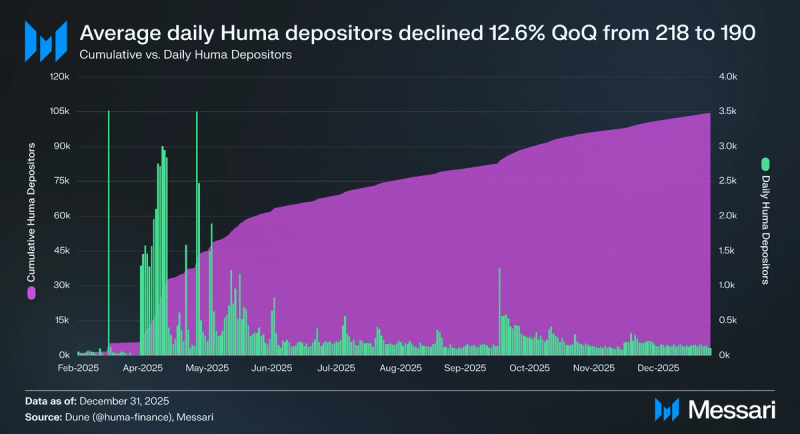
In This fall, common every day Huma pool depositors declined 12.6% QoQ from 218 to 190. The This fall common every day depositor lower was considerably smaller than the Q3 decline of 69.7%, indicating stabilized depositor exercise. In October, Huma averaged 267 every day depositors, the best month-to-month common in This fall, contributed by an integration with Binance Wallets.
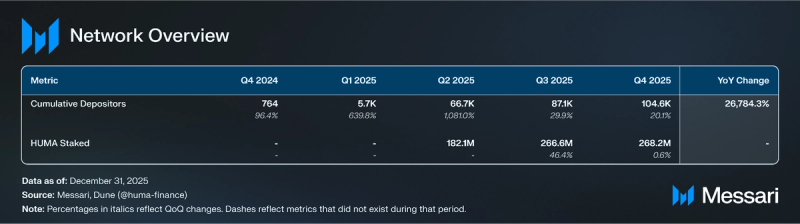
Cumulative depositors elevated 20.1% QoQ from 87,100 on Sept. 30 to 104,600 on Dec. 31. Since Huma 2.0 launched on April 9, no day has had fewer than 88 every day depositors, exhibiting constant baseline utilization.
Staking
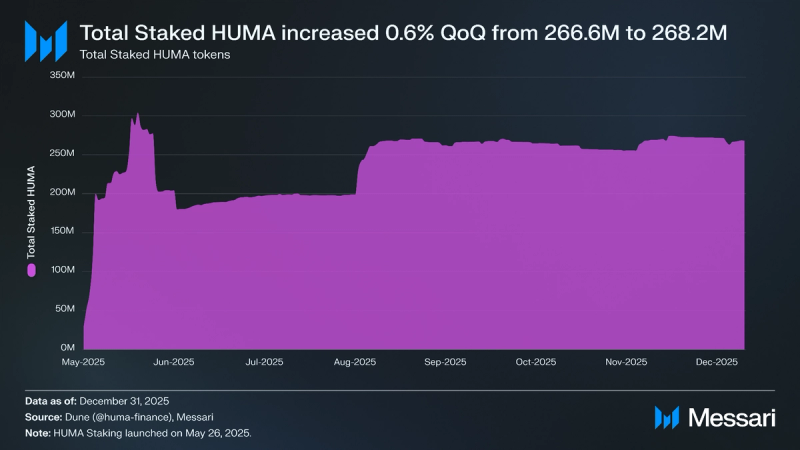
All the HUMA circulating provide may be staked besides the 400 million allotted to market-making and onchain liquidity. As of Dec. 31, customers staked 268.2 million HUMA ($6.6 million), up 0.6% QoQ from 266.6 million on Sept. 30, which represents 14.9% of the 1.8 billion HUMA eligible for staking.
On June 30, the Huma Basis introduced the rewards framework for HUMA stakers, which incorporates governance voting rights, Feathers-based rewards, a staking a number of on LP rewards, early entry to Huma 2.0 vault reopenings, and eligibility for choose ecosystem promotions and associate airdrops. Staking rewards are calculated over 30-day intervals primarily based on the quantity of HUMA staked and two protocol-controlled variables, the Staking Issue and α. The system is 30-day staking rewards = (Staking Issue / α) × staked HUMA. At launch, the Staking Issue was 10, and α was 20, which means 1,000 HUMA staked for 30 days would earn 500 Feathers.
Stakers who additionally LP obtain a multiplier on their LP rewards, capped at 2x when their staked HUMA exceeds thrice their PST or mPST stability. If an LP has a number of positions, the multiplier applies to all of them. Stakers should wait 14 days after initiating an unstake request earlier than tokens may be withdrawn.
Qualitative Evaluation
Huma Prime
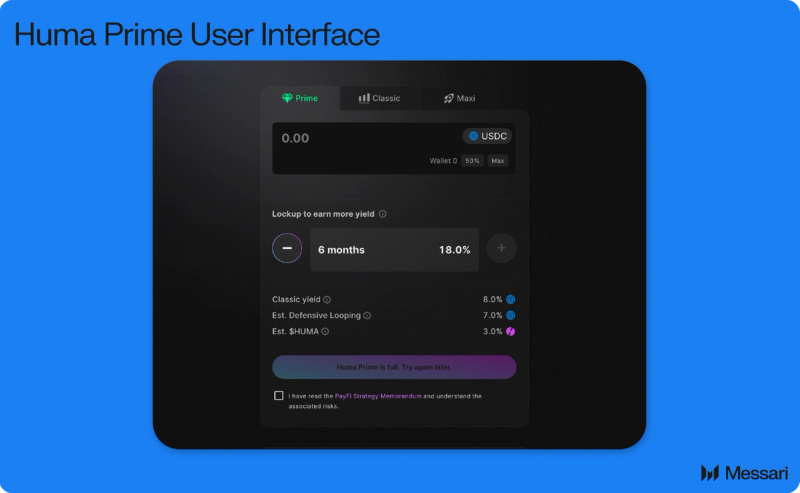
On Jan. 8, Huma launched Huma Prime, a yield product that borrows towards USDC deposits on Jupiter Lend, and redeposits borrowed USDC into Huma lending swimming pools to amplify returns. The protocol borrows USDC towards deposited collateral at a decrease borrow APY and redeposits the borrowed funds as further collateral to extend the place. The cycle repeats (known as looping) when provide APY exceeds borrow APY. The technique income from the unfold between provide APY (curiosity earned on deposits) and borrow APY (curiosity paid on loans), plus protocol rewards.
Looping introduces rate of interest threat. If the borrow APY rises above the provision APY, the place enters unfavorable compounding, the place losses multiply with every loop and erode capital. To mitigate this, Huma makes use of defensive looping. Huma repeatedly displays the unfold between borrow APY and provide APY. If borrowing prices threaten to exceed yield, the sensible contract routinely deleverages the place to guard principal earlier than losses happen.
Supply: Huma App Interface
For Prime deposits, Huma routinely borrows towards depositors’ USDC in Basic Mode and redeposits the borrowed USDC into Basic Mode to amplify base yield. Prime yield comes from three sources: provide APY on PST (8% APY for all lockup intervals as of Jan. 8), yield from defensive looping (as of Feb. 11, an estimated 5% APY for no lockup, 6% for three-month lockup, and seven% for six-month lockup), and HUMA token rewards for badge holders or HUMA stakers.
Customers can convert locked Basic Mode PST positions to Prime, however should lock Prime positions at a maturity date on or after the unique Basic Mode deposit maturity. In contrast to Basic Mode and Maxi Mode, Prime has no secondary change markets, so positions stay locked till maturity. As of Jan. 8, Prime launched with restricted capability for OG and Vanguard badge holders.
Partnerships
TradeFlow x Obligate
On Dec. 12, Huma introduced a partnership with TradeFlow Capital Administration and Obligate to supply USDC liquidity for commerce finance bonds. TradeFlow is a Singapore-based commerce finance firm that purchases commerce receivables from small and medium enterprises (SMEs) in rising markets and points onchain bonds backed by these receivables to certified traders. Obligate is a Swiss fintech firm that operates infrastructure for corporations to difficulty and settle USDC onchain bonds, known as eNotes, on Polygon and Base.
Within the partnership, Huma supplies USDC liquidity, TradeFlow is the asset issuer, and Obligate supplies the issuance infrastructure for eNotes. TradeFlow points USDC-denominated eNotes via Obligate, financing import and export transactions throughout Asia, Africa, and Latin America in sectors together with commodities, client items, and manufacturing.
Tala
On Dec. 10, Huma introduced a partnership with Tala to supply USDC liquidity for tokenized lending on Solana. Tala is a fintech firm that gives small loans starting from $10 to $500 to 13 million customers who lack conventional credit score histories throughout Kenya, the Philippines, Mexico, and India. Tala makes use of smartphone knowledge, various knowledge sources, and an AI underwriting system to evaluate creditworthiness. Authorised customers can take out overcollateralized loans via the app, funded by Huma’s USDC liquidity on Solana.
UnifAI
On Nov. 3, Huma partnered with UnifAI to permit its brokers to allocate capital into Huma 2.0 lending swimming pools on Solana, monitor yield efficiency, and routinely rebalance positions primarily based on programmed parameters.
UnifAI is a DeFi infrastructure platform that permits autonomous AI brokers to execute monetary methods throughout protocols. Customers can deploy AI brokers to automate yield, buying and selling, and liquidity methods, whereas builders can construct brokers utilizing UnifAI’s SDK.
Closing Abstract
In This fall, HUMA’s circulating market cap decreased 9.5% QoQ from $70.4 million on Sept. 30 to $63.8 million on Dec. 31 regardless of 321.6 million HUMA tokens unlocked throughout This fall. HUMA token worth decreased 27.8% QoQ from $0.034 to $0.025. Huma processed $2.2 billion in transaction quantity in This fall, a 26.9% QoQ improve from $1.7 billion in Q3.
As of Dec. 31, Huma 2.0 held $123.8 million in deposits, an 18.3% QoQ lower from $151.6 million at Q3-end. Moreover, customers had staked 268.2 million HUMA ($6.6 million), representing 14.9% of the 1.8 billion HUMA eligible for staking.
Along with continued transaction quantity development, Huma expanded its product choices and institutional partnerships in This fall. On Jan. 8, Huma launched Huma Prime, a yield product that makes use of automated borrowing and redepositing of USDC deposits to amplify returns. On Dec. 12, Huma partnered with TradeFlow Capital Administration and Obligate to supply USDC liquidity for commerce finance, the place TradeFlow points USDC-denominated eNotes via Obligate’s infrastructure, financing import and export transactions throughout Asia, Africa, and Latin America. Huma Prime’s launch, new institutional partnerships, and sustained transaction quantity development bolstered Huma’s place within the PayFi ecosystem. If Huma maintains this development trajectory and expands its partnerships with PayFi leaders, will probably be positioned to surpass $10.0 billion in cumulative transaction quantity in Q1 2026.
