



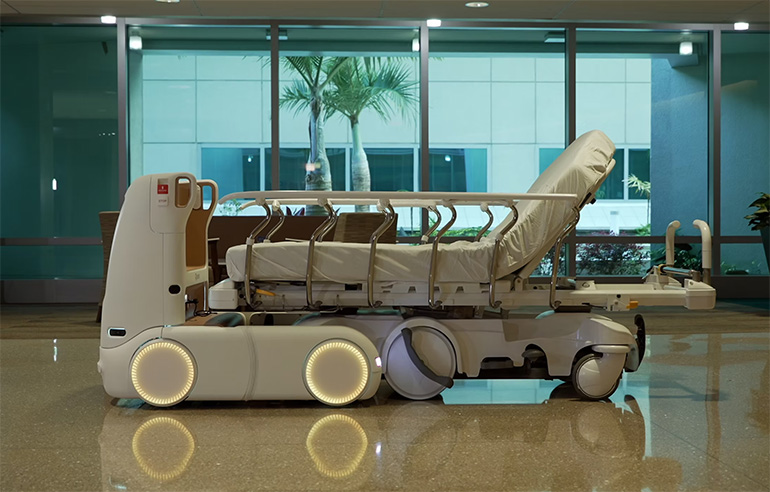
Rovex has launched its inaugural hospital transport system pilot in Florida. Source: Rovex
Last month, I attended eMerge Americas, hosted by Melissa Medina in Miami. The event highlighted South Florida’s rapidly growing innovation ecosystem, featuring startups presenting cutting-edge technology in healthcare, defense, AI, and hardware.
The speaker lineup was equally remarkable, including well-known CEOs, military generals, prominent influencers, and even the president’s son. It’s clear that the center of innovation is gradually moving away from the Northern coasts toward the (tax-free) Sun Belt.
While exploring the exhibition floor, I searched for robotics companies in the eMerge “alligator alley.” Among the various drones and autonomous vehicles, Rovex Technologies caught my attention with its self-driving hospital bed. The company was founded by emergency room physician David Crabb, who was tasked with managing his department and addressing bottlenecks in patient flow through the hospital.
One of the most obvious inefficiencies was how long patients had to wait to be seen by imaging staff. The entrepreneur revealed that it took “over an hour to travel just 200 yards down the hallway.” This resulted in significant patient dissatisfaction, lost revenue, and a rise in workers’ compensation claims.
“Transporters have an incredibly demanding job,” Dr. Crabb explained. “They experience one of the highest injury rates of any occupation in the U.S., with some institutions seeing complete staff turnover within six months and 100% turnover within a year.”
“So I began exploring ways to move patients autonomously,” he said. “We ultimately decided on a solution that could attach to equipment people already use — stretchers, wheelchairs, beds, and so on — and tow them safely down hallways. This speeds up patient care and allows staff to return to bedside duties where they can provide hands-on care, rather than spending time pushing equipment around. There will always be a need for human interaction, particularly with patients who are confused or uneasy around automated systems.”
Rovex enables autonomous mobility through towing
Rovex has created an autonomous patient-transport system designed to work with existing beds and gurneys. It features advanced obstacle detection for safe hallway navigation, but as Dr. Crabb noted, the company’s key intellectual property lies in its towing mechanism.
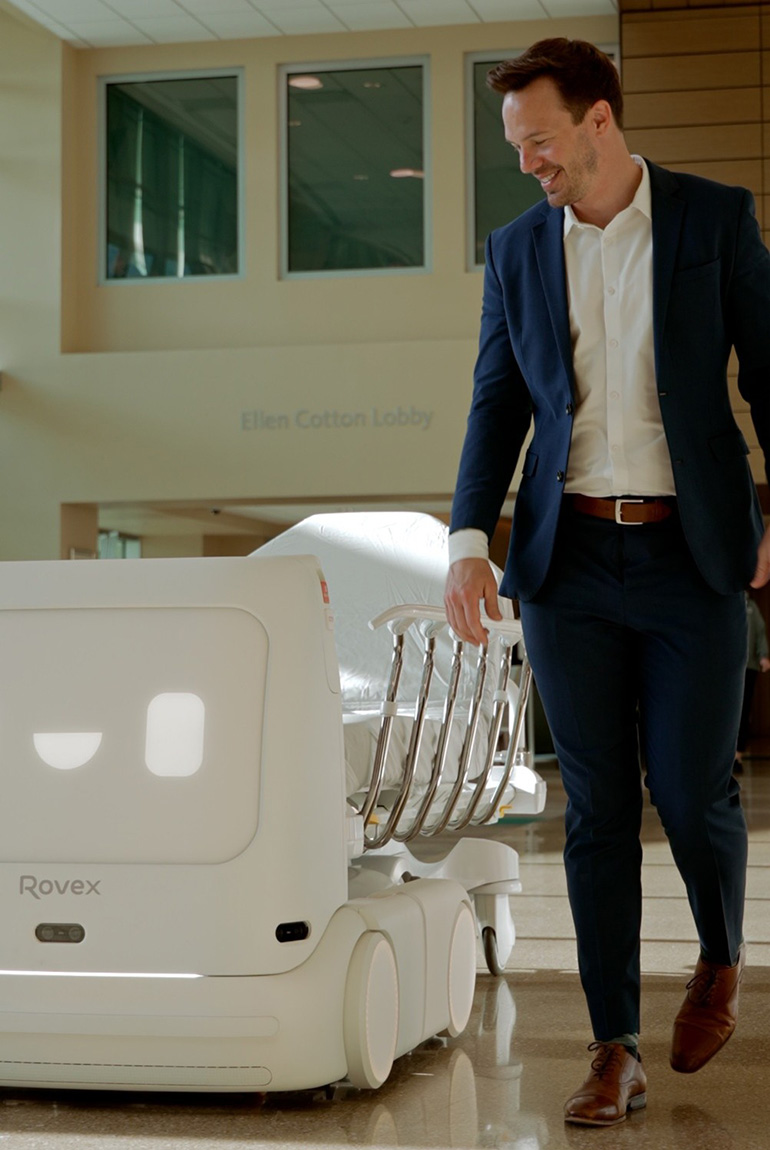
David Crabb, M.D., founder and CEO of Rovex, with the company’s system at Morton Plant Hospital. Source: Rovex
“One of the core technologies we’ve built in-house involves how we grip and interface with caster wheels — those free-spinning wheels,” he said. “We’ve gone through four to five different design iterations to figure out how to securely and efficiently grab them with precise control, quickly attach, and maintain stable handling of stretchers, wheelchairs, or beds as we transport them.”
Crabb pointed out that the data layer could ultimately become the company’s most valuable asset. “The data represents probably the biggest opportunity in this space,” he said. “There are only a limited number of robots operating autonomously out there, so we’re continuously refining our algorithms to ensure safe operation.”
“Social interactions with people in hallways can be unpredictable,” Crabb acknowledged. “Healthcare workers face an endless array of demands. So I’d say the data component is truly critical.”
“I believe the top priority when moving patients is recognizing that this is a vulnerable population,” the doctor said. “You must prioritize safety above all else. You can’t rush. You need to ensure the patient feels in control of the situation, so give them that sense of control to help them feel secure.”
“As a clinician, our foremost commitment is patient safety — first, do no harm,” Crabb stated. “That’s my personal philosophy as a physician, so the first features we install are an emergency stop button for the robot, along with an emergency release mechanism to ensure it can be quickly grabbed and moved aside if needed.”
BayCare Health System tests transport robot
The Robot Report reported last month that Rovex received a significant endorsement when BayCare Health System announced a pilot program to test its robots in real-world conditions at Morton Plant Hospital in Clearwater, Fla. The hospital is implementing a phased approach to assess how the startup’s systems navigate the facility and integrate with current workflows. Initial testing focuses on navigation rather than patient transport.
“Improving patient care demands innovation in every aspect of hospital operations,” said Craig Anderson, vice president of innovation at BayCare. His team explained that the pilot’s objective is to determine whether Rovex’s technology can be expanded across its 16 facilities in West Central Florida to boost efficiency while maintaining safety standards.
“What makes this pilot most exciting is the opportunity to thoroughly evaluate and learn,” said Dr. Chris Bucciarelli, BayCare’s chief medical officer for ambulatory services. “By examining how robotics can assist with patient transport in an actual hospital setting, we can gain valuable insights into designing care systems that benefit both patients and staff.”
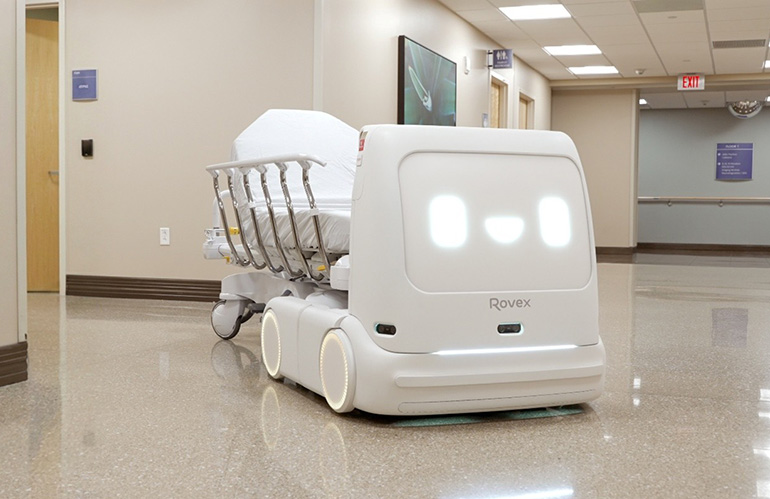
During the BayCare pilot, the Rovex robot is not yet moving patients. Source: Rovex
Other innovators tackle hospital transport
While Rovex has created a unique click-and-tow system, it isn’t the first to automate how patients are moved.
At CES 2025, MOVED introduced “an autonomous driving bed built to efficiently transport surgical patients using dedicated elevators, while maintaining privacy and hygiene.” Although this futuristic design drew significant attention in Las Vegas, updates from its South Korean developer, OGGMA, have been scarce since then.
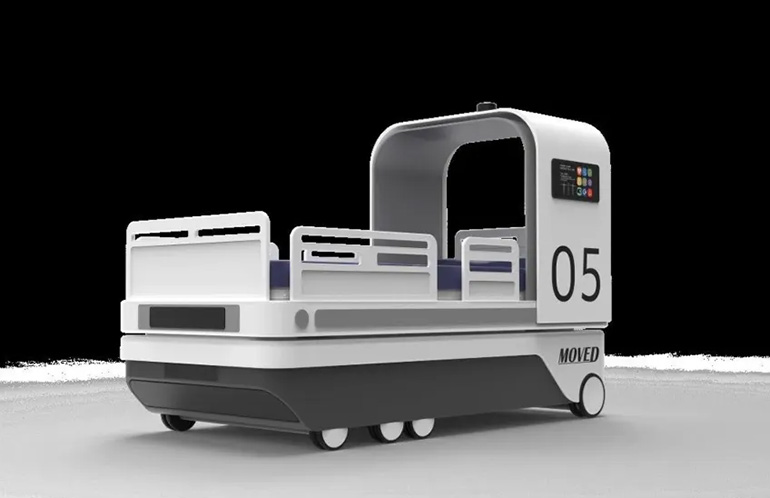
The MOVED autonomous driving hospital bed was recognized as a CES 2025 Digital Health honoree. Source: Consumer Technology Association
ReviMo, part of the fourth cohort in the MassRobotics Healthcare Robotics Startup Catalyst Program, has developed Niko, a lifting device for people with mobility issues. Able Innovations‘ ALTA automatically transfers patients from hospital beds to gurneys without ergonomic strain on hospital personnel.
In addition, robots are already operating in hospital hallways as they provide logistical support for pharmaceuticals, equipment, and linens. These include systems from Aethon, Relay Robotics, and Diligent Robotics (which was acquired by Serve Robotics in January).
Editor’s note: The Robotics Summit & Expo will include a session on hospital logistics with Aethon, Rovex, and SKA Robotics. MassRobotics will also introduce startups in its Healthcare Startup Showcase. Register now to attend next week’s event in Boston.

Moby is a ‘bubble on wheels’
The broader opportunity in patient transport was further underscored this past year at Endless Frontier Labs, where I met Janis Münch, CEO of Sphaira and the inventor of Moby, a mobile protective transportation system complete with air filtration.
“Medical isolation is either you’re immunocompromised or highly infectious,” he explained. “Now, what we did was develop a mobile protective bubble on wheels. It’s a medical device in Europe.”
“We’re undergoing FDA approval, and this has been in use for 1.5 years at Charité – Universitätsmedizin Berlin, arguably the most famous European hospital,” added Münch. “We are now doing a clinical study with Stanford Children’s Hospital.”
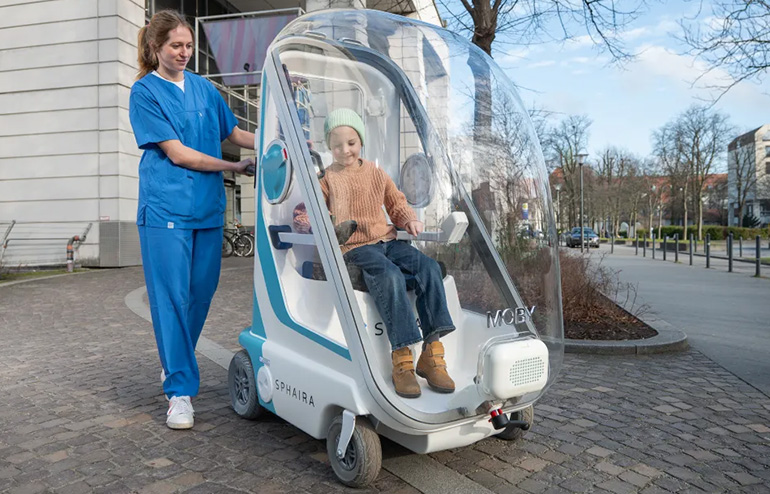
Moby is in use in Germany for cancer patients at Charité, Universitätsmedizin Berlin. Source: Sphaira
Sphaira develops shuttles for the Mayo Clinic
Münch continued to outline his long-term plan to create fleets of autonomous patient and people movers, building on Moby’s success. In October 2025, Sphaira announced a development agreement with the Mayo Clinic for autonomous patient shuttles.
“So the idea is a pod, a one-person shuttle,” elaborated Münch. “It’s an autonomous wheelchair with passive protection. We map the building beforehand to create a digital twin, and then it drives through the building, moving in every direction.”
When I asked Münch why he chose to focus on an autonomous chair rather than a bed or gurney, the German entrepreneur replied, “It’s actually been more manageable, because we’re only going in the main hallways right now, but when you start thinking about doing the autonomous bed, we would need a bigger partner.”
“A Stryker or [another big partner] would be wonderful at one point, once our robotic infrastructure layer is installed. You have to get into every room, and this is a much bigger effort,” he added. “So we’ve already put a lot of thought into this. We haven’t come up with the perfect solution yet, but our first step is the parts, which brings us into the hospitals, so we are already there, and then we can think of all kinds of use cases, and then expand our infrastructure.”
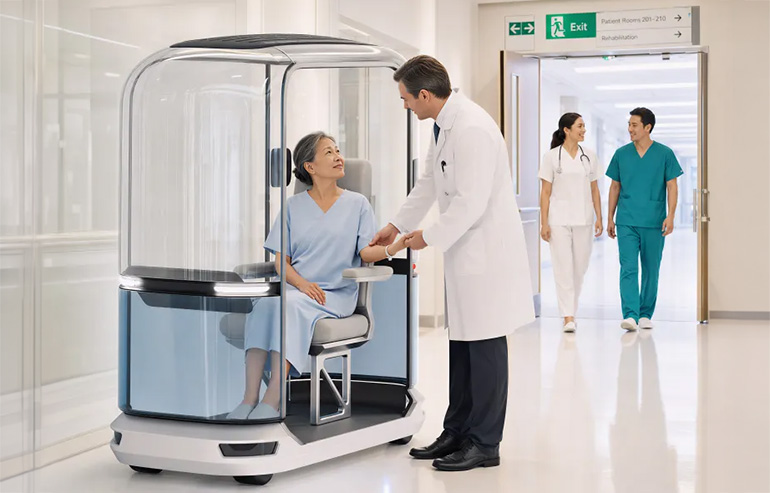
A rendering of the Autopod patient shuttle. Source: Sphaira
Sphaira
Track the per-unit expenses
Every founder in the field highlighted reduced costs, higher income from improved hospital operations, and better results for patients. But Sphaira’s CEO put it most clearly:
“A typical patient transporter, based on the area, earns roughly $43,000 annually. And when you examine how patient transport functions and study it, there’s always a surge during the day. Most occur in the morning, with some around noon, depending on how their processes are organized.”
“These surges are covered by two or three shifts of transporters. That means one of our devices can take the place of two to three transporters, which truly sets us apart in terms of unit capability.”
“Most [hospital] robots offer support, boosting efficiency by 5%, 10%, or 15%, while we’re boosting it by 200 to 300%. That’s the fundamental distinction, and that’s also why it’s an easy sale,” Münch explained.
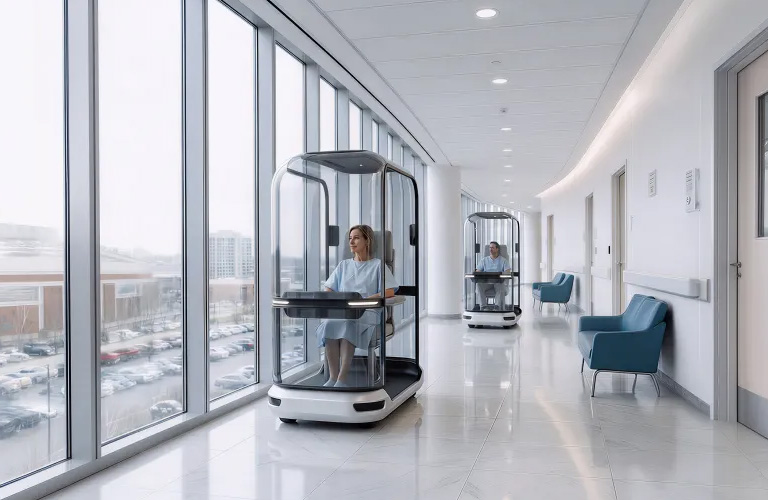
Sphaira’s autonomous patient shuttles navigate hospital hallways. Credit Sphaira
