



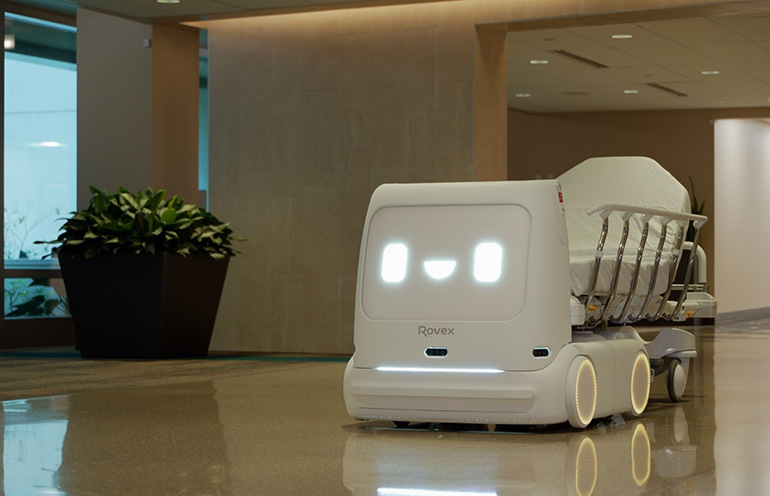
The Rovex robotic transport system navigates a hospital hall at BayCare’s Morton Plant Hospital. Supply: Rovex
BayCare Well being System and Rovex as we speak mentioned they’ve entered a strategic partnership to discover how robotics may help hospital operations and patient-transport workflows. The pilot started this month at BayCare’s Morton Plant Hospital in Clearwater, Fla.
“We are excited to join forces with Rovex to shape the future of hospital robotics and introduce this cutting‑edge innovation to BayCare, the health care industry, and the communities we serve,” said Craig Anderson, BayCare’s vp of innovation.
BayCare’s healthcare system consists of 16 hospitals, together with a youngsters’s hospital, and tons of of different places all through the Tampa Bay and central Florida areas. It mentioned it’s West Central Florida’s largest supplier of behavioral well being and pediatric companies.
The BayCare Medical Group is without doubt one of the largest supplier teams within the area. The corporate mentioned its community of ambulatory companies consists of laboratories, imaging, surgical facilities, pressing care places, wellness facilities, and one in all Florida’s largest residence care businesses.

Rovex addresses shorthanded hospitals
For hospitals, affected person transport is a necessary a part of care supply, famous Rovex. “Delays in patient movement can ripple across the system, slowing imaging and procedural workflows, disrupting schedules, increasing strain and injury risk for staff, and creating a less efficient experience for both patients and care teams,” it mentioned.
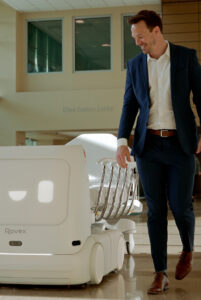
David Crabb, M.D., founder and CEO of Rovex, with the corporate’s system at BayCare’s Morton Plant Hospital. Supply: Rovex
Based in 2024 by emergency doctor David Crabb, M.D., Rovex is creating autonomous expertise for in-hospital affected person transport. The Gainesville, Fla.-based startup mentioned it’s centered on serving to hospitals enhance throughput and make higher use of current operational capability. Roves plans to offer new instruments to satisfy rising demand because the inhabitants ages and workforce shortages proceed to develop.
“Healthcare has seen enormous investment in digital tools and AI, but hospitals still depend on a huge amount of physical work behind the scenes,” mentioned Crabb, CEO of Rovex. “We believe robotics can help offload some of that manual burden so staff and providers can spend more time focused on patients.”
“Hospital logistics has downstream effects on staff workload, patient flow, and the patient experience,” he added. “As an emergency physician, I saw firsthand how often providers are pulled away from direct patient care by operational tasks, and our goal at Rovex is to help return more of that time to patients.”
BayCare begins with a phased pilot
The phased pilot at BayCare’s Morton Plant Hospital will run for about seven months, mentioned Crabb. It started with with workflow analysis, mapping, and studying about operations.
“We do not have a patient-transport phase in the current pilot,” Crabb instructed The Robotic Report. “That remains a long-term goal for Rovex, and the point of this phased approach is to build toward that in a disciplined, step-by-step fashion.”
Testing is starting in a managed space of the hospital and can step by step develop to extra energetic environments, he mentioned.
“BayCare Health System is an ideal early partner for Rovex because it combines operational scale with a willingness to thoughtfully evaluate new approaches to technology,” defined Crabb. “They are regionally close, which matters for a high-touch pilot, and they are part of a strong, increasingly innovation-oriented health care region in West Central Florida.”
“Just as importantly, BayCare understands that effective hospital logistics play a direct role in improving patient care,” he mentioned. “From our perspective, we believe the fit came from our novel approach to supporting health care workers while also addressing important operational processes inside the hospital.”
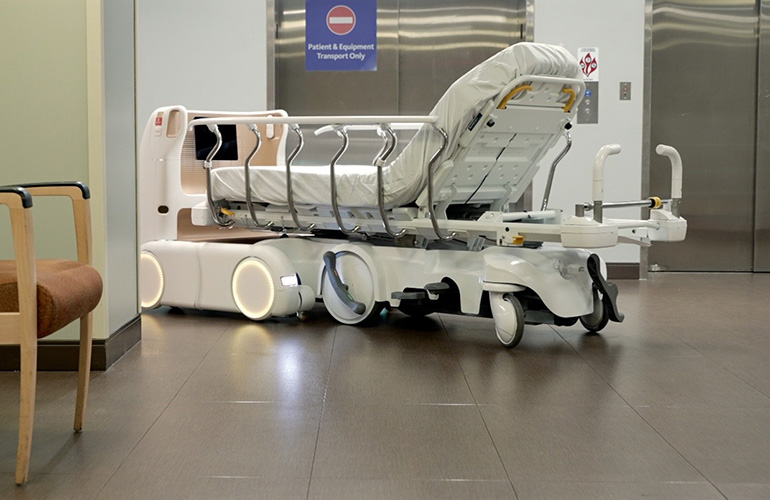
The robotic transport system with a hospital stretcher in the course of the pilot at Morton Plant Hospital in Clearwater, Fla. Supply: Rovex
Companions say techniques will increase current staffers
BayCare and Rovex added that the expertise is designed to help — not substitute — group members by lowering bodily pressure and operational burden, serving to care groups focus extra totally on sufferers. Rovex is working with hospital staffers in the course of the pilot.
“BayCare team members will interact with the robot during the pilot, as it is being developed to support hospital staff and patients, and real‑world feedback is critical to evaluating workflow fit and operational value,” mentioned Crabb. “During the current phase, Rovex personnel will serve as the primary on‑site operators and will remain closely involved in overseeing the system.”
How have healthcare community staff responded thus far?
“The early feedback has been largely positive. A lot of the immediate reaction has been that the robot is visually compelling and approachable,” Crabb replied. “We have also heard people ask when they will get to be transported by it, which obviously reflects curiosity and trust, and we have heard that the concept makes intuitive sense in a hospital setting. At this stage, we view that as encouraging early signal, while recognizing that the real value will come from what we learn operationally over the course of the pilot.”
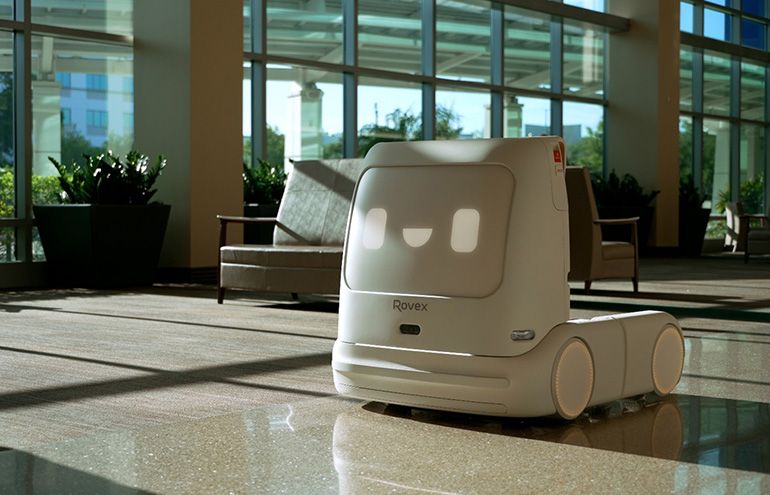
The Rovex pilot at Morton Plant Hospital is evaluating hospital workflows and transport patterns. Supply: Rovex
Each Rovex and BayCare count on to be taught extra
Rovex has not wanted to adapt its techniques for BayCare, however the companions are already studying from the pilot, mentioned Crabb.
“We did not customize the underlying hardware or software specifically for BayCare’s environment ahead of the pilot,” he mentioned. “Our approach is to build a system that can generalize across various hospital settings, while still learning the specifics of each site through mapping, workflow analysis, and phased deployment. We have already completed initial mapping work as part of the pilot kickoff, and that is a key part of how we understand routes, transport patterns, and operational opportunities within the hospital.”
By means of this pilot, BayCare mentioned it may consider how rising applied sciences like robotics can complement current workflows, help secure operations, and enhance resilience.
“What’s most compelling about this pilot is the chance to closely evaluate and learn,” mentioned Dr. Chris Bucciarelli, BayCare’s vp of ambulatory companies and chief medical officer.
“By carefully studying how robotics may support patient transport in a real hospital environment, we can generate insights that extend well beyond one facility,” he said. “Those learnings have the potential to inform how health systems everywhere think about designing care environments that better support both patients and the people who care for them.”
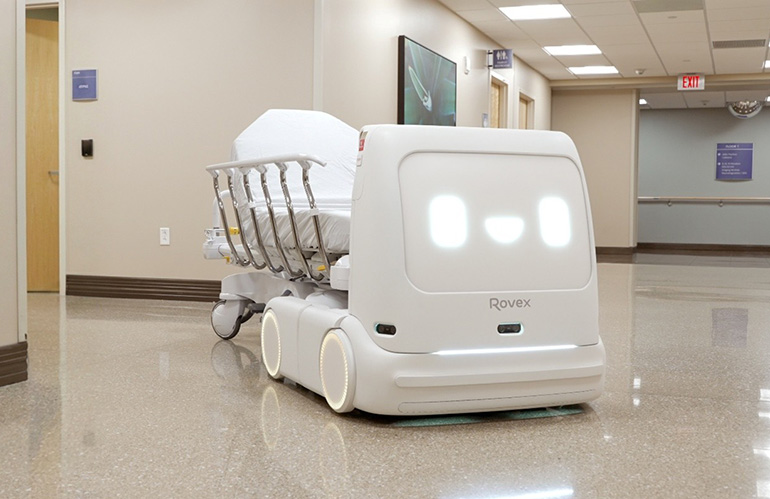
The Rovex robotic isn’t transporting sufferers in the course of the pilot at BayCare’s facility. Supply: Rovex
The publish Rovex and BayCare associate to discover in-hospital transport robots appeared first on The Robotic Report.
