



Observe ZDNET: Add us as a most popular supply on Google.
ZDNET’s key takeaways
- Encrypting information on Android is simple.
- You may encrypt and decrypt information with this straightforward app.
- OpenKeyChain is free to make use of and open-source.
When you take cellular safety significantly (and it is best to), then you definately would possibly need to contemplate file encryption. I am not speaking about saving a file in an encrypted folder to tuck it away from prying eyes.
No. That is all about encrypting information that you may both depart in your gadget and look at when wanted or share with others, understanding they are often considered solely by the recipient.
Additionally: The Thunderbird e-mail shopper lastly landed on Android, and it was well worth the wait
That is made attainable by the OpenKeyChain app. This app is all about encryption, and though it makes the method simple, there are some stuff you’ll have to know earlier than diving in.
Let’s just do that.
It is all about keys
When you’ve ever used public key encryption in your desktop to securely ship a file to somebody, you already perceive it. If not, let me clarify.
Public key encryption makes use of a key pair: one personal and one public. The personal key stays on the recipient’s gadget, whereas the general public secret is despatched to those that have to ship an encrypted file to them. Recordsdata encrypted with somebody’s personal key can solely be opened by somebody who has the corresponding public key. With out that public key, there is not any strategy to open the file.
It really works, and it really works very properly. You may have this on Android, and it is not practically as laborious as you would possibly assume. Let’s have a look at the way it works.
What you will want
To do that, you will want an Android gadget, and you may want the OpenKeyChain app put in. Be sure you set up that app, and also you’re able to go.
Handle the keys
There are two stuff you’ll want/need to do. The primary is to create your individual key.
Open the Keys tab of the app. On that web page, faucet the three-dot menu within the upper-right nook after which faucet “Manage my keys.”
Present extra
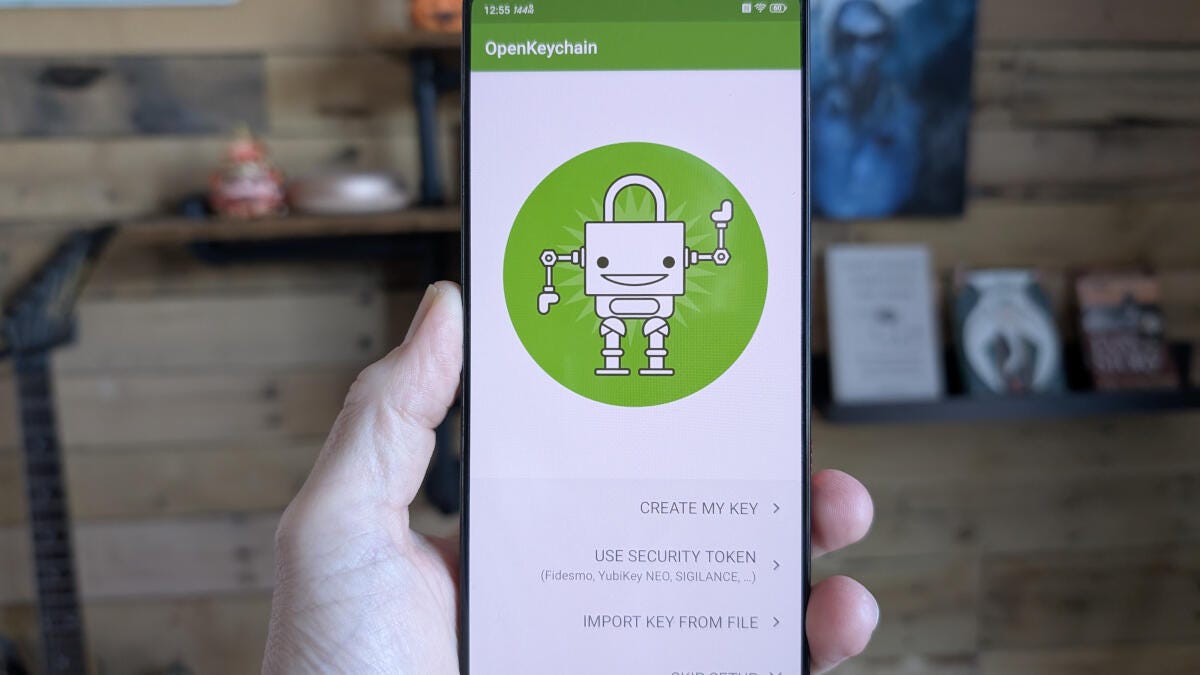
Creating your first key pair with OpenKeyChain is kind of simple.
Jack Wallen/ZDNET
On the ensuing web page, faucet CREATE MY KEY and stroll via the user-friendly wizard.
Present extra
The keys wizard could be very simple to comply with.
Jack Wallen/ZDNET
Import a public key
The subsequent factor you need to do is import the general public key from somebody you need/have to ship an encrypted file to. That is the place OpenKeyChain actually shines. If the individual it’s essential ship the encrypted file to additionally has OpenKeyChain put in, they will open their key, and you may merely scan the QR code related to their key pair so as to add their public key.
Additionally: 3 methods to cease Android apps operating within the background – and why I at all times do
If the individual would not have OpenKeyChain put in, they should ship you their public key, and also you then should import it from inside My Keys > + > Import from File. Find the file the individual despatched you, after which it is prepared to make use of.
You need to import a recipient’s key to ship them an encrypted file.
Jack Wallen/ZDNET
Encrypting a file
Together with your key created, now you can encrypt a file. You may both encrypt the file such that it will be despatched to a different person (utilizing the recipient’s public key), or you possibly can encrypt a file that may be saved in your Google Drive account (or your gadget), utilizing your public key, such that the general public key password (that you simply create inside the important thing creation wizard) is required to open the file.
One factor to remember with saving information to your gadget. These information will finish in .gpg. If somebody will get entry to your gadget, is aware of you could have OpenKeyChain put in, and is aware of the place these information are, they will view them with out getting into your decryption password (as a result of it will routinely match the important thing pair).
Additionally: How I share audio from my Android cellphone to a number of earbuds (and why it is a huge deal)
The excellent news is that you may cover these information “in plain sight,” to make it more durable for somebody to search out/view them. Additionally, these information can’t be considered through Google Drive, as a result of your public secret is saved in your gadget. Meaning if somebody good points entry to your Google Drive account, they will be unable to view these encrypted information.
To encrypt a file, comply with these steps.
1. Open the Encrypt/Decrypt web page
Faucet the three-line menu on the principle web page after which faucet Encrypt/Decrypt.
2. Encrypt the file
On the ensuing web page, faucet Encrypt information. You’ll then have to pick out who the file is to be encrypted for. When you’re encrypting the file so it may be saved to Google Drive, you will use your key pair. When you’re encrypting it for another person, you will have to pick out their public key.
That is the place the magic occurs.
Jack Wallen/ZDNET
Both manner, faucet “Encrypt to” after which kind out the identify of the recipient. Choose the related key after which faucet “Add file(s).” Find the file you need to encrypt, after which faucet the tiny save icon close to the highest proper (to the left of the share icon).
Additionally: Easy methods to use Google Messages’ new Trash function to get better texts you unintentionally deleted
Choose the folder you need to home the file, give the file a reputation, after which faucet Save. Your file will probably be saved within the supposed location. You may then ship the encrypted file to the recipient by no matter means you’d usually use (e-mail, messages, and many others).
Be certain that to provide your file a reputation that does not precisely scream, “Don’t look into this file!”
Jack Wallen/ZDNET
Decrypting a file
That is easy. All you need to do is go to Encrypt/Decrypt, faucet “Select input file” below Decrypt/Confirm, after which find and faucet the file. You may open the file from inside OpenKeyChain, and also you’re good to go.
