



Superior high-strength metal and ultra-high power metal are designed for distinctive strength-to-weight ratios and superior formability. Primarily used within the automotive trade, they permit engineers to create thinner, lighter elements to enhance security and gas effectivity. Widespread functions embody B pillars, roof rails, bumper reinforcements, rocker panels, chassis elements and crossmembers.
Whereas these alloys provide excessive efficiency, they pose manufacturing challenges. They require particular strategies for stamping, and they’re tougher to hitch with typical meeting strategies, reminiscent of clinching.
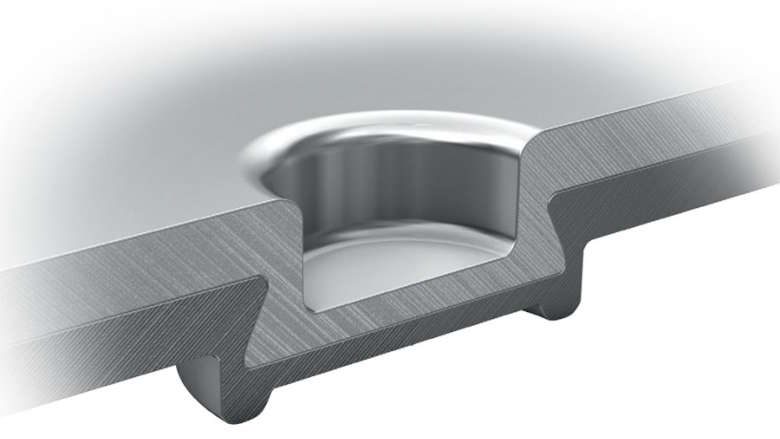
In clinching, a punch and die are used to plastically type a mechanical interlock between metallic sheets. The approach produces a spherical, button-type connection between two to 4 layers of sheet metallic. The method can be part of metallic sheets of various thicknesses or supplies, and it’ll not injury anticorrosive coatings on the metallic. The minimal thickness for anybody sheet within the meeting is 0.1 millimeter, and the complete stack will be as much as 12 millimeters thick.
The instruments include a punch and a die. The punch forces the layers of sheet metallic into the die cavity. The stress exerted by the press forces the punch-side metallic to unfold outwards throughout the die-side metallic.
Clinching is often restricted to metal alloys with a tensile power of lower than 800 newtons per sq. millimeter and an elongation-at-fracture of greater than 14 p.c. The tensile power of ultra-high-strength metal is far larger than that, typically exceeding 1,000 newtons per sq. millimeter.
The Theta course of creates a dependable mechanical connection even with supplies which might be tough or unimaginable to clinch underneath regular situations, together with ultra-high power steels. Photograph courtesy Tox Pressotechnik
Localized Heating Improves Ductility
To clinch high-strength metal, the metallic will be heated domestically on the joint to enhance its ductility with out altering the fabric traits exterior the joint.
That’s the idea behind the brand new Theta clinching course of from Tox Pressotechnik. Previous to clinching, a laser applies focused warmth to the supplies, considerably rising their formability. This creates a dependable mechanical connection even with supplies which might be tough or unimaginable to clinch underneath regular situations, together with high-strength and ultra-high power steels, low-ductility die-cast aluminum alloys, and aluminum sheets.
In search of fast solutions on meeting and manufacturing subjects?
Attempt Ask ASM, our new good AI search software.
Ask ASM
Focused heating instantly earlier than clinching will increase the native ductility of the supplies in order that even high-strength alloys will be joined reliably with out pre-punching or reducing. Clinching with a reducing part can cut back the fabric’s fatigue power as a result of notching, susceptibility to corrosion on the reduce edges, and a nonhomogeneous joint high quality.

Previous to clinching, a laser applies focused warmth to the supplies, considerably rising their formability. Photograph courtesy Tox Pressotechnik
The method has 4 steps. First, a targeted laser beam heats the becoming a member of zone in a focused method. This thermal pre-treatment improves the formability of the fabric. Subsequent, the clinching punch is utilized instantly after heating. Because of the diminished circulate resistance, the fabric begins to deform plastically, a exact transition from heating to forming with none lack of time.
The punch hits the ready supplies however doesn’t pierce them. As a substitute, it’s pressed into the die, compressing and deforming the supplies with out reducing them. The now-formable materials flows underneath stress into the die, making a mechanical interlock with even load distribution. The result’s a sturdy, corrosion-resistant joint.
The system consists of a normal Tox C-frame clinching press, or tong, with a nominal urgent drive of 80 kilonewtons. The usage of customary C frames retains the system weight low and reduces facet hundreds on the software. A 2-kilowatt fiber laser with a wavelength of 1,070 nanometers is built-in into the press. The system is managed centrally through the Tox MultiControl.
The system can be utilized with customary clinching instruments for functions with a mixed materials thickness of as much as 10 millimeters.

The Theta system consists of a normal Tox C-frame clinching press with a nominal urgent drive of 80 kilonewtons. The laser is built-in with the press. Photograph courtesy Tox Pressotechnik
The Theta system meets the DIN EN ISO 11553-1:2021-01 and DIN EN ISO 60825-1:2022-07 security requirements for laser gear. At a minimal distance of 1 meter from the laser clinching head, the system meets the necessities of sophistication 1 laser. Which means there isn’t a want for laser security cabins or laser security goggles throughout common operation, even when changing the laser head in upkeep mode.
For optimum outcomes, the fabric stack have to be stably clamped throughout the complete course of. As well as, the time between laser therapy and clinching needs to be minimized. This may be achieved by optimizing the throat depth of the C body.
For extra info on sheet metallic clinching, learn these articles:
Clinching for Sheet Metallic Meeting
Clinching for Galvanized Sheet Metallic
Strategies for Becoming a member of Sheet Metallic
