



As manufacturers expand automation across assembly and production operations, new technologies are giving robots greater dexterity, improving process control and automating tasks that have traditionally been difficult to perform consistently. From tactile sensing and integrated cobot grippers to automated tape application and real-time weld guidance, these products are designed to improve robot interaction, simplify integration and increase process reliability.
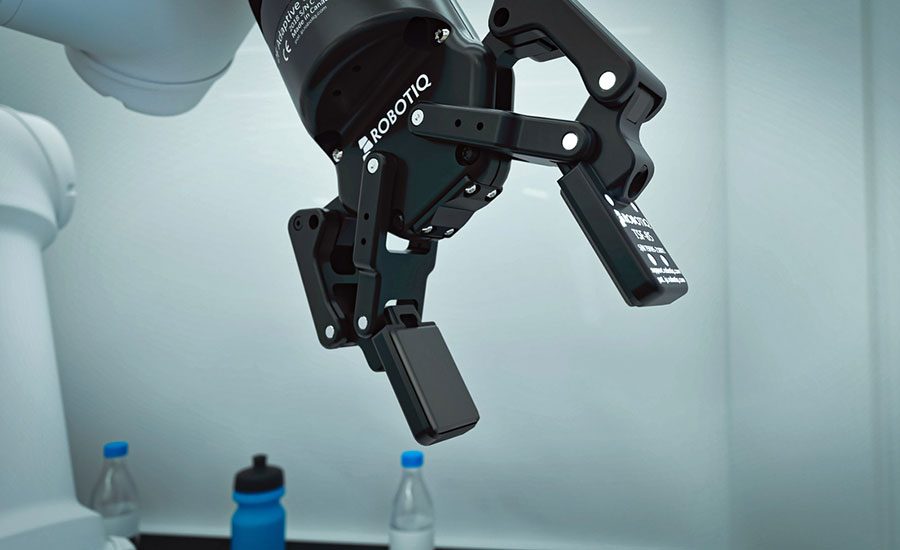
Robotiq has introduced TSF-85 tactile sensor fingertips for its 2F-85 Adaptive Gripper, adding real-time touch feedback for physical AI, industrial automation and humanoid robotics applications.
The fingertips use a 4-by-7 static taxel grid to monitor force distribution and detect micro-slip at 1,000 hertz. An integrated inertial measurement unit provides additional information about finger orientation and contact. Together, the sensors enable robots to identify contact geometry and detect when an object begins to slip, helping improve grasping and manipulation.
The fingertips preserve the gripper’s pinch and encompassing grip capabilities and integrate with existing systems using RS-485 communication and a USB conversion board. Robotiq says more than 23,000 of its grippers have been deployed worldwide.
Robotiq
Image credit: Festo
Pneumatic Gripper Simplifies Cobot Integration
Festo has introduced the HPPH two-finger pneumatic parallel gripper for collaborative robot applications. The compact gripper integrates its pneumatic control valve, position sensors and electrical interface directly into the body, reducing external components, wiring and installation requirements.
Weighing 1.5 pounds, the gripper is designed to preserve payload capacity on smaller cobots. It has a maximum opening of 16 millimeters and can handle objects weighing up to 2.2 pounds. An IO-Link version provides diagnostics and remote configuration.
Looking for quick answers on assembly and manufacturing topics?
Try Ask ASM, our new smart AI search tool.
Ask ASM
The gripper was developed in accordance with ISO/TS 15066 and provides a force-limited collaborative mode of 140 newtons when used with specified gripper fingers. Applications include electronics manufacturing, automotive subassembly, semiconductor operations, part insertion and removal, and tray-to-tray transfer.
Festo Corp.
www.festo.com

Image credit: RoboTape
Automated System Applies Adhesive Tape Along Complex Paths
Innovative Automation’s RoboTape system automates high-volume application of foam, felt and attachment adhesive tapes. The system combines a compact applicator with a continuous material-feed system capable of following corners, curves and 3D profiles while cutting tape to length.
The applicator can be mounted on industrial or collaborative robots or used in fixed configurations in which external automation presents the part. Application speeds reach 300 millimeters per second.
To reduce interruptions, the material-management system supports “hot swapping” of tape spools while upstream equipment continues operating. Scrap liner is automatically removed and collected in a centralized bin. The system also provides splice detection, automatic rejection, spool-level monitoring and data collection.
RoboTape can be integrated into existing production lines or incorporated into new cells.
Innovative Automation Inc.

Image credit: SinceVision
Sensor Provides Real-Time Guidance for Battery Welding
SinceVision’s SD33-85 laser displacement sensor provides closed-loop Z-axis feedback for laser welding of square aluminum shell battery cells. The technology is designed to compensate for changes caused by part tolerances, gaps and thermal expansion during top-cover welding.
Rather than following only a preprogrammed Z-axis path, the system continuously measures the workpiece and adjusts the welding position as conditions change. The sensor operates at a 3-kilohertz sampling rate, which provides a measurement approximately every 0.03 millimeter at typical welding speeds.
The sensor provides 10-micron repeatability and uses BSI-CMOS technology with a built-in amplifier. It carries an IP67 rating and ESD shielding and communicates through RS-485 and analog outputs for integration with existing PLCs. Its compact 60-by-50-by-22-millimeter housing is designed to fit existing welding heads without mechanical redesign.
Shenzhen SinceVision Technology Co. Ltd.
www.sincevision.com
