



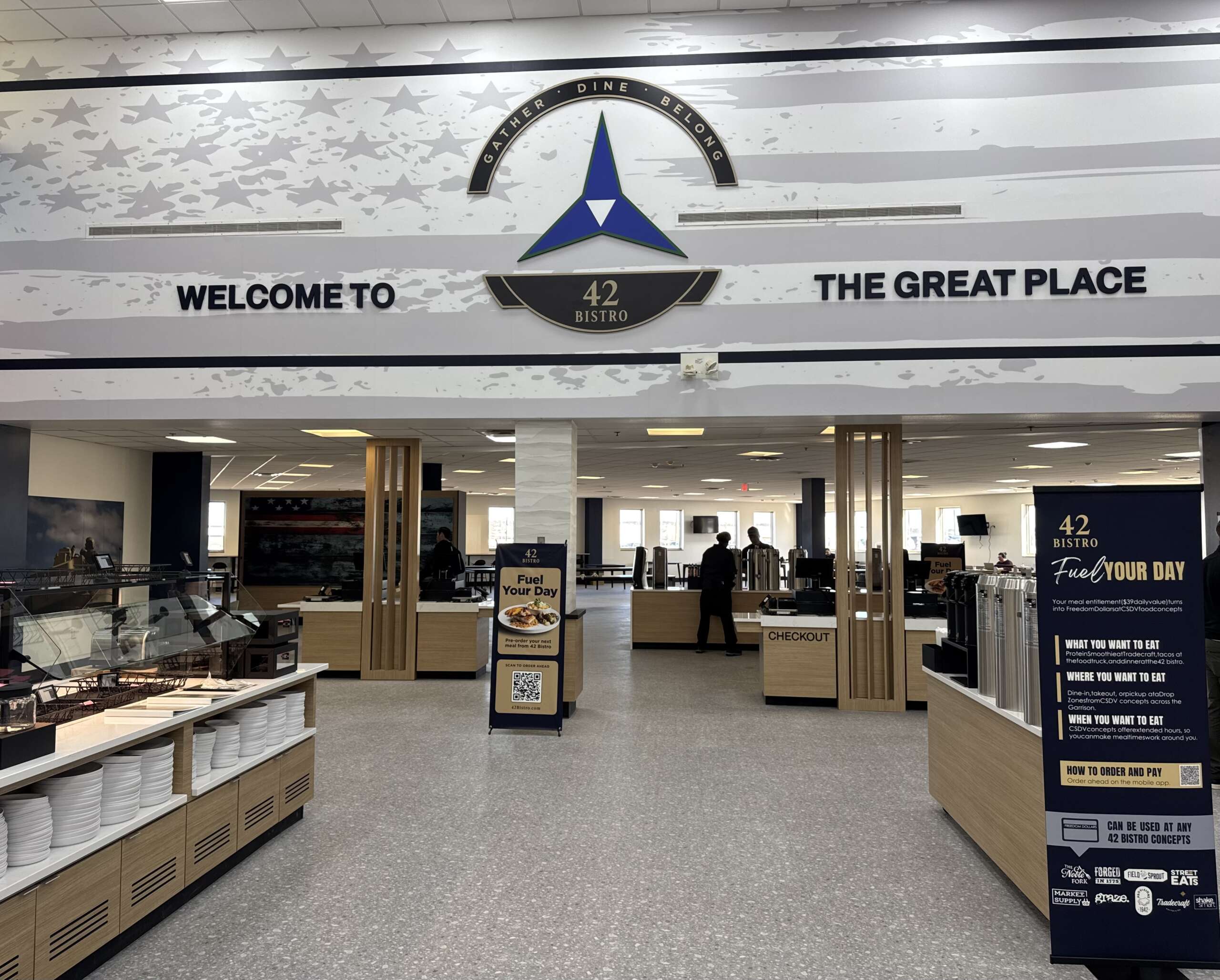
Subsequent week, the Military plans to debut what’s meant to be a “generational” change in the way in which it offers meals to troopers. At Fort Hood, Texas, the service plans to launch its new “campus-style” eating idea — a mannequin that would finally change legacy eating services world wide. However to do it at only one set up, the Military needed to overcome some important bureaucratic and acquisition hurdles.
Subsequent week’s launch would be the first of what are supposed to be 5 campus-style services underneath a contract the Military introduced final yr with Compass Group, a agency that operates meals providers at hospitals, universities and different massive non-public sector venues world wide. The service is attempting to carry a way of neighborhood to the areas in order that they’re not only a place to eat — with facilities like free Wi-Fi and versatile seating.
However Lt. Gen. Chris Mohan, the commander of Military Materiel Command, mentioned vastly bettering the meals is a serious goal too.
“We were not getting it right, and we heard the soldier feedback,” he advised reporters this week. “The team has been working diligently to not only change the campus-style dining venue, but also to offer other options, which are all part of an enhanced package of the way that we feed soldiers. It’s campus-style dining, it’s food trucks, it’s kiosks, it’s take-out meals, it’s meeting the soldiers where they are with additional food options to give that whole-of-enterprise approach to the way that we feed soldiers.”
Expanded menus and repair enhancements
From a dietary standpoint, the Military is attempting to emulate the diets faculties and universities make accessible to their athletes. At 42 Bistro, for instance, the brand new Fort Hood location, troopers will see six completely different stations providing meals from a rotation that features some 3,000 recipes.
“Compass has a long history of serving not only airport lounges, but they also do the food service for the Crimson Tide of Alabama’s athletic department and the LSU Tigers. They know how to do this, and this is why they won the contract,” Mohan mentioned. “At each facility, there will be a professional chef running the place, as well as a registered dietitian who will be authorized to make on-the-spot substitutions based upon what’s available in either the local economy or from their trusted source of vendors to change recipes to account for stock outs, but also to account for fresh fruits and vegetables that are available in season.”
On-line, app-based ordering and supply are additionally anticipated on the new places, which, within the first spherical of adjustments, additionally embrace one facility every at Fort Carson, Colorado, Fort Bragg, North Carolina, Fort Drum, New York, and Fort Stewart, Georgia.
And in comparison with present, conventional eating services, they’ll have prolonged hours: from 6 a.m. till 8 p.m. every day. The services are primarily meant to supply higher choices to troopers who dwell in barracks on-base and have their meals paid for by way of meal playing cards, however civilians and households will be capable to eat there too, paying for his or her meals a la carte.
Bureaucratic hurdles
However Mohan mentioned not one of the departures the Military is taking from the normal eating facility mannequin could be doable with out lots of waivers from present regulation and Military coverage. That’s why it’s been vital that the initiative has had the backing of the Military’s secretary and chief of workers.
For instance, underneath present regulation — particularly, the Randolph-Sheppard Act — the contracting course of for many eating services must prioritize blind distributors.
“Randolph-Sheppard forced us to do local contracts through a state licensing agency. So our contract was actually with the state of Texas or the state of North Carolina, who then went and subbed it out to an authorized blind vendor to deliver the meal service,” he mentioned. “Those contracts were expensive. And if the contractor was failing, we were locked into a very archaic and heavily weighted-against-us arbitration process, and we didn’t get that enterprise level management. That means the dining facility at Fort Meade or Fort Bragg is one of one or one of six.”
Mohan mentioned the Military is assembling a legislative proposal to ask Congress for extra everlasting reduction from the Randolph-Sheppard Act.
Further waivers
However that’s not the one bureaucratic hurdle the Military has needed to overcome to this point.
“We also had to get a waiver to use food vendors other than the Defense Logistics Agency to give [Compass] more options and to do local contracts,” he mentioned. “The second one that we had to get was a waiver from the DoD nutrition committee to allow for the dietitian. This is why the dietitian is specified to be on the site to make recipe changes. The third waiver we had to get was to allow the vendor to use value-added products in the production and delivery of meals.”
Because the aim is to encourage troopers to eat within the eating services fairly than go off-base or eat quick meals, there could also be some price range implications. Beneath the brand new mannequin, Compass will probably be paid for every meal they serve to troopers, which might imply a extra profitable eating mannequin might enhance the Military’s meals prices.
However Mohan mentioned if all goes in keeping with plan, the prices of that increased utilization will probably be at the least partly offset by extra environment friendly operations — for instance, economies of scale in buying. The present bulk meals supplier, the Protection Logistics Company, buys about $3 billion of meals per yr. Compass, even with out its Military contract, buys about $30 billion.
“Our current contracts are about 30% more expensive,” he mentioned. “I think our cheapest location to feed breakfast is probably Fort Bragg, based upon headcount, and the fully burdened cost there is about $10 for a breakfast. We have places where, because the headcount is so low, it’s $50 a plate in terms of what it ends up costing the taxpayers. And I’ll be honest with you, this is why we got such a violent reaction from special interest groups when we said we’re going to change this. So we believe that when you pay them for the meals that they serve, if Compass fails and they don’t have high quality chow, soldiers are going to keep doing what they do right now, which is drive right by that dining facility. But we’re going to be able to see that now, and Compass is not going to make money.”
Copyright
© 2026 Federal Information Community. All rights reserved. This web site just isn’t meant for customers positioned inside the European Financial Space.
