



**New Article**
**Understanding August’s Critical Patch Tuesday Updates: Windows Zero-Days and Server Flaws**
By Swati Khandelwal
August 11, 2026
Tags: Vulnerability, Windows Security
—
Microsoft’s August Patch Tuesday release addressed a significant number of vulnerabilities, but this month’s updates are particularly noteworthy due to an actively exploited zero-day flaw in the Windows kernel. While the severity scores of several vulnerabilities are high, the real urgency lies in the fact that one exploit is already being used in the wild. Let’s break down the key takeaways from this month’s security updates.
***
### Key Vulnerabilities and Threats
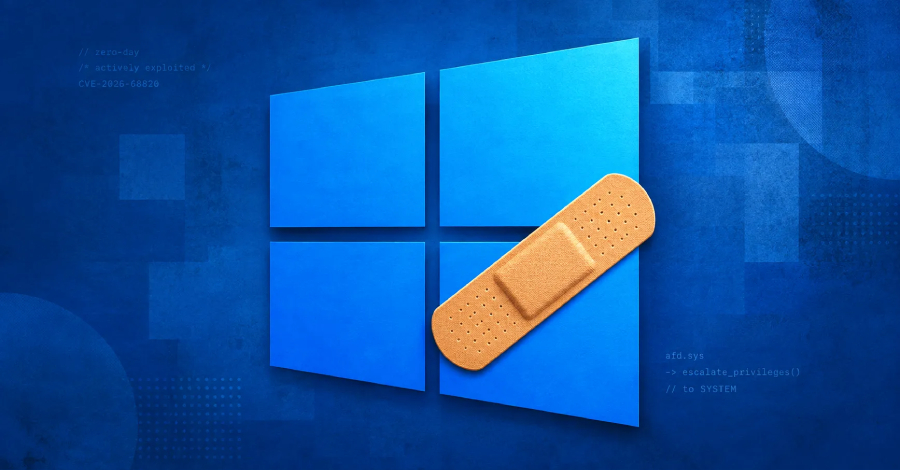
The most critical issue is a previously unknown flaw in a core Windows kernel driver. This vulnerability has already been leveraged by attackers to escalate privileges on a compromised machine to the highest level (SYSTEM).
**The Actively Exploited Zero-Day: CVE-2026-68820**
This vulnerability has been tracked with a CVSS score of 7.0, but its status as “under active exploitation” makes it the top priority. The flaw exists in `afd.sys`, the Ancillary Function Driver for WinSock, which is a kernel-side component handling network socket operations.
Security research firm Check Point Research has linked this zero-day to a sophisticated campaign dubbed “Operation Dream Job,” attributed to the Lazarus hacking group. The exploit uses a race condition to trigger a use-after-free error, allowing an attacker with existing code execution on a machine to escalate their privileges to SYSTEM. This highlights the critical need to apply the patch for this specific vulnerability immediately.
**High-Impact Server Flaws**
In addition to the zero-day, Microsoft released patches for four other vulnerabilities that are rated 9.8 on the Common Vulnerability Scoring System (CVSS)—the highest severity rating. What makes these particularly dangerous is that they allow for *unauthenticated remote code execution*, meaning an attacker can take control of a vulnerable server without needing a user account or to trick anyone into clicking a malicious link.
These vulnerabilities affect:
* **CVE-2026-62878:** Windows DNS Server
* **CVE-2026-62893:** Windows Deployment Services (WDS)
* **CVE-2026-62815:** Microsoft QUIC (a transport protocol)
* **CVE-2026-59124:** High Performance Computing (HPC) Pack
While these flaws are extremely severe, their practical urgency depends on whether the affected services are deployed and exposed to a network. For example, HPC Pack is not installed by default on most Windows machines.
***
### Closing a SharePoint Chain
The August update cycle also completes a two-part fix for an authentication bypass and remote code execution (RCE) chain affecting on-premises SharePoint servers. This chain was reported by Rapid7 Labs in May.
* **July’s Update:** Patched the authentication bypass (CVE-2026-55040), which allowed an unauthenticated attacker to assume the identity of a SharePoint user.
* **August’s Update:** Patches the second half of the chain, the RCE component (CVE-2026-63520).
Rapid7 confirmed that patching the July vulnerability breaks the demonstrated attack chain, meaning the August patch is the final step to fully secure SharePoint environments against this specific threat.
***
### Patch Priority Recommendations
Given the information from Microsoft and security researchers, here is the recommended action plan:
1. **Immediate Action:** Prioritize patching **CVE-2026-68820** on all Windows systems. Check Point Research has confirmed this flaw is being used in active attacks.
2. **Next Steps:** Assess your infrastructure for the presence of the four 9.8-rated server vulnerabilities (DNS, WDS, QUIC, HPC) and apply patches if those services are in use.
3. **SharePoint Users:** Ensure that both the July and August SharePoint patches are installed on all on-premises SharePoint servers to close the complete authentication bypass and RCE chain.
***
## FAQ
**Q: What is a “use-after-free” vulnerability?**
A: A use-after-free vulnerability occurs when a program continues to use a pointer after the memory it was pointing to has been freed. This can lead to unpredictable behavior, crashes, or, most critically, allow an attacker to execute arbitrary code or escalate privileges, as is the case with CVE-2026-68820.
**Q: What does “unauthenticated remote code execution” mean for the server flaws?**
A: It means that an attacker can run malicious code on a vulnerable server from anywhere on the network (or internet) without needing to log in with a username and password or trick a user into interacting with a malicious link. This makes these vulnerabilities exceptionally dangerous and wormable.
**Q: How does the “actively exploited” status change my patching priority?**
A: It elevates the urgency significantly. While all the vulnerabilities listed are serious, a flaw that is “under active exploitation” means there are already automated tools or malicious actors in the wild using it to attack unpatched systems. Therefore, patching CVE-2026-68820 should be done immediately, ahead of other vulnerabilities with higher CVSS scores that are not yet being exploited.
**Q: What is the Zero Day Initiative (ZDI), and why is it mentioned?**
A: The Zero Day Initiative is a vulnerability research program run by Trend Micro’s Zero Day Initiative team. Its goal is to find and report vulnerabilities before malicious attackers can exploit them. The article mentions ZDI’s score and descriptions because it provides an additional layer of technical detail, such as identifying the specific nature of the flaw (e.g., “wormable”) and the components affected.
**Q: Do I need to worry about the HPC Pack vulnerability?**
A: Only if your organization uses High Performance Computing (HPC) Pack. Since it is not installed by default on Windows, the risk for most users is lower. However, if HPC Pack is deployed in your environment, it is important to apply the patch for CVE-2026-59124.
***
## Conclusion
Microsoft’s August Patch Tuesday delivers critical fixes for a landscape where an active zero-day exploit is being weaponized. The most immediate threat is CVE-2026-68820, a kernel-level flaw being leveraged by the Lazarus group. System administrators must prioritize this patch.
Furthermore, the unauthenticated RCE flaws affecting DNS, WDS, and QUIC represent a high-risk category of vulnerabilities that should be assessed and patched based on an organization’s specific infrastructure. Finally, the conclusion of the SharePoint chain remediation ensures that organizations can fully close a significant attack path. A proactive and prioritized approach to this month’s updates is essential for maintaining a secure environment.
