



**Unlocking the Future: A Deep Dive into Self-Evolving AI Agents**
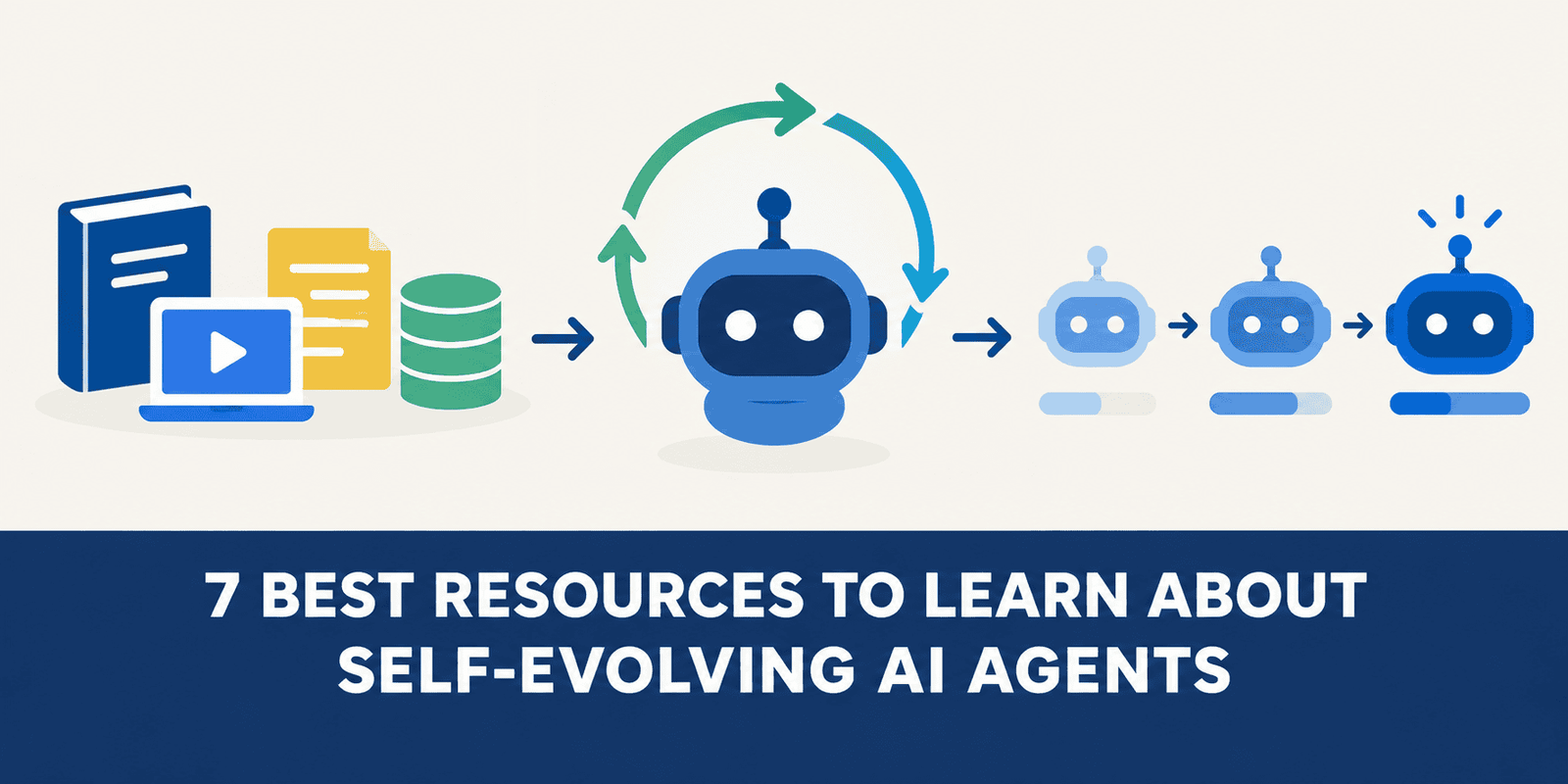
Artificial intelligence is rapidly shifting from static tools to dynamic entities capable of autonomous growth. This evolution brings us to the frontier of self-evolving AI agents—systems designed not just to execute tasks, but to refine their own capabilities through repeated experience. Unlike traditional models that remain static after deployment, these agents adapt by learning from past mistakes, expanding their memory, honing tool utilization, and optimizing their internal reasoning. To navigate this cutting-edge field, here is a curated guide to seven invaluable resources.
**1. The Foundations of Agentic Behavior**
Before diving into systems that alter themselves, grasping the fundamentals is crucial. The Hugging Face Agents Course provides the perfect starting point. It demystifies the core Think/Act/Observe cycle and introduces vital frameworks like smolagents, LangGraph, and LlamaIndex. Learners will explore agentic retrieval-augmented generation, function-calling fine-tuning, and evaluation methodologies. Best of all, this foundational curriculum is completely free and features practical assignments alongside a benchmark-driven final project.
**2. Academic Rigor at Stanford**
For those seeking a structured, scholarly approach, Stanford’s CS329A: Self-Improving AI Agents stands out as the premier academic entry point. This course dives into advanced self-improvement techniques for large language models, including Constitutional AI, verifiers, test-time compute strategies, and reinforcement learning. It also tackles multi-step reasoning, planning, and memory integration. Distinguished by its syllabus built around seminal research papers rather than just frameworks, it offers a profound understanding of the mechanisms behind agentic self-evolution. Reproducing the ideas from the assigned readings is highly recommended.
**3. Defining the Landscape: A Comprehensive Survey**
Understanding the precise definition of a self-evolving agent requires a deep look at the underlying mechanics. A comprehensive survey available in the field frames evolution as a dynamic feedback loop linking the agent, its environment, system inputs, and an optimizer. It meticulously categorizes the components capable of evolution—from the core model and memory systems to prompts, tools, and multi-agent architectures. Furthermore, it highlights domain-specific implementations in programming, finance, and biomedicine.
**4. Distinguishing the Scaffolding from the Core**
Building on the previous survey, another critical review differentiates between enhancing the foundation model itself versus improving the agent’s external structure. This publication provides a system-level taxonomy, clarifying how an agent that rewrites its prompt differs fundamentally from one that builds a skill library or fine-tunes its own weights. It covers the evaluation of these distinct approaches and outlines open research problems currently facing the industry.
**5. The Living Bibliography: Awesome Self-Improving Agents**
Once the conceptual groundwork is laid, a dynamic repository becomes essential. This open-source collection organizes academic papers by the exact element being improved, whether that be model parameters, prompts, memory, tools, skills, or complete agent architectures. It also aggregates benchmarks, courses, talks, and code. With the field advancing at breakneck speed, a continuously updated bibliography like this proves more practical than manually scouring archives for the latest developments, including recent innovations like OpenSkill.
**6. The Broader RSI Ecosystem**
To fully grasp self-evolving agents, one must understand their place within the larger recursive self-improvement (RSI) paradigm. This extensive research map covers a wide spectrum, from model-level self-improvement and harness evolution to memory systems, embodied AI, automated AI research and development, and safety. It serves as an excellent compass for navigating the interconnected ecosystem of self-improving technologies.
**7. Operational Excellence: Harness Engineering**
The final resource zooms in on the operational side of self-improvement. This focused list concentrates on the “harness”—the surrounding ecosystem of tools, memory management, control loops, and evaluation metrics. It includes foundational essays, research papers, and practical engineering insights, making it invaluable for anyone looking to understand how agents can refine not only their outputs, but the very processes and infrastructure they use to generate them.
**Suggested Learning Path**
A logical progression for learners would be to start with the Hugging Face course, move to the Stanford curriculum for depth, read both surveys to map the terrain, utilize the specialized bibliographies, and finally explore the broader RSI and Harness engineering ecosystems. Given the rapid pace of change, focusing on a specific area of interest and building a personal project is often more effective than trying to consume everything at once.
***
**Frequently Asked Questions (FAQ)**
**Q: What exactly is a self-evolving AI agent?**
A: It is an AI system capable of modifying its own behavior, reasoning, or architecture based on past experiences. Instead of remaining static after deployment, it can learn from errors, accumulate memory, and optimize its own workflows without constant human intervention.
**Q: How is self-evolving different from just fine-tuning an AI model?**
A: Fine-tuning typically adjusts the model’s weights using a static dataset before deployment. Self-evolving AI agents go a step further by adapting in real-time or iteratively modifying their prompts, tools, memory, and control logic during operation, creating a continuous improvement loop.
**Q: What is “harness engineering” in this context?**
A: Harness engineering refers to the design and management of the surrounding infrastructure that supports an AI agent. This includes memory systems, tool integration, evaluation loops, and control logic. Improving the harness means making the agent’s operational environment more efficient, allowing the agent to improve not just its answers, but how it produces them.
**Q: Are self-evolving AI agents safe?**
A: Safety is a major area of research within the recursive self-improvement (RSI) landscape. Because these systems can alter their own code and reasoning, ensuring alignment and controllability is a critical open research problem that the community is actively working to solve.
***
**Conclusion**
The journey toward truly autonomous, self-improving AI is one of the most exciting frontiers in technology today. By moving beyond static instruction sets to dynamic, experience-driven systems, we are opening the door to AI that can tackle increasingly complex and evolving challenges. The resources outlined above provide a solid foundation for understanding the mechanics, taxonomies, and engineering behind these systems. Whether you are a researcher diving into academic papers or an engineer building the next generation of autonomous tools, the path to understanding self-evolving agents starts with mastering the fundamentals and progressively exploring the cutting-edge surveys and repositories that map this rapidly expanding field.
Thank you for reading
