



# How Modern Manufacturing Software Is Transforming Assembly Operations
Software has become a cornerstone of modern manufacturing, sitting alongside physical tools like robots, riveters, and nutrunners as an essential part of product assembly. From digitizing work instructions to analyzing the performance of entire production facilities, software solutions are reshaping how factories operate. Here’s a closer look at some of the most impactful innovations currently available on the market.
## Breaking Language Barriers on the Shop Floor
One of the persistent challenges in global manufacturing is communication across multilingual workforces. A new approach to Manufacturing Execution Systems (MES) now includes automatic language translation that identifies each operator’s native language and delivers production content—work instructions, quality alerts, process guidance, and other critical information—in the language they need, without any manual translation effort.
This capability is particularly valuable in facilities where operators, supervisors, and support staff speak different languages. By presenting clear, understandable instructions at the point of work, manufacturers can reduce training time, minimize process variation, lower error rates, and build a more flexible workforce. When combined with real-time mistake-proofing, traceability, and active controls, language translation becomes a powerful tool for standardizing quality across diverse teams.
## Digitizing Quality Inspection
Traditionally, inspection processes have relied on paper forms that are prone to damage, loss, and illegible entries. Modern inspection software now allows users to capture incoming, in-process, and final inspection results electronically using any internet-enabled tablet or laptop. The moment a nonconforming condition is identified, stakeholders receive instant notifications, dramatically shortening the time between detection and correction.
Electronic records eliminate redundant data entry and create a permanent, searchable archive of inspection data. Quality inspectors can evaluate their own work from the plant floor or assess incoming supplier materials at the loading dock, all without returning to a desk. This shift from paper to digital not only saves time but also improves data accuracy and accountability.
## Bridging Design and Production with a Unified Platform
For manufacturers who produce high volumes of complex products with thousands of parts, maintaining alignment between design engineering and production execution is a constant challenge. A new software platform addresses this by creating a single, living model that connects CAD, Product Lifecycle Management (PLM), Manufacturing Execution Systems (MES), and Enterprise Resource Planning (ERP).
The process begins with engineers uploading a CAD file in standard formats like STEP, SLDASM, or JT. The software loads the model and bill of materials, opens it in an interactive viewer, and either preserves the original CAD hierarchy or recommends an optimal assembly sequence. If connected to a PLM system, the software automatically pulls in new product releases or engineering changes, mapping each revision into the existing manufacturing process so that prior work isn’t duplicated.
A virtual build workflow module transforms raw CAD data into a complete manufacturing model, automatically sequencing assembly steps, flagging collisions before they reach the floor, and identifying logical subassemblies based on part relationships. The platform can also generate work instructions, line flow diagrams, and routings—with some implementations even supporting 3D animated guidance. During production, it monitors line balancing, work center allocation, and cycle times, enabling engineers to compare actual performance against standards and drive continuous improvement.
## AI-Powered Operator Guidance
A connected worker platform combines step-by-step visual guidance with error-proof validations, advanced data collection, and seamless hardware integration. AI-driven dashboards translate raw shift data into plain-language insights that operators and supervisors can act on immediately. One standout feature is automated video-to-SOP conversion, which transforms raw video recordings of assembly processes into structured digital work instructions.
Integrated quality checks enforce compliance at each workstation, while edge computing capabilities automate data collection from tools, sensors, and programmable logic controllers (PLCs). This unified ecosystem captures institutional knowledge, accelerates onboarding of new employees, and provides complete traceability across the entire production lifecycle—from the first operation to final shipment.
## Agentic AI in Enterprise Resource Planning
Enterprise resource planning software has entered a new era with the introduction of agentic AI. Instead of simply displaying data, modern ERP platforms now incorporate networks of vertical AI agents that can execute tasks directly within the system. These agents are governed by a consistent framework that ensures security, user experience standards, and transparency.
A dedicated workspace allows customers and partners to build custom AI agents tailored to specific business goals, using their own data. These agents can orchestrate workflows, provide visibility tools, and take actions across the ERP system while remaining within enterprise governance guardrails. Available agents include tools for analyzing MRP output logs to explain recommendations, reconciling freight spend discrepancies, synthesizing ERP data into actionable insights, and providing rapid shipment tracking. The agents are designed to keep humans in the loop, providing context, confidence levels, and potential consequences for every action they recommend or take.
## A Centralized Operating System for Manufacturing
A Manufacturing Operating System (MOS) connects a plant’s machines, operators, and quality records into a unified platform. It consolidates shop floor operations, quality management, and compliance documentation so that problems are caught and corrected in real time rather than discovered during final inspection.
The system collects data directly from machines, controllers, sensors, and measuring equipment using communication standards already common on plant floors—OPC UA, Modbus, MQTT, and Open Protocol. It also integrates with existing business systems for production, inventory, and product design management, adding capability without requiring replacement of current infrastructure. Production and quality data are stored centrally in tamper-resistant records that remain traceable and retrievable for years. This centralized data architecture also supports AI applications such as predictive maintenance, helping manufacturers anticipate equipment failures before they occur.
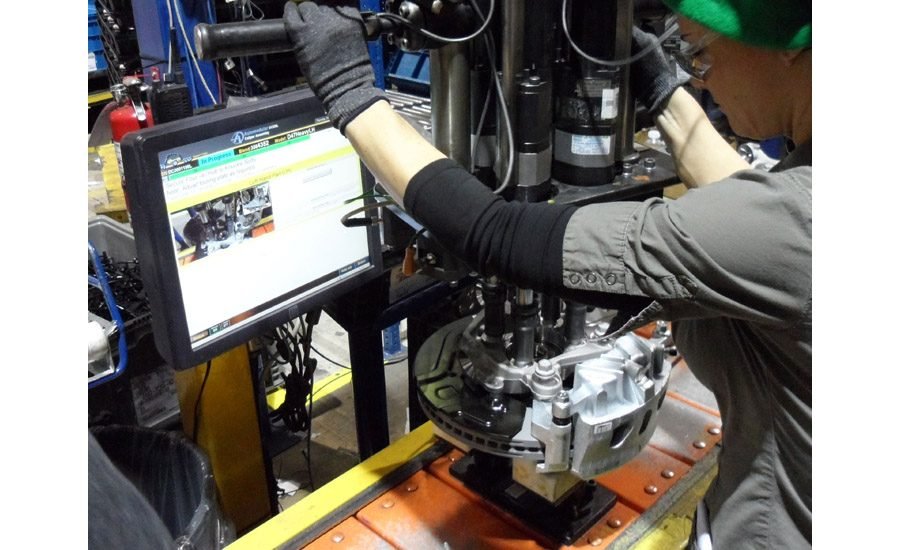
At the operator level, digital instructions replace paper documents and are displayed on screens at each workstation. The software guides employees through jobs step by step, verifies completion order and specification compliance, and adapts automatically to the specific product variant being built. Every completed step is recorded in real time, building a production record automatically. Additionally, the system verifies that assembly tools—those used for screwdriving, riveting, and crimping—are operating within specified parameters and that resulting joints meet requirements, documenting results for every critical fastener without relying on sampling.
## Turning Fragmented Data into Actionable Intelligence
Manufacturing data is often scattered across departments, locations, and systems in inconsistent formats. A dedicated data intelligence platform ingests this diverse information and transforms it into AI-ready data, creating a comprehensive “data map” that reveals relationships and traceability across the enterprise.
A data discovery module searches across the entire organization, connecting related information across time periods, functions, and locations while enforcing granular access controls. An autonomous AI agent analyzes manufacturing data to support decisions using a company’s own historical experience and criteria, handling tasks like part standardization, cost reduction, and quality-impact analysis.
Other modules include a design reuse simulator that identifies optimal baselines from similar past products and assesses the risks of each change, an equipment intelligence tool that turns repair histories and operational knowledge into reusable assets, and a production readiness control tower that generates preliminary PFMEA drafts from product drawings and process data. Additional tools support cross-functional design reviews on CAD models, cost analysis by comparing historical purchases and quotes, and centralized RFQ management with AI-driven supplier recommendations.
—
## Frequently Asked Questions
**Q: What types of manufacturing software are most important for assembly operations?**
A: The most impactful categories include Manufacturing Execution Systems (MES) for real-time production guidance and quality control, ERP systems for resource planning and data management, inspection software for quality assurance, and connected worker platforms that deliver step-by-step operator instructions. The right combination depends on the complexity of the products, the size of the facility, and the specific challenges being addressed.
**Q: How does automatic language translation in manufacturing software work?**
A: These systems identify each operator’s native language profile and automatically deliver work instructions, quality alerts, and process guidance in the appropriate language. No manual translation is required, and the content is updated dynamically when processes change, ensuring every team member receives clear, understandable information at the point of work.
**Q: Can modern inspection software replace paper-based quality checks entirely?**
A: Yes, digital inspection platforms can fully replace paper-based processes. They allow users to capture results electronically via tablets or laptops, create permanent records, notify stakeholders instantly when failures are found, and eliminate redundant data entry. The shift also improves data integrity and makes historical inspection data searchable and analyzable.
**Q: What is the benefit of connecting CAD, PLM, MES, and ERP systems?**
A: Connecting these systems eliminates the disconnect between design engineering and production execution. When a design change occurs, it automatically propagates through all connected systems, ensuring that manufacturing processes, work instructions, and material requirements stay aligned without manual rework or duplicate effort.
**Q: How do AI agents in ERP systems differ from traditional analytics?**
A: Traditional analytics present data and require humans to interpret and act on it. AI agents in modern ERP systems can autonomously execute tasks—such as analyzing logs, reconciling discrepancies, or recommending suppliers—by drawing on the company’s own data and business rules. They provide context, confidence levels, and potential consequences for each action, keeping humans informed and in control.
**Q: Is it necessary to replace existing systems when implementing a new manufacturing software platform?**
A: Not necessarily. Many modern platforms are designed to integrate with existing systems rather than replace them. They communicate through standard industrial protocols and can layer additional capabilities—such as real-time quality monitoring or AI-powered analytics—on top of current infrastructure.
**Q: How does digital work instruction software improve operator performance?**
A: Digital instructions guide operators step by step through each task, verify that steps are completed in the correct order, adapt to different product variants automatically, and record completion in real time. This reduces errors, shortens training time for new employees, and builds a complete, tamper-proof production record without manual paperwork.
—
## Conclusion
Manufacturing software is no longer a peripheral tool—it is central to how products are built. From automatic language translation that bridges communication gaps on multilingual shop floors to AI agents that autonomously execute tasks within enterprise systems, the innovations showcased at industry events reflect a clear trend toward smarter, more connected, and more resilient assembly operations.
The common thread across all these solutions is their ability to turn information into action. Whether it’s capturing inspection results instantly, connecting design data to production workflows, or transforming fragmented manufacturing data into AI-ready insights, each platform addresses a specific pain point while contributing to a larger vision of efficient, error-free production.
As manufacturers face mounting pressure to increase output, improve quality, and do more with fewer resources, the right software stack is no longer a luxury—it is a competitive necessity. The solutions highlighted here demonstrate that the industry is rising to meet that challenge with tools that are increasingly intuitive, intelligent, and integrated.
Thank you for reading
