



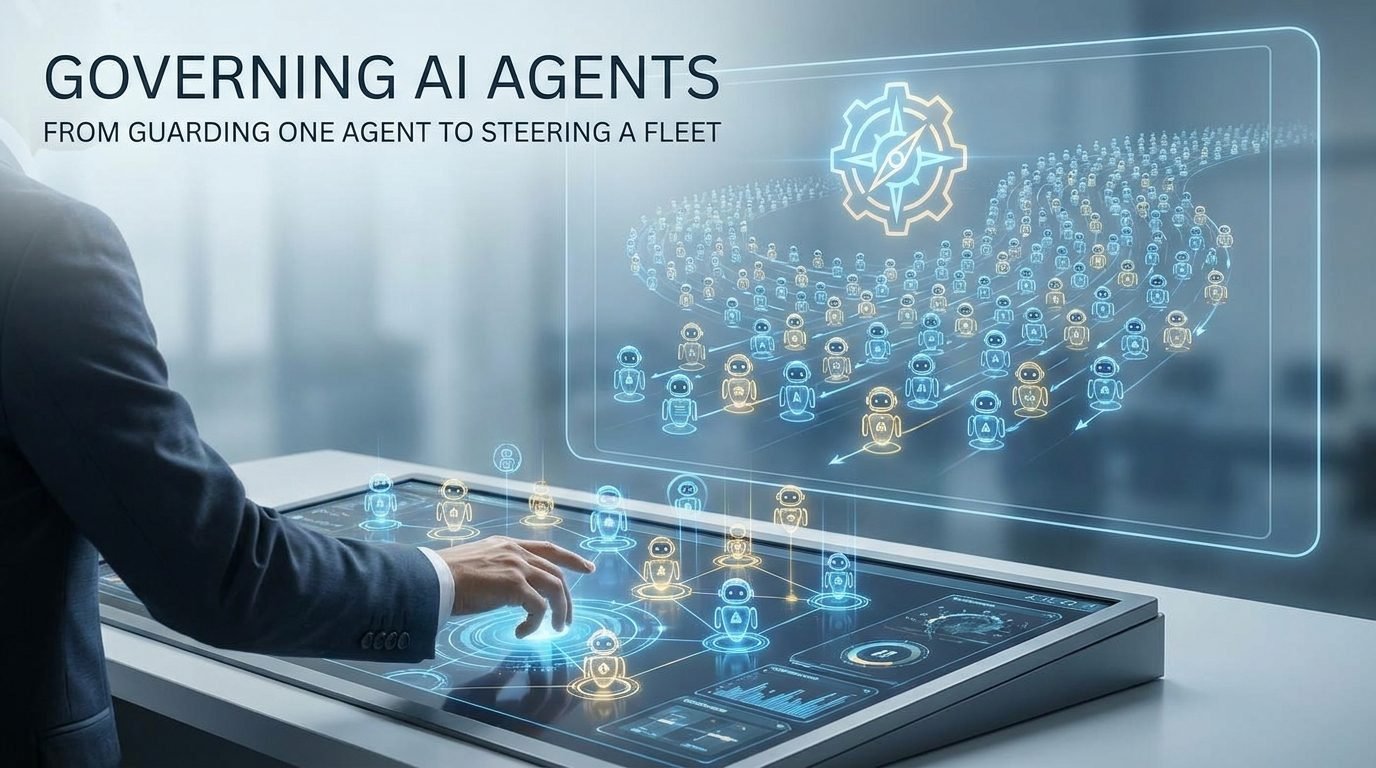
# Governing AI Agents at Scale: From Single-Agent Oversight to Fleet-Wide Control
## The Governance Gap Nobody Anticipated
In early 2025, a landmark breach study revealed that 97% of organizations experiencing an AI-related incident had no proper access controls in place, and nearly two-thirds had not established a single AI governance policy. This wake-up call prompted a wave of educational initiatives aimed at helping developers build and deploy AI agents responsibly. The core message was straightforward: before you ship an agent, you need a governance framework.
At the time, the conversation centered on a single agent—how to version it, monitor it, restrict its data access, and log its every action. That felt ambitious enough. But the pace of innovation in autonomous AI has been extraordinary. Within a year, coding agents, low-code platforms, and no-code deployment tools have made it trivially easy for any team to spin up autonomous workflows. What was once a carefully controlled experiment is now a fleet management problem.
## Agent Sprawl: The New Frontier of Risk
The term “agent sprawl” has entered the AI lexicon to describe a very real phenomenon: the uncontrolled proliferation of autonomous AI agents across organizations, often without centralized tracking, clear ownership, or consistent governance standards. According to industry analysts, the average Fortune 500 enterprise is projected to operate over 150,000 AI agents by 2028. Yet fewer than 15% of organizations believe they currently have adequate governance over their agent footprint.
The consequences of this gap are tangible. Teams deploying agents at speed are encountering two acute problems. First, unchecked agent fleets generate enormous volumes of token usage, translating into surprise costs that strain engineering budgets. Second, each additional agent represents another attack surface—another pathway through which sensitive data can inadvertently leak to unauthorized parties or external systems.
The governance challenges that seemed theoretical a year ago have become operational realities. The question is no longer “should we govern agents?” but “how do we govern thousands of them simultaneously?”
## The Original Four Pillars of Agent Governance
Every responsible agent deployment rests on four foundational pillars. These principles remain unchanged—but the scale at which they must now be applied has transformed entirely.
### 1. Lifecycle Management (Separation of Duties)
Agents should move through clearly defined stages: development, staging, and production. Each stage requires distinct permissions, version tracking, and deployment controls. When an agent is retired, its access must be revoked completely and auditably. Lifecycle management ensures that what runs in production is a known, approved artifact—not an untracked experiment that slipped through the cracks.
### 2. Risk Management (Defense in Depth)
No single safeguard is sufficient. Effective risk management layers multiple defenses: automated PII detection, content guardrails, compliance checks, and continuous monitoring that spans the entire data pipeline—from ingestion at the source to the model’s final output. The goal is to catch failure modes, malicious inputs, and policy violations before they reach end users or downstream systems.
### 3. Security (Least Privilege Access)
Every agent and every user should operate with the minimum permissions necessary to perform their function. This means enforcing authentication at every boundary, encrypting data in transit and at rest, and applying granular access controls that prevent an agent from reaching data it was never meant to touch. In practice, this means structuring data access through masked views, role-based groups, and aggregation-only permissions on sensitive datasets.
### 4. Observability (Audit Everything)
If you cannot trace an agent’s behavior, you cannot govern it. Observability demands comprehensive logging of every input, output, intermediate decision, and tool call. When auditors or internal stakeholders ask what an agent did on a given day, the answer should be a straightforward query—not a forensic investigation that takes weeks.
## The Shift: Governing One Agent vs. Governing a Fleet
The original framework assumed a single agent with a single data access pattern. That model breaks down completely when applied to a fleet of hundreds or thousands of agents running simultaneously on shared infrastructure.
The fundamental challenge has shifted from the agent layer down to the infrastructure layer. Hand-configuring permissions, lineage, and access controls for one carefully designed agent is feasible. Doing that for a hundred agents running on a data platform never designed for multi-agent governance is not.
This is where the concept of a **control plane** becomes essential. Rather than wiring governance into each individual agent, organizations need a centralized layer that sits above the entire fleet—intercepting requests, enforcing policies, routing tasks intelligently, and tracking costs in real time. Think of it as the difference between securing a single building versus managing the security infrastructure for an entire campus.
## The Control Plane: Five Capabilities That Make Governance at Scale Possible
Modern agent governance platforms are delivering five interconnected capabilities that transform governance from a per-agent manual process into an organization-wide default.
### Agent Configuration (Central Policy Enforcement)
Administrators define the complete set of authorized tools, models, MCP (Model Context Protocol) servers, and spending limits for each team or project. These policies are published centrally and enforced automatically. When a developer launches an agent, the system checks for configuration drift and ensures the agent inherits the exact permissions and guardrails defined by policy—no manual wiring required.
### Smart Routing (Model Selection by Task Complexity)
Not every task requires the most powerful model available. A control plane can intelligently route requests based on complexity, sending straightforward queries to lightweight models and reserving heavyweight reasoning models for tasks that genuinely need them. In practice, this approach has delivered cost reductions exceeding 30% while maintaining output quality for complex tasks.
### Smart Budgets (Spend as a Governed Metric)
Cost governance moves from a retrospective finance exercise to a real-time control mechanism. Teams can set monthly budgets with configurable thresholds—triggering alerts, throttling requests, or blocking further usage when limits are approached. The system can also proactively recommend switching to a more cost-effective model as spending approaches budget caps, turning cost awareness into an automated guardrail rather than a manual spreadsheet review.
### Unified Tracing (End-to-End Fleet Visibility)
Every tool call, model inference, and interaction is automatically captured in a centralized trace table. This includes the tool name, input arguments, errors, token consumption, and latency metrics. The result is a queryable dataset that provides immediate visibility into fleet-wide behavior—enabling teams to identify waste, detect anomalies, and reconstruct any agent’s activity on demand.
### Dynamic Access Control (Attribute-Based Policies)
Governance policies use attribute-based access control (ABAC) to apply rules consistently across the entire fleet. A single policy written against governed tags applies to every agent, model, and MCP tool uniformly. This means a new agent automatically inherits the correct permissions based on its owner, team, or project classification—eliminating the error-prone process of manually granting access for each deployment.
## The Fifth Pillar: Cost as a First-Class Governance Concern
The original four pillars—lifecycle, risk, security, and observability—remain essential. But at fleet scale, cost has emerged as an undeniable fifth pillar. Agent deployments that lack cost controls tend to suffer from token maxing, redundant model calls, and inefficient routing that erodes budgets without delivering proportional value.
The modern approach treats cost as a governance metric alongside latency, accuracy, and security. It is governed in near real time, not discovered months later in a finance audit. Smart routing, budget caps, and unified tracing work together to ensure that every token spent is traceable, justifiable, and optimized.
## What the Roadmap Looks Like
Several capabilities that were conceptual a year ago are now in active production use. Blue-green deployment strategies for agent rollouts allow teams to test new agent versions alongside existing ones before switching traffic. Centralized endpoint management gives administrators a single pane of glass for all agent communications. Anomaly detection on agent behavior—identifying unusual patterns in requests, token usage, or data access—is moving from research to practical implementation.
The infrastructure that once existed primarily on presentation slides is now real, production-grade technology that organizations can adopt today.
## Getting Started: A Practical Framework
For teams ready to take their first steps toward fleet-wide agent governance, the path is well-defined:
**Start with an audit.** Map every existing agent against the five pillars. For each agent, document what data it can reach, what models it uses, how costs are tracked, and whether its actions are fully traceable. This audit will quickly surface gaps and shadow deployments.
**Implement centralized policy.** Define your organization’s baseline rules for agent access, model selection, spending limits, and logging. These policies should be enforced at the infrastructure layer rather than embedded in individual agents.
**Deploy observability first.** Unified tracing is the highest-leverage starting point. Once you can see what every agent is doing, you can identify waste, detect risks, and build the case for more advanced governance controls.
**Scale incrementally.** Govern the highest-risk or highest-cost agents first, then expand coverage across the fleet. The goal is not perfection on day one but continuous improvement with each deployment cycle.
—
## Frequently Asked Questions
**What is agent sprawl, and why is it a governance problem?**
Agent sprawl refers to the uncontrolled growth of autonomous AI agents across an organization, where agents are created faster than they can be tracked, monitored, or governed. It becomes a governance problem because each unmanaged agent represents a potential security risk, a cost liability, and a compliance gap. Without centralized oversight, organizations lose visibility into what their agents are doing, what data they access, and how much they cost to operate.
**How is governing a fleet of agents different from governing a single agent?**
Governing a single agent is primarily a technical challenge—you configure access controls, logging, and guardrails for that one system. Governing a fleet is an organizational and infrastructural challenge. It requires automated policy enforcement, centralized configuration management, fleet-wide observability, and cost controls that operate at scale. Manual governance approaches do not survive contact with hundreds or thousands of agents.
**What role does a control plane play in agent governance?**
A control plane is a centralized infrastructure layer that sits between developers and the resources their agents need—models, data, tools, and APIs. It enforces organizational policies automatically, routes requests intelligently, tracks costs in real time, and provides a unified audit trail. By moving governance from the agent level to the infrastructure level, a control plane ensures consistency and scalability.
**Why is smart routing important for agent governance?**
Smart routing matches the complexity of a task to the most appropriate model, ensuring that simple queries do not consume expensive model capacity. This directly supports cost governance and efficiency, reducing unnecessary spending while maintaining quality for tasks that require more powerful reasoning capabilities.
**How does attribute-based access control (ABAC) improve agent security?**
ABAC allows administrators to write access policies based on attributes (such as team, project, data classification, or user role) rather than individual permissions. When applied to agents, this means that permissions are inherited automatically based on the agent’s context, reducing the risk of over-provisioning and ensuring that every agent operates within its intended boundaries without requiring manual configuration for each deployment.
**Is agent governance only relevant for large enterprises?**
While the scale of the problem is most acute in large enterprises, the principles apply to any organization deploying multiple AI agents. Even a small team with five or six agents can benefit from centralized configuration, unified tracing, and cost controls. Governance is a spectrum, not a binary state, and starting early prevents the accumulation of technical debt that becomes increasingly expensive to remediate.
—
## Conclusion
The evolution of AI agent governance over the past year reflects a broader truth about the field: the tools for deployment have advanced far faster than the frameworks for oversight. Organizations that built single-agent governance playbooks a year ago now face a fundamentally different challenge—managing fleets of autonomous agents that multiply faster than they can be individually configured.
The response to this challenge has been the emergence of control plane infrastructure that enforces governance centrally, automatically, and consistently across the entire agent footprint. The five pillars—lifecycle management, risk management, security, observability, and cost—provide a framework that scales from one agent to one hundred thousand.
The fundamentals have not changed. Data access must be restricted, behavior must be traceable, risks must be layered, and costs must be visible. What has changed is the infrastructure that makes enforcing these fundamentals practical at scale. Organizations that treat governance as a first-class engineering concern—not an afterthought bolted on after deployment—will be the ones that deploy agents confidently, operate them efficiently, and maintain trust with their stakeholders.
The shift from individual agent oversight to fleet-wide governance is not optional. It is the price of admission for the era of autonomous AI at scale.
Thank you for reading
