



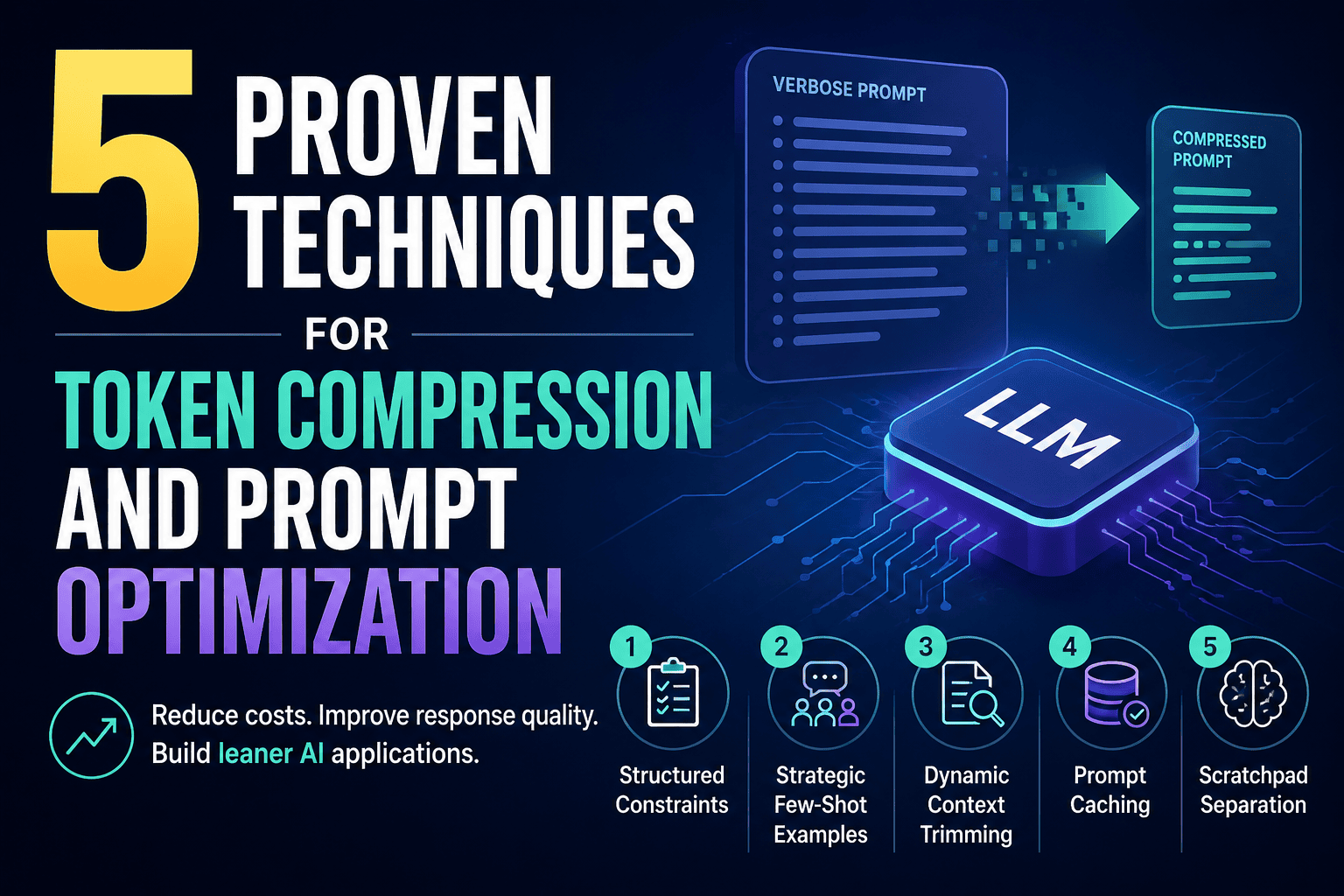
# Streamlining LLM Prompts: 5 Methods to Cut Token Usage and Boost Efficiency
Every token counts. Whether you are building production applications with large language models (LLMs) or running experiments in a notebook, overly long prompts quietly drain budgets and degrade response quality. Token compression is the practice of conveying maximum intent with minimum tokens, while prompt optimization ensures that this intent is structured so models respond accurately and efficiently. This guide covers five techniques you can apply immediately to reduce token consumption without sacrificing output quality, along with the reasoning behind each approach and practical implementation strategies.
## 1. Replacing Lengthy Instructions with Structured Constraints
Long, conversational system prompts feel natural to write but cost significantly more than tightly structured equivalents. The solution is moving from narrative instructions to declarative constraints using schema-like formatting that models parse efficiently. Instead of writing out full sentences to dictate formatting and length, compress these rules into concise, pipe-delimited key-value pairs or YAML-style snippets. For example, a single line using structured constraints can replace a multi-sentence directive to limit word count and omit sign-offs. This drastically reduces the character count of your system prompt, and across thousands of API calls, the savings compound quickly.
## 2. Using Few-Shot Examples Strategically, Not Exhaustively
Few-shot prompting—providing example input-output pairs before your actual request—dramatically improves output format consistency. The mistake most practitioners make is adding too many examples. Research consistently shows diminishing returns beyond three to five examples for most classification and generation tasks. Providing ten examples rarely improves accuracy and often introduces contradictions that confuse the model. A lean set of three carefully chosen examples establishes the pattern just as effectively as a larger set. Audit your existing prompts and benchmark quality at one, three, and five examples before committing to a larger group.
## 3. Applying Dynamic Context Trimming for Long Documents
When you pass long documents into a prompt—such as transcripts, legal text, or knowledge base articles—you are almost always paying for tokens the model does not need. Dynamic context trimming retrieves only the relevant passage rather than the entire document. By utilizing semantic search with sentence embeddings and similarity metrics, you can isolate the exact text segments required to answer a query. If a 10,000-token knowledge base only has an 800-token relevant section, this technique alone can slash context costs by over 90%, ensuring you only pay for what matters.
## 4. Maximizing Server-Side Caching for Repeated Prefixes
Many applications repeat identical system prompts across every user request: the same persona definition, the same tool descriptions, and the same policy constraints. Sending those tokens fresh each time is unnecessary. Modern inference infrastructure now supports storing and reusing static prompt prefixes server-side, billing cached tokens at a fraction of standard input pricing. Structure your prompts so the stable content comes first and the dynamic content comes last. Before implementing, consult your provider’s caching documentation to understand the specific token thresholds and time windows required to activate these savings.
## 5. Isolating Reasoning Traces with Scratchpad Separation
Chain-of-thought prompting improves model reasoning on complex tasks, but the reasoning trace itself—sometimes hundreds of tokens—often appears verbatim in your API response even when you only need the final answer. That inflates output token costs fast. The fix is to separate the reasoning scratchpad from the final answer using structured output markers. Direct the model to place its step-by-step logic inside specific tags, and reserve another tag exclusively for the final conclusion. Your application then parses and discards the internal reasoning block, paying for the thinking process without returning or storing the verbose trace for end users.
## Frequently Asked Questions
**Q: Why is token compression important for large language model applications?**
A: Reducing token usage directly lowers API costs and improves response latency. By eliminating unnecessary verbiage and redundant context, you maintain budget efficiency without sacrificing the accuracy or quality of the model’s output.
**Q: How many few-shot examples should I include in my prompt?**
A: The optimal range is generally between three and five examples. Beyond this threshold, you risk diminishing returns, where additional examples no longer improve accuracy and may instead introduce conflicting patterns that confuse the model.
**Q: Can I use these optimization techniques with any LLM provider?**
A: Most techniques—such as structured constraints, dynamic context trimming, and scratchpad separation—are provider-agnostic and work with any modern model. However, specific features like server-side prefix caching are dependent on the inference provider’s infrastructure and may require using platforms that explicitly support this functionality.
**Q: What is the best way to measure token savings before making an API call?**
A: You can utilize tokenizer libraries to pre-flight count the tokens in your prompt configuration. This allows you to compare different prompt structures, evaluate the impact of context trimming, and forecast costs accurately before committing resources.
## Conclusion
Token compression is not about cutting corners; it is about precision. By adopting structured constraints, optimizing few-shot sizing, dynamically trimming context, leveraging server-side caching, and isolating reasoning from output, you eliminate unnecessary token waste across your entire application stack. Start by auditing your most frequently used prompts, measure the current footprint, and test one technique at a time. Incremental, evidence-based optimization is far more sustainable than overhauling everything at once. As LLM usage scales, even modest per-call savings translate into real cost reductions and measurably faster response times.
Thank you for reading
