



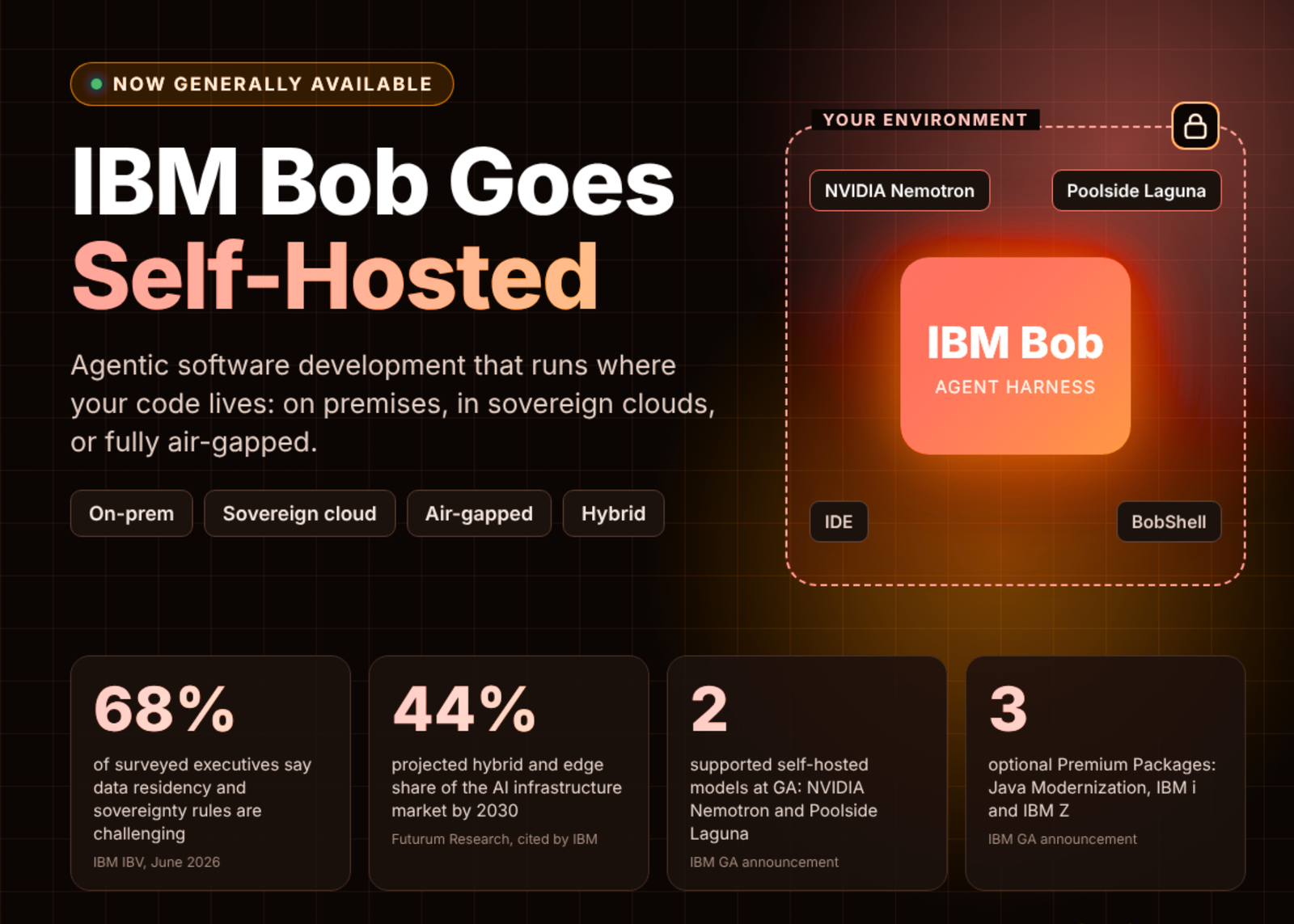
# IBM Bob Self-Hosted Deployment: A New On-Premises Option for Agentic Software Development
IBM has officially launched a self-hosted deployment variant of its agentic software development platform, IBM Bob. The move is designed to give enterprise teams the ability to run Bob’s full agentic workflow inside their own infrastructure—whether that’s on-premises servers, private cloud environments, sovereign cloud deployments, or fully air-gapped networks.
The platform covers the entire software development lifecycle. It helps teams understand complex codebases, plan development or modernization work, execute code changes, and validate results—all through an agentic framework that orchestrates multiple tools, skills, and modes in parallel.
## What’s Included in the General Availability Release
The self-hosted deployment brings several core capabilities into customer-managed environments. Teams get the full Bob IDE experience, BobShell for terminal and CI/CD pipeline integration, parallel tool calling, the agent harness, and the full suite of skills and modes that define the platform.
The deployment also supports optional Premium Packages targeting specific enterprise workloads. These include capabilities for Java Modernization, IBM i platform-specific workflows, and IBM Z enterprise-scale application analysis. The packages are designed to extend Bob’s agentic abilities to platforms that have traditionally been difficult to modernize.
## The Model Layer: Customers Choose Where Inference Runs
One of the most significant architectural decisions in the self-hosted deployment is how IBM handles the model layer. Bob does not come bundled with a large language model. Instead, customers are responsible for sourcing, licensing, and hosting a model from IBM’s supported list on their own infrastructure.
IBM organizes its supported models into two deployment categories. For fully self-hosted deployments, the currently supported models include NVIDIA Nemotron and Poolside Laguna. For hybrid or private SaaS configurations that use external connectivity, the supported roster includes Claude Sonnet 5.0, Claude Opus 4.8, Gemini 3.7 Flash, and OpenAI GPT 5.6 Sol.
This separation matters because it determines where code, development context, and build artifacts are processed. When a self-hosted model is used, everything can remain inside the customer’s own environment. IBM has used the example of a bank running on-premises inference for core banking applications while simultaneously routing less sensitive workloads to an approved external model through a private connectivity pattern.
## Hybrid Flexibility Without Bundled Models
The self-hosted option does support hybrid configurations, where certain workloads are processed locally and others route through external model services. This per-workload routing means that restricted, sensitive code can stay inside the customer environment, while less sensitive tasks can leverage externally hosted models. IBM has noted plans to expand the model portfolio and introduce multi-model routing, though those features are part of a future roadmap rather than a current shipment.
## How Bob Self-Hosted Stacks Up Against the Competition
Several other platforms offer self-hosted or on-premises AI coding assistance, each with a different focus and set of trade-offs.
GitLab Duo Agent Platform Self-Hosted integrates agentic capabilities into the GitLab DevOps platform and supports on-premises deployment through GitLab Self-Managed. It also offers air-gapped operation with an offline license and hybrid routing through its AI Gateway.
Mistral Vibe for Code Enterprise targets on-premises and private cloud deployments and works well with Mistral’s own open-weight models, including the Devstral series that supports air-gapped environments.
GitHub Copilot CLI’s BYOK (Bring Your Own Key) model allows users to connect to any provider that supports tool calling and streaming, though the core Copilot service itself runs on GitHub.com or GitHub Enterprise.com, limiting full on-premises isolation.
IBM Bob’s distinguishing angle is its focus on modernizing long-lived enterprise codebases—particularly Java applications, IBM i systems, and mainframe code—inside environments that may have no access to the public internet. This narrows the competitive field for enterprises with highly regulated, air-gapped, or sovereignty-sensitive infrastructure requirements.
## Key Takeaways
– IBM Bob self-hosted is generally available for on-premises, sovereign cloud, and air-gapped deployments.
– Customers must source and license their own model from IBM’s supported list, which includes NVIDIA Nemotron and Poolside Laguna for full isolation scenarios.
– Hybrid configurations allow per-workload routing between local and external models, including Claude, Gemini, and OpenAI options.
– Optional Premium Packages add modernization workflows for Java, IBM i, and IBM Z.
– IBM has not published pricing for the self-hosted option and directs interested buyers to request a demo.
—
## Frequently Asked Questions
**What is IBM Bob?**
IBM Bob is IBM’s agentic software development platform. It is designed to understand code, plan development or modernization work, execute changes, and validate results using an orchestrated set of agentic tools, skills, and modes.
**Can I run IBM Bob completely offline?**
Yes. By using a self-hosted model such as NVIDIA Nemotron or Poolside Laguna on infrastructure that has no external connectivity, Bob can operate in a fully air-gapped environment.
**Do I need to bring my own model license?**
Yes. IBM does not bundle a model with Bob self-hosted. Customers are responsible for sourcing, licensing, and hosting a model from IBM’s supported list on their own infrastructure.
**What models can I use in a hybrid configuration?**
In hybrid or private SaaS configurations, IBM supports Claude Sonnet 5.0, Claude Opus 4.8, Gemini 3.7 Flash, and OpenAI GPT 5.6 Sol, delivered through an approved private connectivity pattern.
**Is pricing available for the self-hosted option?**
IBM has not published pricing for the self-hosted deployment. Interested enterprise customers are directed to request a demo through IBM’s sales channels.
**What makes IBM Bob different from GitLab Duo or GitHub Copilot in a self-hosted setup?**
IBM Bob is specifically built to target modernization of long-lived enterprise codebases, with premium packages for Java, IBM i, and IBM Z. It is optimized for environments where code must remain inside a customer-managed perimeter, including air-gapped and sovereign cloud scenarios.
**Are multi-model routing and an expanded model portfolio available now?**
No. IBM has confirmed that both multi-model routing and an expanded model portfolio are on the roadmap but have not yet shipped.
**Who is the target audience for this release?**
The self-hosted deployment is aimed at enterprise customers with sensitive, mission-critical, or regulated software systems that require governance, sovereignty, or air-gapped operation—such as financial institutions, government agencies, and large enterprises with long-standing code estates.
—
## Conclusion
The general availability of IBM Bob’s self-hosted deployment marks a significant step in making agentic development tools accessible to enterprises that cannot send code or context outside their own infrastructure. By decoupling the platform from the model and placing the responsibility for model sourcing and hosting squarely on the customer, IBM has created a deployment option that satisfies strict security and sovereignty requirements while still delivering the full agentic workflow across the development lifecycle.
The addition of hybrid routing gives enterprises flexibility to handle different workloads with different levels of restriction, and the Premium Packages for Java, IBM i, and IBM Z modernization address a niche that many general-purpose coding agents do not serve well. For enterprises running sensitive, long-lived codebases in regulated environments, IBM Bob self-hosted represents a purpose-built option worth evaluating.
Thank you for reading
