



# The Rise of the Forward Deployed Engineer: Why AI’s Next Critical Role Is Sitting Inside Your Enterprise
## The Number That Spooked the Industry
In early 2025, a relatively obscure job title — “forward deployed engineer” — barely showed up on major job boards. By mid-2026, demand had surged to over 5,000 percent above that baseline. One analysis tracked a more than 800 percent jump in monthly postings within just eight months, from January through September 2025. Meanwhile, general software development job postings on major platforms remained significantly below pre-pandemic levels, underscoring just how unusual this growth pattern really is.
The most telling financial signal came in May 2026, when OpenAI announced it had raised over four billion dollars for a new venture explicitly built around the forward deployed engineer model. That single announcement crystallized what many in the industry had been sensing: this wasn’t a passing trend — it was a structural shift in how AI gets built, sold, and deployed.
## What Exactly Does a Forward Deployed Engineer Do?
At its core, the role is deceptively simple. A forward deployed engineer (FDE) embeds directly with a customer’s organization, works inside their systems and data environments, and builds production-grade solutions on site. Unlike a typical software engineer who works from a headquarters building or a remote office, the FDE’s office is the customer’s data center, their cloud environment, their team’s daily workflow.
This model traces its origins to Palantir, the data analytics company that, years before the term became fashionable, deliberately sent engineers “forward” to work alongside clients rather than building everything from the inside out. For a long time, the approach was dismissed as consulting repackaged in engineering clothing. But Palantir’s leadership argues that this very dismissal gave the company an enormous advantage, allowing them to refine a deeply customer-aligned operating model over two decades.
The financial results speak for themselves. Palantir reported an 85 percent gross margin for the second quarter of 2026, up from 81 percent a year earlier — a figure that makes the consulting comparison look quaint.
### What Separates an FDE from Other Roles
An FDE is distinct from a solutions engineer, a sales engineer, or a traditional consultant in one critical way: **what they learn at the customer must feed back into the company’s product roadmap.** Without that feedback loop, the role is just consulting. It’s not sales either — analysis of roughly 1,000 FDE job postings found that exactly zero percent of them carried any sales quota. The FDE owns outcomes in production, not deliverables on a slide deck.
| Role | Primary Goal | Production Code? | Sales Quota? | Shapes Product Roadmap? |
|——|————-|——————-|————-|————————|
| Forward Deployed Engineer | Customer outcome in production | Yes, heavily | No | Yes, by design |
| Solutions / Sales Engineer | Win the deal | Demos and prototypes only | Often | Sometimes |
| IT Consultant | Deliver a scoped project | Varies | No (billable hours) | No |
| ML Engineer (Product Team) | Build and ship the core product | Yes | No | Yes, directly |
The final column is the decisive one. It is where a genuine FDE role and a renamed consulting engagement diverge permanently.
## The Last-Mile Bottleneck
The explosion in FDE demand isn’t hard to explain once you look at where AI is actually failing inside enterprises. Frontier models have made extraordinary strides. Multiple labs now offer comparable capabilities, which means the competitive differentiator has shifted. When every provider can give you a capable model, the question becomes: **who can make that model work inside a real business with all its messiness?**
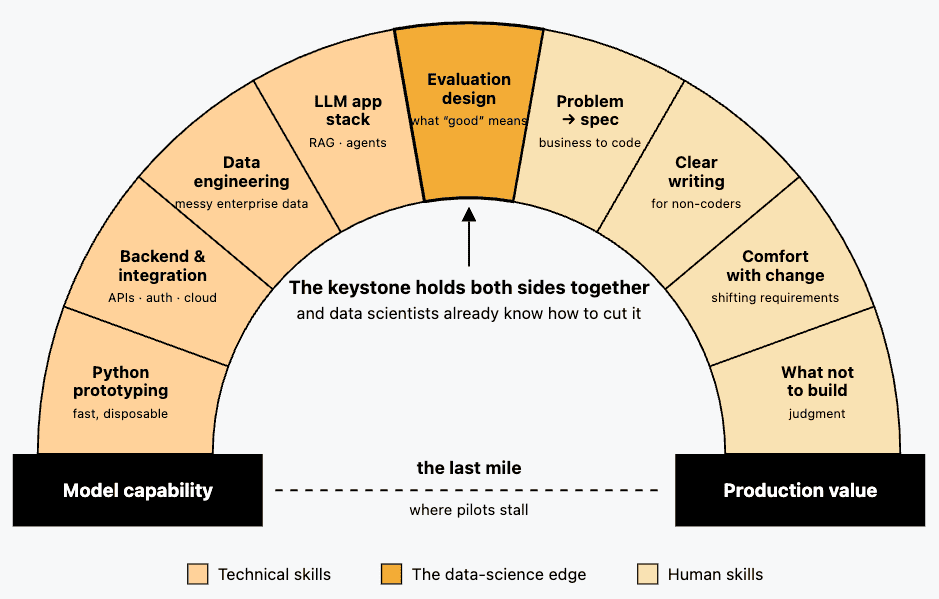
This is the last-mile problem, and it kills pilots at an alarming rate. A pilot that looks promising during a controlled notebook demo stalls because the data it needs sits in a legacy warehouse behind permissions that nobody on the project team can grant. Or it stalls because the stakeholders never agreed on what a good output looks like, so everyone judges the system by the last answer they happened to see.
Integration failures are even more common. A retrieval pipeline that can’t read the ticketing system, or an AI agent whose tools don’t match how the team actually works, might be technically impressive but practically useless. Then come the organizational obstacles: unclear ownership, skeptical department heads, compliance reviews stuck in queues. The clock is always running because the pressure for time-to-value starts the day the contract is signed, not the day the data is cleaned.
None of these are research problems. They are engineering problems that can only be solved by someone on-site, with enough context to recognize them and enough technical depth to resolve them. As one industry guide puts it, the models already work — what’s missing is someone embedded deeply enough to wire them into real data, real systems, and real workflows.
## The Capital Bets: Where Frontier Companies Are Investing
Recruiter enthusiasm alone wouldn’t be worth noting. The stronger signal is where the strategic capital is flowing.
**OpenAI** launched its Deployment Company in May 2026 with backing from nineteen investors and over four billion dollars. The company was built from the ground up around the FDE model. It acquired the consultancy Tomoro, bringing roughly 150 FDEs and deployment specialists on day one. OpenAI also hires FDEs directly, with reported base compensation between 220,000 and 280,000 dollars plus equity.
**Anthropic** moved a week earlier. On May 4, 2026, it announced a standalone enterprise AI services firm with Blackstone, Hellman & Friedman, and Goldman Sachs as founding partners. CNBC valued the venture at 1.5 billion dollars. The focus is on mid-sized companies — community banks, regional health systems — with Anthropic’s applied AI engineers working alongside the enterprise team. At the time of the latest reporting, Anthropic’s own careers page lists Forward Deployed Engineer positions with a manager track, sitting right next to Applied AI Engineer and Applied AI Architect roles.
**Salesforce** has committed to building a team of 1,000 FDEs for its Agentforce platform. **AWS**, according to industry reporting, has committed to its own FDE organization. **Microsoft** launched its Frontier Company with 2.5 billion dollars behind it. **Google Cloud**, **Databricks**, and **Adobe** are all hiring under the FDE title or close variants. A growing roster of startups — including Harvey, Sierra, Decagon, and Hebbia — are doing the same.
Even traditional consultancies are entering the space. Deloitte has posted listings for “Anthropic Forward Deployed Engineers.” The recruiting platform Paraform has noted that the pool of qualified candidates has not kept pace with demand, which is likely a key driver behind rising compensation packages.
## Compensation: What FDEs Are Making in 2026
Pay figures for FDE roles vary considerably depending on the source, the company, and the seniority level. Because many data points come from recruiting firms with a vested interest in highlighting the trend, it’s wise to treat each figure as a range rather than a fixed number.
Indeed lists an average base salary of roughly 171,900 dollars. Bloomberg’s analysis lands in a similar range, with a median of about 173,800 dollars, and found that 70 percent of FDE postings mention equity as part of the package.
For mid-level and senior FDEs, total compensation at some companies reaches 300,000 to 550,000 dollars. Staff and principal-level roles at frontier labs are listed from 600,000 dollars up to over 1.2 million dollars. More grounded individual offers include founding FDE roles at companies like Glean paying 160,000 to 270,000 dollars in base salary, and roles at Ramp offering 161,500 to 190,000 dollars plus equity.
Geographically, FDE jobs cluster in the major tech hubs. Anthropic lists openings in New York, San Francisco, Seattle, London, Paris, and Munich. Salesforce posted a role in Toronto in late summer 2026. One complication for job seekers is the proliferation of titles. Beyond the literal “Forward Deployed Engineer,” the role appears as “Forward Deployed AI Engineer,” “Forward Deployed Software Engineer,” “Applied AI Engineer,” “Deployment Engineer,” “Solutions Engineer,” and various company-specific formulations. Industry estimates suggest that candidates searching only for the exact phrase “forward deployed engineer” miss roughly a third of the active market.
## The Skills That Matter — and Why Data Professionals Are Well Positioned
The FDE skill set is broad rather than narrowly deep. At its foundation sits the large language model application stack: retrieval-augmented generation (RAG), agent and tool-use architectures, and prompt and context engineering. Surrounding that is data engineering on messy, real-world enterprise data stacks, backend work including APIs, authentication, cloud deployment, and observability, and the ability to prototype quickly in Python.
One skill deserves particular emphasis: **designing evaluations for a customer-specific task.** This is the gap that the last-mile problem keeps exposing, and it is precisely what data scientists already do well. Defining what “good” looks like, building a labeled evaluation set, and measuring against it is standard data science work — and it is also exactly what a stalled pilot almost never had in place.
The non-technical skills are often the differentiator in hiring decisions. An effective FDE must tolerate shifting requirements, translate business problems into technical specifications, write clearly for stakeholders who will never read the code, and exercise sound judgment about what not to build. Interview formats reflect this reality. According to industry reports, OpenAI’s FDE interview process emphasizes continuous narration of reasoning rather than producing a polished final answer in silence — a format that mirrors the real-time, on-the-spot nature of deployment work far more than it does a traditional algorithmic puzzle.
The profile maps naturally onto data scientists who already work with business stakeholders, machine learning engineers who prefer shipping to researching, backend and data engineers who communicate well, and former solutions architects who want deeper technical ownership.
For those looking to make a credible transition, the evidence that matters is evidence of deployment. Shipping an end-to-end language model application on real, messy data and documenting the evaluation methodology used is the strongest signal. Leading an internal AI rollout at your current organization is essentially running an FDE engagement with your own company as the customer.
## What the Skeptics Are Right About
A balanced view requires taking the counterarguments seriously, and there are several worth examining.
**The growth numbers are noisy.** Depending on who is counting and when, growth estimates for FDE postings range from 350 percent to over 1,100 percent. The dramatic headline figures are often index comparisons against a very small base on a single job board, not measures of actual headcount. One curated live index counted just 224 open FDE roles across 39 companies at a specific point in mid-2026 — a number that can coexist with explosive growth from a very small starting point.
**Relabeling is rampant.** Many companies are renaming existing solutions engineers or consultants as “forward deployed engineers” without actually building the feedback loop that makes the role valuable. Palantir’s own head of global commercial described imitators as “half measures” — companies that copied the outward structure without the inward engine of product learning.
**The margin-for-moat trade-off is real.** Some companies accept lower margins on hands-on deployment work in exchange for becoming difficult to replace. Others slide into billable-hours thinking. Warning signs to watch for include performance reviews that emphasize utilization, features built for customers that never reach the actual product, and engagements that keep getting extended rather than concluded.
**Burnout is a structural risk.** OpenAI’s FDE role, for example, asks for up to 50 percent travel, and roughly two-thirds of analyzed postings require some travel. There is constant context-switching, months spent as the company’s face at a client, and accountability for adoption outcomes that are partly outside the engineer’s control. Industry guides warn that two years of acting as integration glue can erode systems-level depth, making the transition back to core product engineering harder than it initially appears.
## Is This a Lasting Career or a Hype Cycle Label?
The honest answer is: probably both, depending on the company and the role. The title “forward deployed engineer” could splinter into a dozen variants, fade the way other hot job titles have faded, or gradually merge into broader labels like “applied AI engineer” — a drift already visible at companies where both titles sit side by side on career pages.
But the need behind the title will not disappear. Turning AI model capability into real production value inside messy, complex organizations is a problem that will persist as long as AI adoption lags behind AI capability. Every deployment-focused venture launched in 2026 is, fundamentally, a bet that this gap will not close quickly.
That makes the underlying skill set one of the strongest career bets available in technology right now, regardless of what the next decade’s job titles turn out to be. FDE work builds transferable capabilities: broad technical range, sharp customer judgment, and firsthand knowledge of exactly how AI projects fail in practice — which is ultimately the most practical education in knowing what to build next. The most common exit paths from the role include product management, founding a startup, applied AI engineering, and solutions leadership.
The key caveat is that not every job carrying the FDE title will deliver on these promises. Before accepting any offer, ask the right screening questions. Who on the product team actually reads what FDEs learn in the field, and how often? Do performance reviews mention utilization or billable hours? How does an engagement end, and how frequently do they get extended instead? Does code written for one customer ever become platform-level code? Can the hiring manager show you something an FDE built last quarter that is now shipping in a real product?
That last question is the most important one, and it comes down to a single test: does what you learn at the customer actually reach the product roadmap? If the answer is yes, you are looking at a genuine FDE role — one of the most interesting seats in AI today. If the answer is no, you are looking at consulting with a better title. Knowing the difference before you sign will save you months of frustration and a potentially costly career detour.
## Frequently Asked Questions
**What is a forward deployed engineer in simple terms?**
A forward deployed engineer is a software engineer who goes directly to the customer, works inside their systems and data, and builds production solutions on site rather than working from a central office. The FDE is responsible for real outcomes in production, not just presentations or proposals.
**How is this different from a consulting role?**
The critical difference is the feedback loop. A genuine FDE role ensures that what the engineer learns at the customer changes what the company builds next. Without that loop, the role is effectively consulting — delivering a scoped project and leaving. Real FDE roles also do not carry sales quotas.
**Why is demand for FDEs exploding right now?**
AI models have become powerful enough that the bottleneck has shifted. The challenge is no longer building better models; it is making existing models work inside real enterprise environments with messy data, legacy systems, and complex organizational dynamics. FDEs are the people who solve that last-mile problem.
**What companies are hiring FDEs?**
Major players include OpenAI, Anthropic, Salesforce, AWS, Microsoft, Google Cloud, Databricks, and Adobe. Startups like Harvey, Sierra, Decagon, and Hebbia are also hiring aggressively. Even traditional consultancies such as Deloitte have started posting FDE roles.
**What does an FDE earn?**
Base salaries typically range from roughly 160,000 to 270,000 dollars, with total compensation at mid-to-senior levels reaching 300,000 to 550,000 dollars or more at frontier labs. Most roles include equity, and staff- or principal-level positions at top companies can exceed one million dollars in total compensation.
**What background makes someone a strong FDE candidate?**
Data scientists, machine learning engineers, backend engineers, and solutions architects are all natural fits. The most important signals are demonstrated ability to deploy end-to-end AI applications on real data, strong communication skills, and comfort operating in ambiguous, rapidly changing environments.
**Is the FDE title here to stay?**
The title itself may evolve, splinter, or merge into other labels over time. But the skill set — deep technical ability combined with customer-facing deployment expertise and product feedback — addresses a durable need that will outlast any single job title.
**What should I watch out for in an FDE job listing?**
Red flags include utilization metrics in performance reviews, features built for customers that never reach the product, engagements that get repeatedly extended, and no visible path for the engineer’s learning to influence the company’s roadmap.
## Conclusion
The forward deployed engineer role represents something more significant than a trendy job title on a hiring board. It reflects a fundamental reality about the state of artificial intelligence: the technology has arrived, but the work of making it useful inside real organizations has only just begun. Every company investing billions in FDE organizations in 2026 is making the same bet — that the gap between what AI can do and what AI can actually accomplish inside a business will take years to close, and that bridging that gap requires engineers who are willing to go directly to the customer, roll up their sleeves, and build in the messy middle.
Whether the specific title endures is secondary. What matters is that the skill set it represents — combining deep technical chops with customer empathy, deployment experience, and product thinking — has become one of the most valuable and sought-after combinations in the technology industry. Professionals who develop these skills now, regardless of what the next decade’s job descriptions call them, will find themselves at the center of one of the most consequential shifts in how software gets built and delivered.
The most important thing to remember is to evaluate any FDE opportunity against a single standard: does what you learn at the customer actually make the company’s product better? If it does, you have found a rare and valuable role. If it doesn’t, no amount of title prestige will compensate.
Thank you for reading
