



# The Evolution of Activation Functions: From Biological Mimicry to Mathematical Pragmatism
## A Question of Firing
The choice of how an artificial neuron responds to its inputs is one of the most consequential design decisions in machine learning. It determines not just how individual units behave, but whether entire networks can learn from data. For decades, this decision was guided by a deceptively simple question: should artificial neurons resemble their biological counterparts?
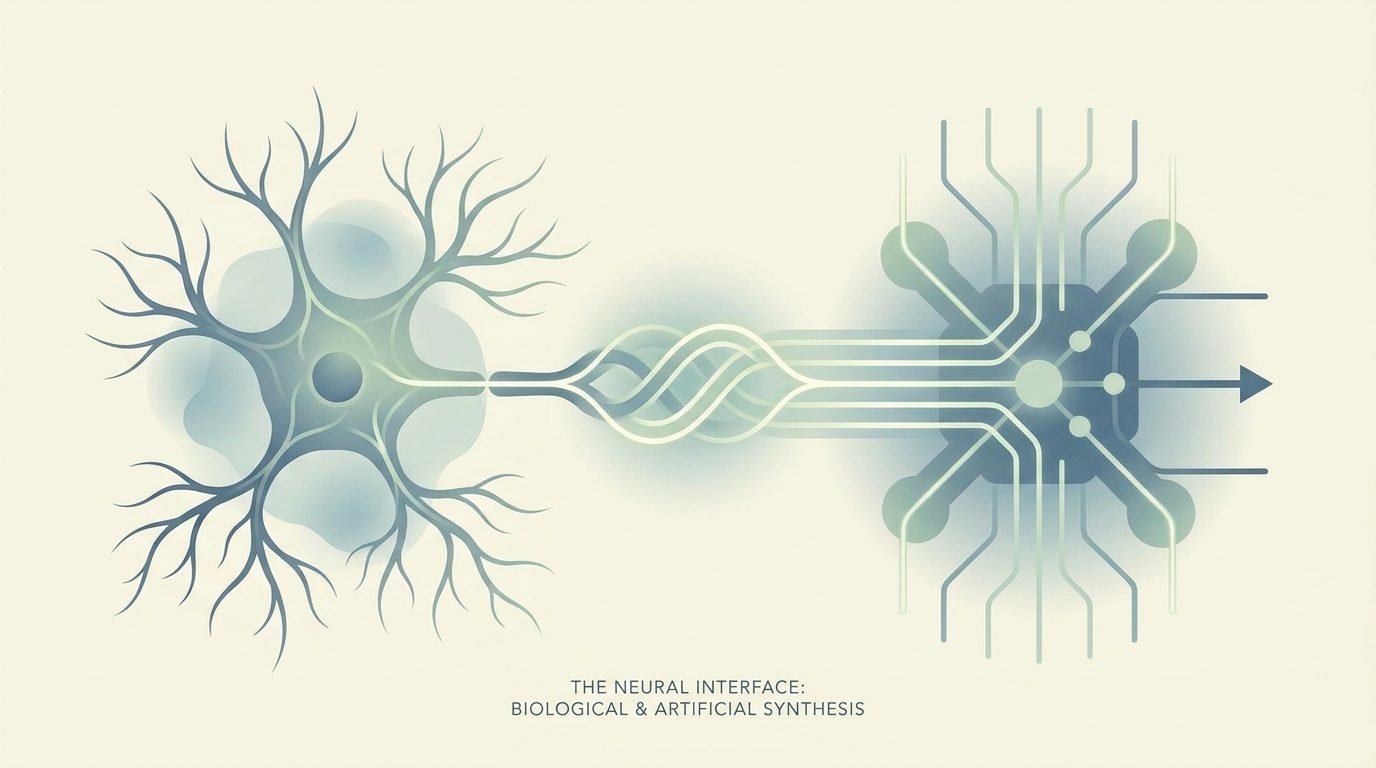
The history of activation functions is, at its core, a story about the tension between biological inspiration and engineering pragmatism. What began as an attempt to model real neurons gradually evolved into a purely empirical pursuit driven by training performance, computational efficiency, and the demands of ever-larger architectures.
## The Biological Blueprint and Its Limitations
Early computational neuroscience attempted to formalize the neuron as a binary decision-making device. The foundational model treated neurons as threshold units that either fired or remained silent, depending on whether incoming signals crossed a critical boundary. Later extensions introduced adjustable connection strengths, allowing these simple units to adapt based on experience.
The sigmoid function became the standard choice for hidden layers throughout the late twentieth century. Its smooth, S-shaped curve seemed to capture the graded nature of biological firing, producing outputs between zero and one that could be interpreted as firing probabilities. For weak signals, the output approached silence; for strong signals, it approached maximum activation.
Mathematically, the sigmoid offered elegance—it was everywhere differentiable and possessed a particularly tidy derivative that expressed the function in terms of itself. This property simplified the calculus required to adjust connection strengths during learning.
## The Vanishing Signal Problem
The practical difficulty emerged during the training process itself. Modern networks learn through a mechanism called backpropagation, which calculates how much each connection contributed to errors by propagating corrections backward through the layers. Because each layer’s adjustment depends on the derivative of its activation function, these derivatives multiply together as the signal travels deeper into the network.
For the sigmoid, these multiplicative factors proved devastating. The maximum possible derivative occurs at the center of the curve and equals only one-quarter. Once signals pass through multiple layers, the product of these small numbers shrinks exponentially, leaving the earliest layers with negligible updates. The network effectively forgets how to adjust its foundational parameters, stalling learning in deeper architectures.
This phenomenon, known as the vanishing gradient, meant that networks deeper than a few layers were nearly impossible to train using sigmoid activations. The biological elegance that made the function appealing became the very obstacle that prevented scalability.
## The Rise of Rectified Linear Units
A dramatically simpler alternative emerged in the early 2010s and rapidly transformed the field. Rather than compressing all inputs into a narrow range, this function passed positive values through unchanged while zeroing out negative ones. Its definition required only a single conditional statement.
The mathematical advantage was immediate and profound. For any active positive input, the derivative equals exactly one—meaning gradients flow backward through that unit without attenuation or amplification. Unlike the sigmoid, which guaranteed signal degradation with each layer, this rectified function allowed errors to propagate intact across dozens of layers, unlocking the training of genuinely deep networks.
The geometric implications were equally significant. Each unit acted as a binary switch, creating linear partitions of the input space. Stacking layers allowed networks to carve increasingly complex regions, with the theoretical capacity for exponential growth in representational power as depth increased.
## The Biological Paradox
Here lies perhaps the most intriguing irony in the history of neural network design. The activation function that replaced the biologically-inspired sigmoid actually turned out to be more neuroscientifically plausible than its predecessor.
Biological neurons spend most of their time silent, firing only when inputs cross a specific threshold. A sigmoid unit receiving no input produces an output of precisely half its maximum—a persistent baseline activity that real neurons simply do not exhibit. The rectified function, with its hard silence below threshold and sparse, threshold-dependent firing above it, better matches the observed behavior of cortical neurons.
This biological argument was published contemporaneously with the function’s adoption in deep learning, yet it failed to shape the field’s narrative. The community had once selected activation functions for their neurological realism, but when performance demanded otherwise, the biological argument was abandoned wholesale. The rectified function was remembered not as a more accurate model of biology, but as a clever engineering shortcut.
## The Cost of Hard Zeros
The simplicity that made rectified units so effective came with a distinct failure mode. When a unit’s inputs fell consistently below zero across all training examples, the gradient became identically zero, permanently silencing that unit. The connections feeding into it ceased updating, and the unit became effectively dead—contributing nothing to the network’s computations for the remainder of training.
In deep networks trained with aggressive learning rates, this “dying unit” phenomenon could eliminate substantial portions of the network’s capacity. The problem emerged because the hard zero created an absolute barrier rather than a soft transition, leaving no gradient to guide recovery once a unit crossed into silence.
Researchers responded with a series of modified functions designed to preserve the benefits of rectification while preventing permanent silencing. Some allowed small negative slopes instead of absolute zeros, ensuring that even inactive units retained a minimal gradient pathway. Others replaced the hard boundary with smooth curves that transitioned gradually rather than switching abruptly.
These variants represented a philosophical shift: instead of optimizing for biological plausibility, they optimized for gradient health and training stability. The functions were judged not by what they resembled in nature, but by how well they enabled learning in practice.
## The Frontier Beyond Rectification
As architectures scaled to unprecedented sizes—particularly in transformer-based language models—even the rectified approach began showing limitations at the cutting edge. The original transformer architecture used rectified units, but subsequent generations adopted smoother, more sophisticated alternatives that often outperformed their predecessors without clear theoretical justification.
The newest generation of activation functions are frequently discovered through automated search rather than biological reasoning or hand-crafted mathematical intuition. Noam Shazeer, one of the pioneers behind the most widely adopted variant, attributed his function’s success to chance rather than principled design—describing it as the result of “divine benevolence.”
This represents a fundamental departure from the field’s origins. Activation functions are no longer chosen to mirror nature or satisfy mathematical elegance; they are selected because they empirically improve performance at scale. The question of what a neuron should look like has been replaced entirely by the question of what trains best.
## What This Progression Reveals
The trajectory from sigmoid to rectified units to modern variants demonstrates that activation functions have always functioned as working hypotheses rather than fixed commitments. Each generation’s dominant choice was revised when empirical evidence exposed its limitations, and the biological motivations that originally guided the field’s earliest decisions were eventually abandoned in favor of raw performance metrics.
This is not to say that biological inspiration lacks value—it simply serves a different role than many early researchers assumed. The historical pattern suggests that biological plausibility functions more as a source of initial inspiration than as a binding constraint on engineering decisions. When the numbers conflict with the biology, the numbers win, consistently and without apology.
The replacement of each dominant activation function also demonstrates a self-consuming pattern of innovation. Rectified units enabled the deep architectures that eventually made them obsolete. GELU and its successors emerged precisely because rectified units created limitations that deeper, larger networks exposed. Each breakthrough contains within it the seeds of its own supersession.
## Frequently Asked Questions
**What exactly is an activation function doing in a neural network?**
An activation function determines the output of a single neuron given its inputs. It introduces non-linearity into the network, allowing it to learn complex patterns that cannot be captured by simple linear combinations of inputs. Without such functions, stacking layers would reduce to a single linear transformation regardless of depth.
**Why did the sigmoid function fall out of favor?**
The sigmoid suffers from the vanishing gradient problem, where gradients shrink exponentially as they propagate backward through layers. Since its derivative never exceeds 0.25, deep networks using sigmoid activations become extremely difficult to train—the earlier layers receive insufficient signal to learn meaningfully.
**Is ReLU truly more biologically plausible than the sigmoid?**
Yes, surprisingly so. Real neurons remain silent below a firing threshold and exhibit sparse activation patterns, which closely matches ReLU’s behavior of outputting zero for negative inputs and passing positive inputs unchanged. The sigmoid’s persistent half-maximum output for zero inputs actually diverges more significantly from observed neural behavior.
**What is the “dying ReLU” problem?**
When a ReLU unit receives only negative inputs across all training examples, its gradient becomes zero permanently. The unit stops learning entirely, effectively removing itself from the network. This can waste significant capacity in deep networks, particularly when learning rates are set too aggressively.
**How do modern variants like GELU and Swish differ from ReLU?**
Modern variants typically replace the hard zero boundary with smooth curves or small negative slopes, ensuring gradients never completely vanish even for negative inputs. Some variants also center activations around zero or introduce gating mechanisms that dynamically modulate information flow, improving performance in very large models.
**Will there be another major shift in activation function design?**
Given the historical pattern of functional replacement driven by scaling and architectural changes, another shift seems inevitable. As models grow larger and architectures continue evolving, current functions may encounter limitations that prompt the adoption of new designs—potentially discovered through automated search rather than human intuition.
**Are there activation functions designed specifically for certain layer types?**
Yes, different architectures often favor different functions. Recurrent networks sometimes use tanh for hidden states due to its zero-centered outputs, while attention mechanisms in transformers frequently employ softmax for normalization. The choice increasingly depends on the specific computational requirements of each layer’s role within the larger system.
## Conclusion
The evolution of activation functions traces a clear arc from biological aspiration to mathematical pragmatism. What began as an attempt to build artificial brains that mirrored their organic counterparts gradually shifted into a purely empirical discipline governed by training dynamics and benchmark performance. The sigmoid was abandoned not because biologists proved it unrealistic, but because deep networks couldn’t learn with it. ReLU succeeded not because it was more biologically accurate than alternatives, but because it made gradient flow tractable across many layers. And today’s cutting-edge functions succeed not because anyone understands why they work theoretically, but because they empirically improve results at scale.
This journey reveals something important about the relationship between neuroscience and artificial intelligence: biological inspiration can seed initial design choices, but empirical results ultimately dictate adoption. The artificial neuron persists as a computational construct, but what it means to “fire” has been continually renegotiated according to the demands of each new generation of architectures. The history of activation functions is, ultimately, a history of learning to let go of metaphors in favor of measurable performance—and of recognizing that the best engineering often comes not from mimicking nature, but from reimagining what computation can be.
Thank you for reading
