



# Introduction
Data science evolves at a rapid pace. If you’re entering the field in 2026, the sheer volume of knowledge can feel overwhelming. From learning Python to grasping cloud platforms and staying current with cutting-edge machine learning techniques, the learning curve is steep.
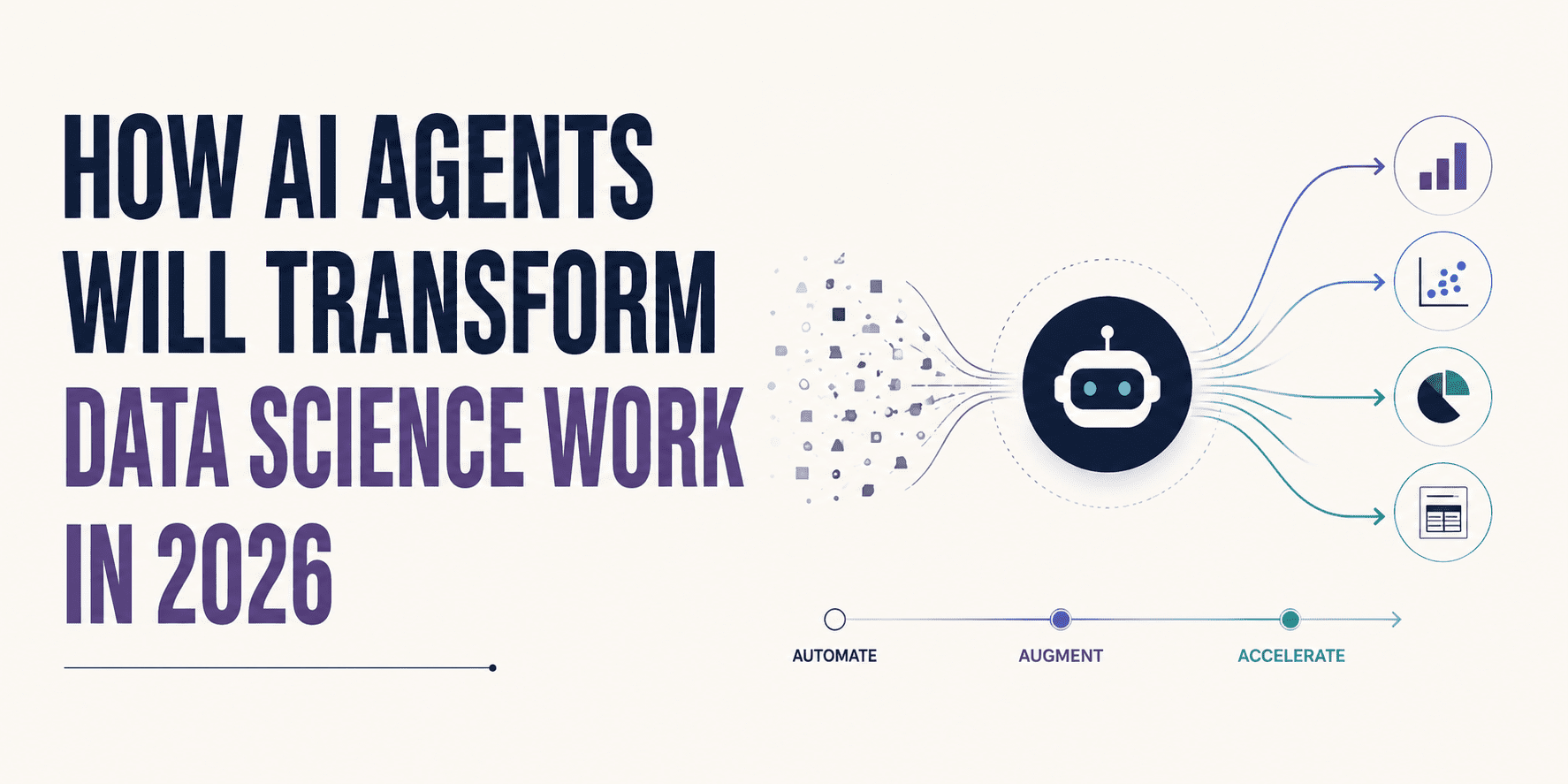
However, an emerging development is set to revolutionize the landscape—not by increasing your workload, but by amplifying your capabilities. This game-changer is the emergence of AI agents.
Set aside the sensational headlines about machines replacing humans. By 2026, AI agents are poised to become ideal collaborators for data scientists. They won’t take your place; instead, they’ll tackle the tedious aspects of the work, freeing you to concentrate on strategic thinking and complex problem-solving that only humans can perform.
So, what does the future hold for AI agents in 2026? Let’s explore how these intelligent assistants will transform the data science process.
# What Exactly Is an AI Agent?
Before diving ahead, let’s define what an “AI agent” actually is.
Picture a conventional AI tool, such as a large language model (LLM), as an exceptionally knowledgeable but inactive encyclopedia. You pose a question, and it provides a response. An AI agent, in contrast, behaves more like an eager junior team member. It’s an autonomous system capable of:
- Comprehending your data, your code, and your objectives
- Figuring out the optimal approach to reach a goal
- Taking independent action to finish tasks
- Improving over time by learning from outcomes
Within data science, an agent goes beyond merely producing lines of code. You can assign it a goal such as “boost the accuracy of the customer churn prediction model,” and it will independently experiment with various algorithms, construct new features, and verify the outcomes, then present you with its discoveries.
# Will Data Science Be Replaced by AI in the Future?
This is the crucial question for newcomers and veterans alike. The straightforward answer is no. In reality, AI agents in data science will probably increase the value of human data scientists, not diminish it.
History follows this pattern. Spreadsheets didn’t eliminate accountants; they accelerated their work and shifted their focus to financial planning rather than manual calculations. In the same way, AI agents will take over the “grunt work” of data science. This covers:
- Data Cleaning: The agent can automatically identify and resolve missing entries, anomalies, and inconsistencies within your dataset.
- Feature Engineering: It can propose or even generate new variables from existing data that could enhance your model’s performance.
- Model Selection and Hyperparameter Tuning: Rather than spending days conducting experiments, an agent can methodically test numerous model configurations and parameters to identify the top performer.
The human data scientist’s role transitions from task executor to strategic leader. You frame the business challenge, supply the necessary context, and assess the outcomes. The agent does the heavy lifting. The data science job market in 2026 will highly value professionals who can oversee and work alongside these AI agents, combining technical expertise with business acumen.
# What Is the Trend in Data Science in 2026? Shifting to Agentic Workflows
If 2023 centered on generative AI producing text and 2024 focused on code generation, then 2026 is the year of the “agentic workflow.”
Consider a typical project. Previously, you might dedicate 80% of your time just preparing the data (the well-known “data wrangling“). In 2026, you’ll simply pass your unstructured dataset to an agent with directions like, “Clean this data following standard time-series analysis practices, and record every action you perform.”
This transformation reshapes the entire pace of work. Here’s how a forward-thinking data science workflow could appear in 2026:
- Problem Definition (You): You consult with stakeholders to grasp the business requirement.
- Orchestration (You and Agent): You assign a “Project Manager Agent” with the overarching objective. This agent then divides the project into smaller tasks and assigns them to specialized agents (e.g., a “Data Cleaning Agent,” an “EDA Agent,” a “Modelling Agent”).
- Execution (Agents): The specialized agents operate simultaneously, managing data preparation, analysis, and preliminary modelling. They track their progress, highlight any concerns (such as data quality issues), and save their findings.
- Review and Refinement (You): You examine the agent’s report, the produced code, and the proposed models. You offer feedback, request alternative approaches, or approve the results.
- Deployment and Monitoring (You and Agent): Once a model is finalized, a “Deployment Agent” packages it and deploys it to production, configuring dashboards to track its performance and notify you if issues arise.
This represents the natural evolution of tools like AutoML and ChatGPT, integrated into a unified, self-directed system.
# What Will AI Be Like in 2026? Becoming a Collaborative Partner
So, what will AI resemble in 2026? It will shift from being a mere tool to functioning as a true partner. For an aspiring data scientist, this is excellent news. Rather than being stuck for hours on a syntax error, you’ll have an agent that not only corrects the mistake but also clarifies the underlying cause, aiding your learning. Rather than feeling overwhelmed by countless algorithms, you’ll have a reasoning companion that can recommend the best course of action based on your data’s characteristics.
This reshapes the competencies needed to thrive. While a solid foundation in statistics and machine learning remains essential, your most critical skills will be:
- Critical Thinking: Can you determine whether the agent’s output makes sense within a business framework?
- Communication: Can you articulate problems clearly for your AI agents to address?
- Judgment: Which solution generated by the agent is genuinely the most ethical, fair, and reliable?
# Conclusion
The emergence of AI agents in 2026 won’t signal the end for data scientists. Rather, it heralds the start of a powerful collaboration. By handling the repetitive and technical duties, AI agents will unleash human creativity to concentrate on the broader vision—such as posing the right questions, devising innovative solutions, and creating tangible business value.
As you develop your expertise, aim to become the leader of this team. Master the language of data, understand the core principles, and above all, learn to guide your new AI colleagues. The future of data science isn’t human versus machine; it’s human and machine, collaborating seamlessly.
References and Further Reading
- Large Language Models and How They Function
- Automated Machine Learning (AutoML)
- Learn More About Data Wrangling
Shittu Olumide is a software engineer and technical writer passionate about leveraging cutting-edge technologies to craft compelling narratives, with a keen eye for detail and a knack for simplifying complex concepts. You can also find Shittu on Twitter.
