



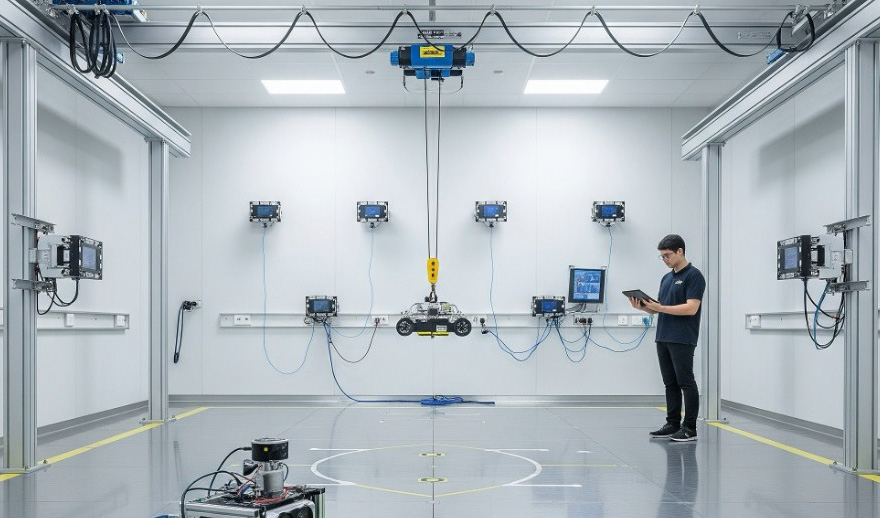
Fennec Engineering has worked with clients including Amazon Robotics. Source: Fennec Engineering
Functional safety plays a vital role in building public trust and driving adoption of robots and related technologies, and it needs to be addressed from the very earliest stages of development, according to Fennec Engineering. The company announced today that it has earned independent certification from TÜV Rheinland for its Advanced Safety Acceleration Platform, commonly known as ASAP.
The year-long Tool 2 (T2) qualification process confirmed that ASAP satisfies the demanding requirements of IEC 61508 and ISO 13849 for software tools used in safety-critical development. Steven Marks, Fennec’s director of product, spearheaded the effort to evaluate the platform’s methodology and full end-to-end traceability against both standards.
Beyond that, the company documented the entire process for IEC 61508 certification to establish a clear roadmap that its customers can follow going forward.
“Building this process clearly benefits the manufacturer, but what I discovered during the qualification journey was how much it also helped the assessor,” said Marks. “Having a unified, traceable safety narrative makes it far simpler to show that safety has been systematically engineered into the product. That matters just as much for earning public trust as it does for securing certification.”
“I like to think of our SaaS platform as the TurboTax of safety — it’s the first tool of its kind,” he told The Robot Report. “We’ve built proprietary test cells that demonstrate how safety can be a competitive edge rather than an obstacle to innovation.”
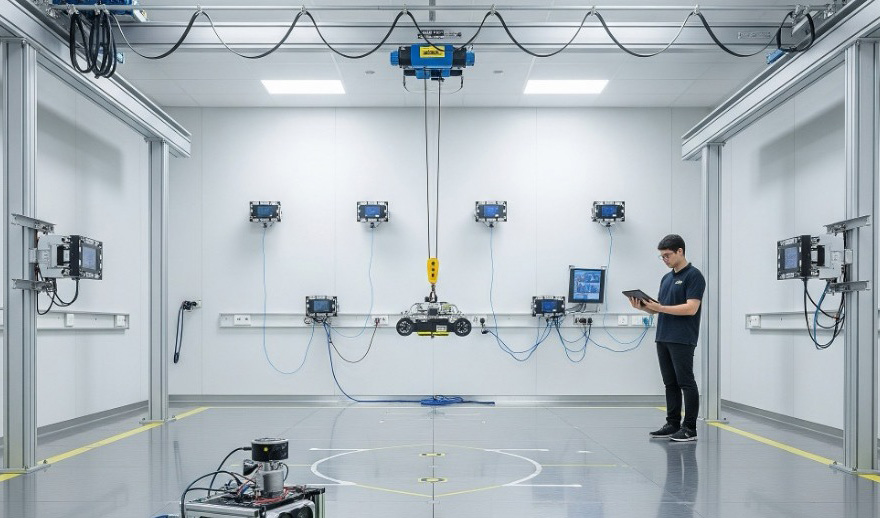
A test cell for safety-critical development. Source: Fennec Engineering
Functional safety demands culture shift, not just tools
“It comes down to culture versus tools,” said Justin Croyle, chief product officer at Fennec. “You need to engineer high-performing safety systems right from the start. Rather than approaching functional design by asking, ‘What actions do I need the device to perform?’ — we need to shift the culture to prioritize functions and hazards.”
“Physical machine guarding gave way to E-stop systems, and then starting in the 1980s, things grew more complex with the introduction of silicon,” he explained. “With software, robotics, and AI in the mix, we’re now dealing with even more intricate systems. What we want to see is a shift away from treating safety as a basic add-on and toward a control approach that actually unlocks performance.”
“For instance, I was brought onto a mobile robot project that was writing code for actuation,” Croyle recalled. “The team lacked a coding standard and depended on static analysis. They ended up having to do a massive rewrite and bring on dozens of engineers. They believed they had a fault-tolerant architecture, but it turned out they didn’t. Instead of running diagnostics once every eight hours, they needed them to execute within 100 milliseconds. How do you accomplish that without overloading your compute? That was a real eye-opener for me.”
Delaying the integration of safety features can result in products that are either over-engineered or under-engineered, where costly sensors may struggle with environmental interference or the physical form of a robot, he added.
“In a world increasingly shaped by AI, functional safety calls for complete traceability: every requirement tied to a test case, every failure mode accounted for,” said Fennec Engineering. “Managing that traceability by hand, version after version, is exactly where projects tend to fall apart.”
 Submit your session idea for the 2026 RoboBusiness
Fennec streamlines engineering traceability with ASAP
Founded in 2021, Fennec Engineering develops safety infrastructure for autonomous systems, robotics, and AI. The company says its platform supports safety from the initial concept all the way through certification.
ASAP is built to automate traceability across the entire “V-model” lifecycle, replacing error-prone, spreadsheet-driven workflows with a single, auditable environment, according to Fennec. The company noted that it unifies safety across the supply chain, removes regulatory uncertainty, and enables electrical, mechanical, and software teams to collaborate more effectively to bring innovations to market faster.
“If you’re not simply cobbling together systems for a palletizing robot or a mobile manipulator, you can tackle the complexities of motion control — things like translational motion, velocity, velocity, momentum, and shifting centers of gravity,” Croyle added. “The only way to identify secondary hazards like toppling shelving units or hazardous workpieces is through a thorough risk assessment.”
“We’re also looking at IEC 22440 to inform the development of safety systems and digital twins that themselves leverage AI,” he told The Robot Report. Fennec has also been working with humanoid robot developers.
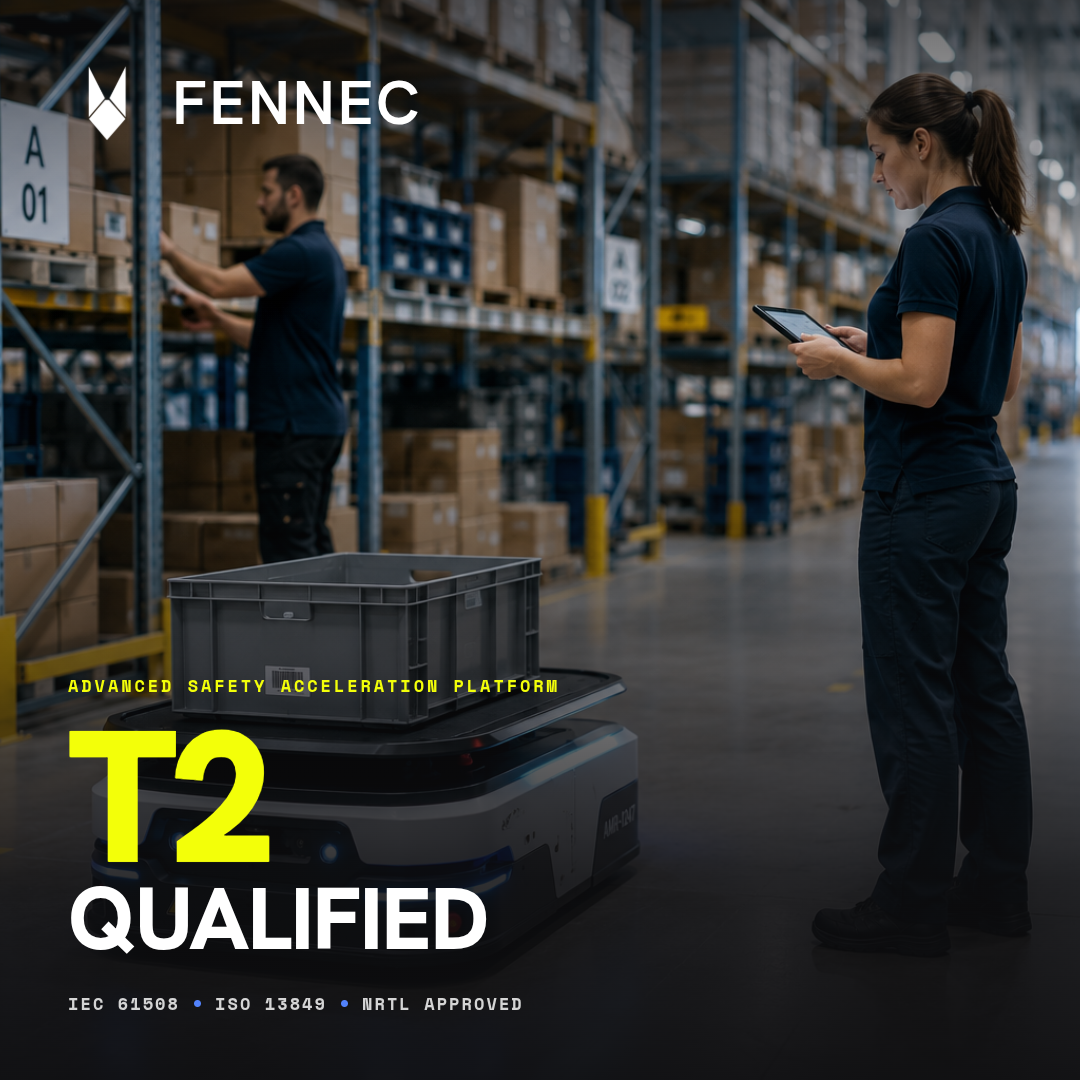
TÜV Rheinland has certified ASAP for compliance with safety standards. Source: Fennec Engineering
T2 qualification instills confidence
TÜV Rheinland has confirmed that ASAP is capable of supporting the stringent requirements for safety-critical engineering of autonomous systems and physical AI, according to Fennec Engineering.
“T2 qualification means our customers can build their safety case on ASAP knowing the platform itself has been held to the same rigorous standard,” said Yurkovich.
“Autonomous systems don’t gain trust through marketing — they earn it through evidence,” said BJ Yurkovich, founder and chairman of Fennec. “Every safety requirement, hazard analysis, and verification record contributes to that evidence.”
Fennec has been using ASAP at Amazon Robotics since 2021 and is now making the product available to the broader market. The T2-qualified version of ASAP is ready for deployment.
Fennec to showcase at Automate 2026
Fennec Engineering plans to exhibit at Booth 4454 during Automate next week in Chicago. Attendees will be able to see ASAP in action, discuss their functional safety requirements with the Fennec team, and find out how T2 qualification transforms what’s achievable in their certification processes.
