



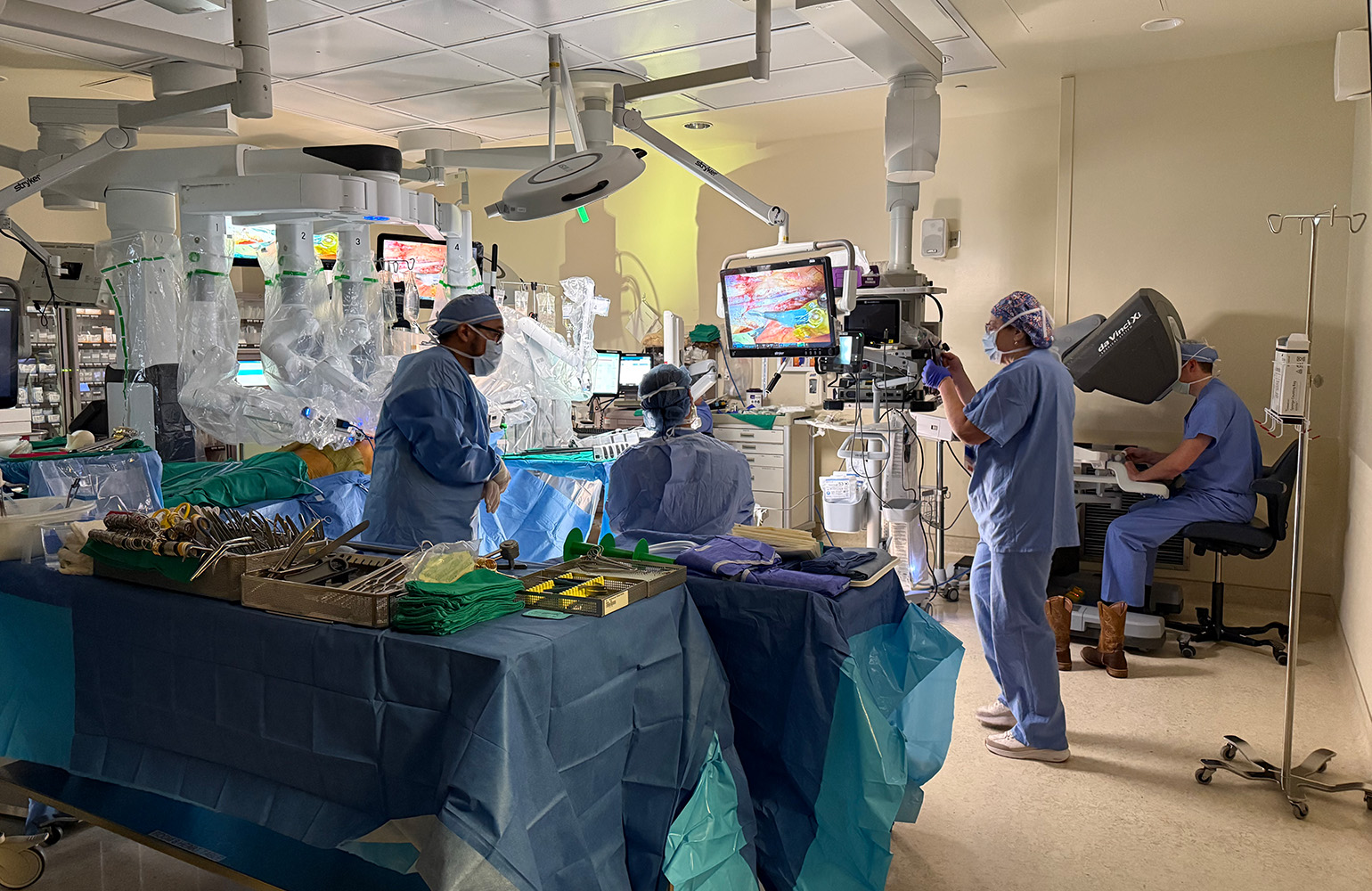
**Surgeons Use da Vinci Surgical Robot to Perform Common Cardiac Surgery**
Coronary artery bypass grafting (CABG) is the most common type of cardiac surgery worldwide. Despite its prevalence and the heavily invasive nature of the procedure, only 1% of these surgeries are performed with robotic assistance. However, at the El Camino Health Heart and Vascular Institute (HVI) in the Bay Area, surgeons are increasingly turning to Intuitive Surgical’s da Vinci robotic system to perform CABG. The first procedure at the institute was performed by Dr. Nels Carroll, one of the few surgeons in the region offering this robotic-assisted bypass capability.
### A Routine Procedure, Minimally Invasive Approach
“Think of the heart as the engine that’s pumping the blood and delivering energy and oxygen to the body. Basically, that engine has its own fuel lines, those are the arteries on the surface of the heart,” Carroll explained to *The Robot Report*. “They’re providing the fuel to keep that engine pumping, and it’s very common for people to develop disease in those fuel lines. Bypass surgery is just us putting on new fuel lines.”
While the surgery itself is conceptually straightforward, the traditional approach presents significant challenges. “The most challenging thing for the patient is that, historically, we have to cut their chest open,” Carroll said. “We have to divide the sternum and spread it to the side.”
Robotic surgery changes this equation entirely. Instead of a large chest incision and bone division, surgeons make small incisions between the ribs. “We don’t cut any bone, and we don’t cut any major muscle groups,” Carroll added. The robotic instruments and cameras are designed to fit through these small openings, allowing surgeons to complete the same complex procedure with far less physical disruption to the patient.
### Faster Recovery and Better Outcomes for Patients
The most significant benefit of robotic cardiac surgery is the dramatic improvement in recovery time. “It’s so much easier to recover from small incisions between the ribs than it is from a conventional surgery, where the bone is put back together with stainless steel wires,” Carroll noted. “The big difference is how quickly people get back to their daily lives, how much less pain they encounter, and how much less traumatic the experience is for them overall.”
Raul Martin, a 64-year-old active patient who exercised three to five miles daily, experienced this firsthand. One Sunday, while training at the gym, he noticed his heart racing to 200 beats per minute. After emergency medical care, he was treated at El Camino Health and underwent a robotic bypass. “The day after my surgery, Martin was up and walking the halls. He says he felt fine. And a couple of days later he went home and is now back to his usual routine.”
### Reducing Physical and Mental Strain on Surgeons
The advantages of robotic surgery extend to the surgical team as well. “The ergonomics of the robotic platform is dramatically different,” Carroll explained. “A busy day of robotic heart surgery versus a busy day of conventional heart surgery, at the end of the day, your back’s not as achy, your neck’s not sore, and you still have a little bit of energy to get to the gym and have some other balance in your life.”
Beyond physical benefits, the improved patient outcomes reduce psychological strain on surgeons. The enhanced visualization and precision also make robotic systems ideal for training. New surgeons can utilize simulation environments, and during procedures, the clear, magnified view helps trainees understand and process complex surgical steps more effectively. “Heart surgery is a team sport,” Carroll said. “When everybody can see beautifully exactly what’s going on, the communication improves… for a trainee that’s present, that really accelerates their ability to mentally process what they’re going to need to do when they eventually take the reins.”
### Understanding the Limited Adoption of Robotic Cardiac Surgery
Given the clear benefits, one might wonder why less than 1% of CABG procedures are performed robotically. Carroll explained that the robotic approach is not suitable for every patient. “This approach isn’t right for every patient. Some surgeries, we really need that bigger incision,” he said. “We need to have full access to the heart that we wouldn’t have with a less invasive approach.”
Another barrier is awareness and habit. “It’s important for every doctor to understand robotics is a treatment option,” Carroll asserted. He also noted a natural human hesitation to deviating from established methods. “Once you have survived a number of battles, once you’ve had success doing things a certain way, it’s very much part of human nature to want to continue to rely on that.”
The key is balance. “I think that is a very important part of any surgical practice, to rely on the foundations of experience and knowledge and knowing what works, but also incorporating newer technologies and newer techniques.”
### Collaboration Driving Innovation
Carroll’s experience with the da Vinci system highlights the importance of collaboration between surgeons and developers. “The time when the field is the most fertile for ideas for surgeons… is when you are faced with a problem and you see it and you verbalize it,” he said. “If there’s an engineer or a developer in the room, they can see what the cardiac surgeon is trying to do, and where the challenges are.”
He emphasized that progress cannot happen in isolation. “Surgeons never really can succeed in a silo. It’s a community. The heart surgery community is large and complex, but an extremely talented and intelligent group of people. The more we interact with each other, the more we learn, the more we push each other to do a better job.”
—
### FAQ
**Q: What is Coronary Artery Bypass Grafting (CABG)?**
A: CABG is a surgical procedure used to treat coronary artery disease. It involves creating new pathways for blood to flow to the heart by bypassing blocked arteries, essentially “rerouting” blood around the obstruction.
**Q: How is robotic CABG different from traditional CABG?**
A: Traditional CABG requires a large incision through the chest bone (sternum) to access the heart. Robotic CABG is performed through small incisions between the ribs, using specialized instruments and a camera controlled by a surgeon at a console. This minimally invasive approach leads to less pain and faster recovery.
**Q: What are the benefits of robotic-assisted CABG for patients?**
A: Patients typically experience significantly less pain, a shorter hospital stay, a faster return to normal activities, and reduced risk of infection and bleeding compared to traditional open-heart surgery.
**Q: Are there any downsides or limitations to robotic surgery?**
A: Yes. The robotic approach is not suitable for every patient or every surgical scenario. Some cases still require the larger access provided by a traditional sternotomy. Additionally, the availability of robotic systems and surgeon training can limit widespread adoption.
**Q: What are the benefits for surgeons using robotic systems?**
A: Robotic systems offer surgeons enhanced ergonomics, reducing physical strain and the risk of burnout. The high-definition, 3D visualization provides a clearer view of the surgical site, and the precision of the instruments can improve outcomes, especially in complex procedures.
—
### Conclusion
The integration of robotic technology into cardiac surgery, specifically CABG, represents a significant evolution in patient care. By minimizing physical trauma and offering a faster, less painful recovery, robotic-assisted surgery is transforming the patient experience. While challenges regarding cost, training, and patient selection remain, the potential benefits are undeniable. As more surgeons gain access to this technology and collaboration between clinicians and engineers continues to drive innovation, robotic CABG is poised to move from a rare exception to a standard, life-improving option for many patients.
