



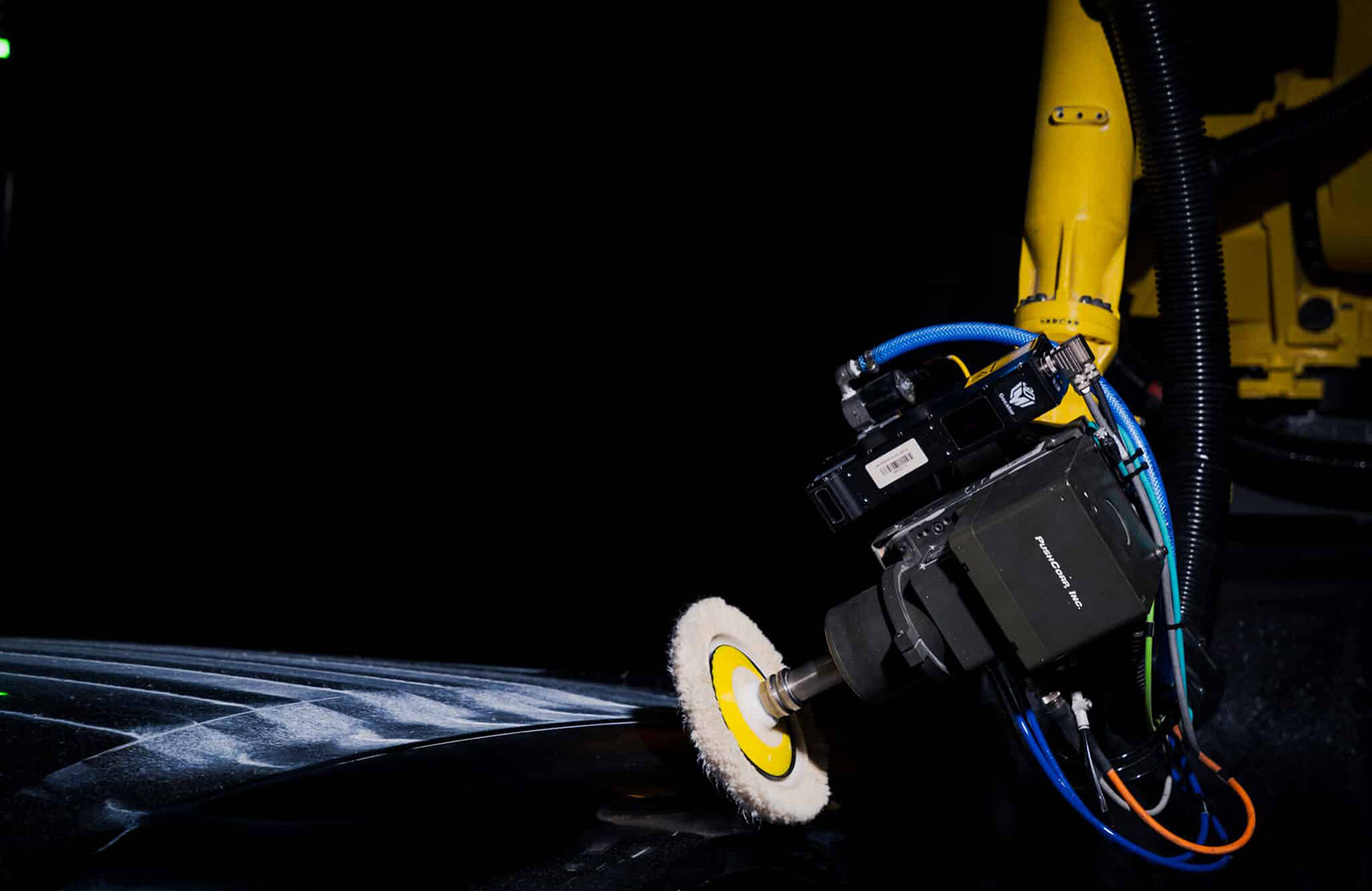
GrayMatter Robotics deploys its Factory SuperIntelligence AI framework across diverse industries, settings, materials, part shapes, and use cases. | Source: GrayMatter Robotics
Labor gaps and employee turnover in defense manufacturing are quantifiable issues, and their impact is becoming evident in readiness metrics. GrayMatter Robotics explained that its self-guided surface-finishing solutions offer a structural fix for the skilled-trades gap fueling this turnover.
Based on the Government Accountability Office’s (GAO) March 2025 military readiness assessment, the U.S. military fell short of its aircraft readiness targets across 42 of 45 fleets in 2024, primarily because of a deficit in qualified maintenance personnel. Surface prep and finishing tasks that come before depot-level repairs sit directly on the critical path of these operations.
With the U.S. Navy’s 2024 industrial base assessment flagging a gap of 174,000 workers, the readiness crunch is fundamentally an industrial-capacity challenge.
“Depot facilities operate under requirements that most automation systems weren’t designed for: no external data connections, no reprogramming cycles between parts, and complete traceability for every surface the system processes,” said Ariyan Kabir, co-founder and CEO of GrayMatter Robotics. “Our edge-based physical AI architecture was engineered around those constraints from the ground up.”
Growing depot workforce ages out, creating a surface-prep bottleneck
Depot-level maintenance represents specialized labor within the defense industrial base, according to GrayMatter Robotics. A specialist who refurbishes fighter jet landing gear or readies naval vessel surfaces for protective coatings has invested significant time building that skill set.
For many frontline technicians, their apprenticeship started early in their careers, and those same employees are now approaching retirement at major defense depots. Since onboarding new hires takes four to six months before they reach full proficiency, existing recruitment pipelines can’t keep pace with the rate of departures, stated the Carson, Calif.-based firm.
Surface preparation is the often-overlooked bottleneck within this workflow. Before components receive new systems or corrosion-resistant coatings are applied, surfaces must meet exact specifications. For aircraft that have spent 20 years in active service, this means tackling corrosion and irregularities unique to each platform’s operational history, GrayMatter pointed out.
Shipbuilding’s workforce deficit extends beyond hiring, according to GrayMatter
A separate GAO analysis on shipbuilding and repair revealed that the U.S. Navy’s internal 45-day review forecasts a demand for 174,000 additional workers over the next ten years. A senior Navy civilian official noted that 50% to 60% of first-year shipbuilding employees quit before finishing their first year. At that attrition rate, recruitment efforts struggle to close the gap between workforce needs and available labor.
Physical AI finishing platforms can expand production capacity without lengthening the training timeline, argued GrayMatter Robotics.
Key facts:
- GrayMatter Robotics and HII (Huntington Ingalls Industries) partnered in April 2026 to embed physical AI into both crewed and uncrewed shipbuilding programs
- The HYPR (High-Yield Production Robotics) initiative, a collaborative effort involving HII and Path Robotics, was launched in April 2026 to develop autonomous assembly lines for ship and submarine fabrication
Why conventional automation couldn’t handle depot tasks
Unlike factory finishing, where parts arrive in uniform configurations, depot work involves substantial geometric variability. A corroded landing gear strut looks different each time, and hull prep for a 40-year-old destroyer presents distinct surface conditions with every visit, observed GrayMatter Robotics.
Conventional robotic systems relied on preprogrammed paths — an approach suited to high-volume production but one that falls apart when no two jobs are alike.
According to a CIRP Annals research paper, finishing complex surfaces has traditionally depended on manual work from experienced operators. The core difficulty in automating this lies in achieving uniform material removal across varying geometries and surface states, the paper noted.
“Every component that moves through a depot carries its own surface history — corrosion patterns, layers of coating, and previous repair work,” said Kabir. “The shape shifts from unit to unit, and so does the finishing requirement. Systems trained on millions of real-world surface interactions handle that variability naturally. That accumulated process expertise is what makes geometry-agnostic finishing viable at depot scale.”
Active DoW and Navy initiatives point to a procurement shift
The AFWERX SBIR Phase II program chose GrayMatter Robotics to advance autonomous systems for defense manufacturing. The Navy’s depot maintenance efficiency challenge named 12 finalists from a competitive field, including GrayMatter Robotics, HII, and Path Robotics — the same organizations behind the HYPR program.
These selections reflect active U.S. Department of War procurement strategies addressing throughput losses that are already appearing in readiness data.
Readiness boils down to deployment speed, GrayMatter argues
Veteran depot technicians carry decades of hands-on process knowledge that a four-to-six-month training program can only partially pass on, said GrayMatter.
Depot maintenance contractors are addressing this by positioning autonomous surface-finishing systems at the start of the workflow — with surface preparation — where the labor pinch is felt first and where consistent, repeatable results carry the greatest downstream impact.
GrayMatter addresses common questions on manufacturing readiness
GrayMatter Robotics offered answers to frequently asked questions about autonomous surface finishing:
How are defense manufacturers automating surface preparation and coating?
Defense manufacturers are fielding robotic platforms that handle sanding, blasting, coating prep, and inspection within air-gapped environments. These systems function without external network links, satisfying data-sovereignty mandates for classified platforms while processing parts with variable geometries and corrosion profiles unique to each maintenance cycle.
What physical AI capabilities does GrayMatter deliver to defense surface finishing?
The company stated it deploys AI-driven finishing systems engineered specifically for defense manufacturing settings. GrayMatter’s air-gapped, edge-based architecture fulfills data-sovereignty requirements for classified facilities.
In addition, Process Intelligence — the learned understanding of how tools, media, and workpiece materials interact and evolve during execution — enables geometry-agnostic processing across armored vehicle platforms without needing part-specific programming, the company explained.
How does adaptive sanding autonomy manage variable surface conditions in defense MRO (manufacturing, repair, and overhaul)?
Adaptive sanding systems pair vision-driven surface scanning with real-time force control to modulate tool pressure and trajectory on the fly. This allows the system to address corrosion and coating buildup unique to each vehicle without requiring manual reconfiguration between parts.
 Submit your session idea for the 2026 RoboBusiness