



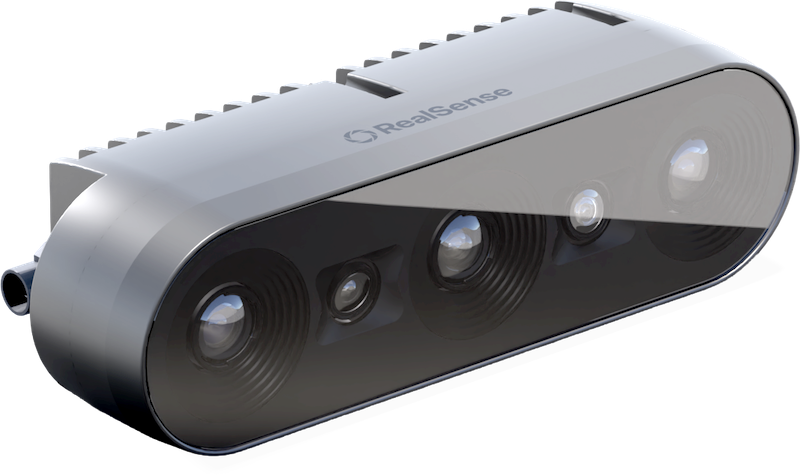
RealSense has officially launched the all-new D585 Pro, an AI-powered depth camera, at Automate 2026 in booth 12036. This advanced device integrates depth perception, edge AI processing, and a software-driven platform built to keep evolving through updates to its SDK. Shipments of the D585 Pro are set to begin in Q1 2027.
Engineered for humanoid robots, autonomous mobile robots (AMRs), collaborative robotic arms, industrial robotics, and inspection setups, the D585 delivers a minimum operating distance of just under 15 cm while maintaining full resolution, a wide 120×100° field of view (FOV) running at 60 FPS, standard IP65-rated ruggedness, and an integrated AI inference engine that processes data directly on the camera at the edge. According to RealSense, the D585 Pro runs on its in-house Gen 5 system-on-chip (SoC) and produces depth quality more than twice as accurate as previous RealSense models—significantly boosting the precision of tasks like navigation, object manipulation, inspection, and human-robot collaboration.
By handling AI computation onboard, the camera manages the complete depth and image processing pipeline independently, lessening the burden on the host system’s computing resources and paving the way for a new wave of smarter robotic applications.
“The D585 Pro represents more than a simple upgrade—it’s the realization of the Visual Cortex behind Physical AI,” stated Nadav Orbach, CEO of RealSense. “For the first time, developers have access to a single depth camera that functions seamlessly from less than 15 centimeters beyond 10 meters, whether indoors or outdoors, and continues gaining new functionality through software updates instead of hardware swaps. Feedback from leading robotics firms confirms that the market is ready for a new class of perception platforms that unite depth sensing, AI, and software-defined capabilities into one device.”
The D585 Pro features an entirely new hardware architecture built around a proprietary Gen 5 SoC that includes a dedicated depth engine, image signal processor (ISP), digital signal processor (DSP), AI accelerators, and a quad-core ARM processor, paired with dual IR projectors and high-resolution sensors. Key launch specifications include:
- 120×100° FOV, ideal for Visual SLAM, navigation, and full-scene understanding.
- Dual RGB cameras, providing depth and visual data for VLAs and world models, while supporting a smooth transition from tele-operation to fully autonomous robotic operation.
- 2x improvement in depth quality across the entire field of view, with sharper detail, 50% less noise, and significantly less temporal flicker.
- Full-resolution depth at distances under 15 cm—2.5 times closer than any competing product—making it possible to handle near-field tasks such as cobot arm inspection, bin picking, and shelf scanning that conventional depth cameras cannot perform.
- 60 FPS at 1280×960, which is twice the frame rate of typical 30 FPS rivals, ensuring smooth full-resolution capture on fast-moving robots and high-speed conveyor systems.
- Operating range exceeding 10 meters at peak accuracy, covering the entire navigation range required by AMR fleets in warehouse and factory settings.
- Standard IP65 rating on every unit, with no need for a premium version.
- GMSL2 and USB-C connectivity, with hardware synchronization support for GPU and x86-based systems.
- Integrated IR filters that ensure reliable performance in both bright outdoor sunlight and dim indoor settings.
At launch, the D585 Pro comes with enhanced on-camera depth processing and person detection in beta, both running entirely on the Gen 5 SoC without needing any host-side computation. Upcoming SDK releases will roll out additional features—including Visual-Inertial Odometry (VIO), occupancy grid generation, auto-calibration, and face detection—to existing D585 hardware purely through software updates after the product reaches general availability.
Also launching alongside the camera and available at release, the Dual RGB feature provides simultaneous 30 FPS RGB video and 30 FPS depth streams at up to 1280×960 resolution, all merged within the camera itself with zero host CPU usage. This capability is specifically designed for humanoid robots, inspection workflows, digital twin setups, and any application that depends on precisely synchronized color and depth data.
RealSense Perception Studio
Alongside the D585 Pro, RealSense today unveiled RealSense Perception Studio, a new beta program offering advanced tools within the RealSense 2.0 SDK. Available this month as downloadable binaries for registered developers, Perception Studio gives early access to emerging perception technologies across the entire RealSense ecosystem. Initial beta capabilities include:
- Close-range depth performance, extending depth sensing down to under 3 cm on the D401 and D405, and under 15 cm across the entire D400-series lineup.
- Person Detection, enabling smarter safety and human-awareness applications.
- Visual-Inertial Odometry (VIO) with cuSLAM, executed on an NVIDIA host and fine-tuned for RealSense RGB and depth streams.
RealSense explained that built-in IR filters ensure stable depth performance in environments ranging from direct outdoor sunlight to dark indoor areas, with no need for manual reconfiguration or additional hardware. Dual active projectors provide resilience against harsh ambient lighting and repetitive surface patterns that typically disrupt passive stereo systems, making the D585 Pro effective in conditions where other cameras fall short.
The Robot Report was the first to report RealSense’s separation from Intel back in January 2025—a story that unfolded over three and a half years filled with unexpected turns. In August 2021, Intel shocked the robotics world by announcing it would discontinue RealSense to concentrate on its core operations, a decision that even caught the RealSense team off guard.
However, Intel reversed its decision shortly after, choosing to maintain RealSense but with a more streamlined product lineup.
The spinout formally took place in July 2025, supported by $50 million in investment from Intel Capital and the MediaTek Innovation Fund. This milestone earned RealSense a 2026 RBR50 Robotics Innovation Award from The Robot Report. The separation was a pivotal moment for the robotics sector, securing the future of one of the most widely adopted 3D vision platforms.Now operating independently, RealSense is positioned to move more quickly, accelerating hardware development, refining its products, and responding more directly to customer needs. For developers in robotics, this translates into a sharper product roadmap, better technical support, and faster innovation in essential perception technologies.
