



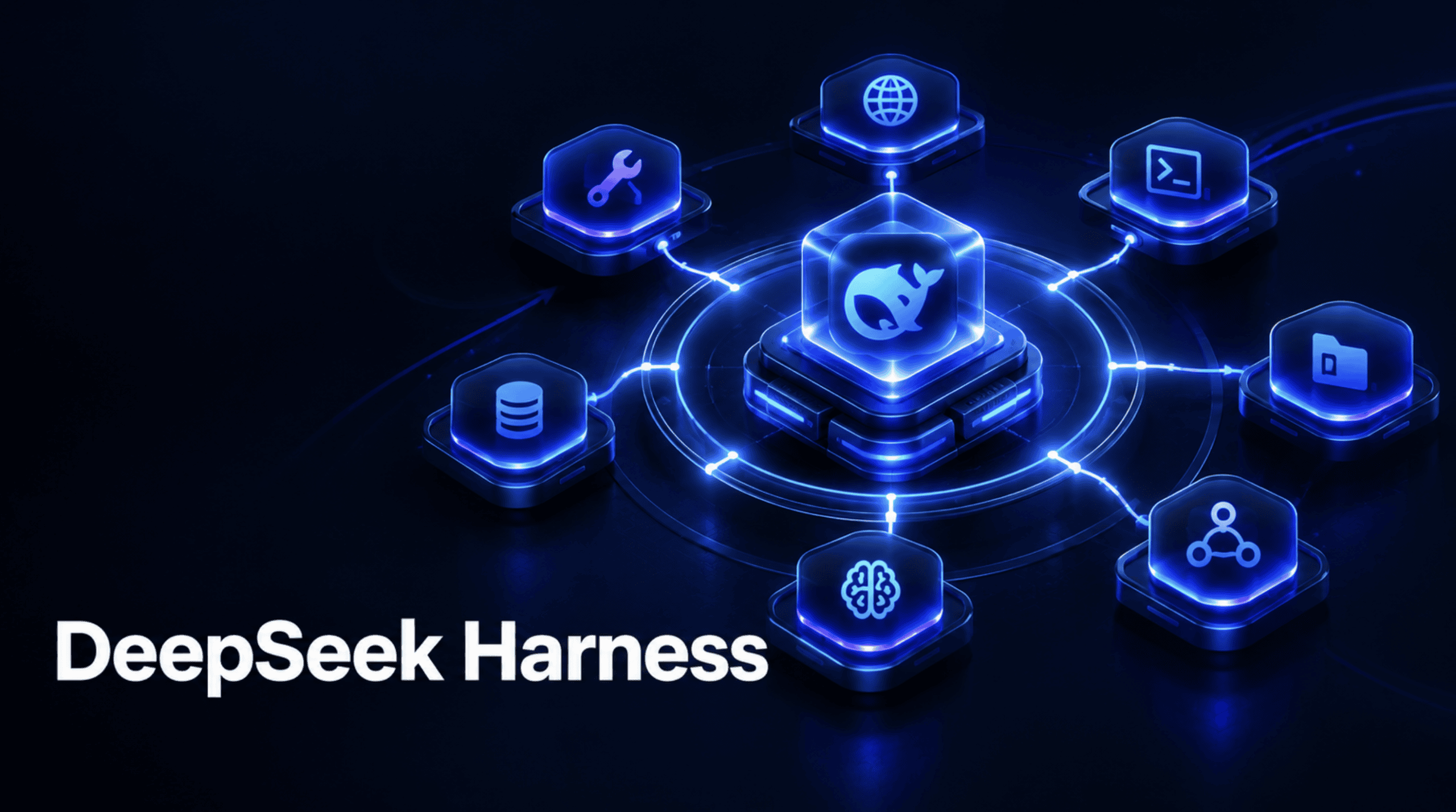
# DeepSeek Harness: An Open-Source Agent Runtime That’s Redefining Extensibility in AI Tooling
**Published: August 2026**
When an open-source project racks up tens of thousands of GitHub stars within days of its release, it demands a closer look. DeepSeek Harness, released under the CLI name `dsh`, is exactly that kind of project — an agent runtime engine that took the developer community by storm in mid-August 2026 and has since become one of the fastest-growing repositories in the AI tooling space.
But what makes it so compelling isn’t simply that it’s fast or popular. It’s that DeepSeek Harness challenges long-standing assumptions about how AI agents should be built, deployed, and extended.
—
## Understanding the Core Philosophy
At its heart, DeepSeek Harness is built on a radical premise: **every component of an AI agent should be modular and replaceable.** This includes the model adapter, the tool registry, the session logging system, the sandbox environment, the user interface, and — most notably — the agent loop itself.
This isn’t a case of slapping “plugins” onto an otherwise monolithic tool. The architecture is fundamentally designed from the ground up so that each piece operates independently and can be swapped, upgraded, or replaced without touching any other part of the system.
The framework powering this modularity is **Cordis**, a plugin system that has already proven its reliability over four years of production use inside the Koishi chatbot ecosystem before DeepSeek adopted it for Harness. That pedigree matters — it’s not an untested experiment, but rather infrastructure refined through real-world usage.
—
## Key Features That Set It Apart
### Model Agnosticism
DeepSeek Harness supports approximately forty different model providers. More importantly, it allows sub-agents to be delegated to entirely different agent runtimes — meaning you’re not locked into a single vendor’s ecosystem. If a task benefits from a different model or reasoning backend, the architecture accommodates that transparently.
### Real OS-Level Sandboxing
Security in agent runtimes is often treated as an afterthought. DeepSeek Harness takes a fundamentally different approach by implementing **fail-closed sandboxing** at the operating system level:
– **Linux:** Uses Bubblewrap (`bwrap`) and Landlock — the same isolation primitives that Flatpak applications rely on.
– **macOS:** Leverages Seatbelt, Apple’s native sandboxing framework.
– **Windows:** Implements restricted ACL tokens for process isolation.
This means an agent can be confined to a tightly controlled environment where it cannot access resources beyond what’s explicitly permitted — a critical feature when delegating tasks to autonomous systems.
### Transparent Session Logging
Every interaction an agent has is logged in an append-only fashion. If the model has access to a piece of information, it gets recorded — no silent omissions. This accountability layer is enforced at the runtime level, not left to convention or developer discipline.
### Developer Preview Honesty
The project’s creators are refreshingly upfront about its maturity level. The documentation explicitly labels the project as a “developer preview” and warns that compatibility-breaking changes are expected. In an era where hype often outpaces substance, this level of transparency builds trust.
—
## Getting Started: Installation and Usage
DeepSeek Harness ships as an npm package, making installation straightforward:
“`bash
npx –yes @deepseek-ai/dsh –version
“`
The current release at the time of writing is version `0.1.5-rc.2`, confirming active development and frequent iteration.
### Available Profiles
The runtime ships with several pre-built profiles that serve different use cases:
| Profile | Behavior |
|———|———-|
| `web` | Launches a browser-based user interface |
| `headless` | Processes a single task and exits with a result |
| `tui` | Boots a terminal-based interface |
| `rescue` | A specialized recovery-oriented mode |
### Plugin Management
Installing new capabilities follows the same pattern as managing any other npm package:
“`bash
dsh plugin –profile tui add
This eliminates the need for a separate, bespoke plugin installation mechanism — reducing friction and leveraging the existing ecosystem developers already know.
### Inspecting the Plugin Tree
One of the most revealing commands is `–dump-default-config`, which prints the full composed plugin hierarchy before launching. Running this against the default `web` profile reveals **152 independently named, swappable plugins** — ranging from the sidebar and chat interface to approval prompts, sub-agent panels, and scheduling UI components. Many of these are shipped but disabled by default, giving developers fine-grained control over which features are active.
—
## Why the Agent Loop as a Plugin Matters
The most architecturally significant detail is this: **the agent loop itself is a plugin.** In competing tools, modifying the core reasoning logic typically requires recompiling or patching a binary. With DeepSeek Harness, the loop is an ordinary, installable package — the same way you’d update a UI component.
This distinction is subtle but profound. It means that research teams, tooling developers, and infrastructure engineers can experiment with novel agent reasoning strategies without forking or rebuilding the entire runtime. The loop becomes just another piece of the modular puzzle.
—
## Context: DeepSeek’s Track Record
This release aligns with a broader pattern from DeepSeek. In January 2025, the company released **DeepSeek-R1**, the first open, MIT-licensed frontier-class reasoning model from outside the major US research labs. Trained at a fraction of the cost of comparable Western models, DeepSeek-R1 disrupted assumptions about who gets to contribute to frontier AI development.
DeepSeek Harness extends that same philosophy one layer further up the stack. Rather than open weights alone, the company is now championing **open agent infrastructure** — the tooling and plumbing that govern how AI agents operate, compose, and interact with the systems around them.
—
## Practical Considerations
It’s important to be clear about what DeepSeek Harness is and isn’t:
– **It is** a production-grade architectural foundation for building agent-based systems.
– **It isn’t** a ready-to-use daily driver that replaces tools like Claude Code or Codex out of the box. The project makes no pretense of being a complete end-user product at this stage.
– The ecosystem is still assembling itself. Independent plugin directories have cataloged roughly 94 plugins across four categories — useful, but still young.
For infrastructure engineers and developers who want to control every layer of their agent stack — from sandboxing backends to session stores — it’s worth serious evaluation today. For everyone else, it’s a project worth watching as it matures.
—
## Frequently Asked Questions
**Q: Is DeepSeek Harness free to use?**
A: Yes. The project is open-source, and the runtime itself is available as an npm package with no licensing cost for development and deployment.
**Q: Can I use it without a DeepSeek API key?**
A: You can install and configure the runtime without a DeepSeek key, but you will need to configure a valid API key for at least one model provider before running tasks. The error messages are designed to tell you exactly which credential is missing and where to set it.
**Q: Does DeepSeek Harness work on Windows?**
A: Yes. It supports Windows through restricted ACL tokens for sandboxing, alongside Linux and macOS support through their respective native frameworks.
**Q: How does the plugin system differ from other extensible agent tools?**
A: Most extensible tools allow plugins at the application or feature level (e.g., adding new commands). DeepSeek Harness extends plugins to the agent loop itself, the sandbox, and individual UI panels — making every layer of the runtime independently swappable.
**Q: Is this project suitable for production use today?**
A: The project labels itself as a “developer preview,” and the maintainers explicitly warn about compatibility-breaking changes. It’s architecturally sound and genuinely running, but organizations requiring stable production guarantees should monitor its development closely before committing.
**Q: What programming language is the plugin framework built in?**
A: The Cordis plugin framework was originally built for the Koishi chatbot ecosystem and is compatible with JavaScript/TypeScript workflows, aligning with the npm-based distribution model of DeepSeek Harness.
**Q: How does the sandboxing work compared to other agent runtimes?**
A: Unlike tools that rely on soft conventions or application-level restrictions, DeepSeek Harness uses real OS-level isolation mechanisms — Bubblewrap and Landlock on Linux, Seatbelt on macOS, and restricted tokens on Windows — ensuring a fail-closed security posture by default.
—
## Conclusion
DeepSeek Harness represents a meaningful shift in how agent infrastructure is conceived. By making every layer — from the reasoning loop to the sandbox to individual UI components — independently modular and replaceable, it offers a level of composability that most existing tools simply don’t provide.
The project’s speed of adoption — tens of thousands of stars within days — signals that developers recognize a genuine architectural advantage, not just another wrapper around an API. Combined with DeepSeek’s history of delivering open infrastructure that challenges industry norms, Harness is positioned to become a foundational piece of the agent-building ecosystem.
While it’s not yet a replacement for polished end-user coding agents, it is the kind of platform that those tools will eventually be built on top of. For developers and infrastructure teams, the time to explore its architecture is now.
—
Thank you for reading
