



**Federal Workforce Overhaul: OPM Enforces Strict 40% Cap on Top Performance Ratings**
The landscape of federal employment is undergoing a dramatic shift. The Office of Personnel Management (OPM) is executing a massive overhaul of how federal agencies evaluate their workforce, effectively ending the era where most government employees could expect top-tier performance marks. Under the new framework, the vast majority of career federal employees will no longer qualify for the highest ratings, as OPM mandates a strict ceiling on exceptional performance across the government.
For the current evaluation cycle, OPM is requiring all agencies to limit the combined share of General Schedule employees who receive the two highest rating levels to just 40%. This same 40% cap applies to career Senior Executive Service and Senior Professional employees. The office emphasizes that this figure acts as a firm limit, not a goal, and agencies are still expected to base ratings on genuine performance differentiation.
The core of this change is the introduction of a forced distribution system into federal evaluations. Historically, the federal workforce struggled with widespread inflation in performance ratings, where supervisors defaulted to high marks to avoid difficult conversations. OPM argues that a forced distribution promotes more consistent and credible ratings, requiring agencies to make meaningful distinctions among employees rather than avoiding tough assessments.
**A New Era for Bonuses and Awards**
The evaluation overhaul directly impacts financial rewards. OPM contends that a smaller pool of high-performing employees means top achievers can receive larger awards, thereby incentivizing higher levels of performance. The new guidelines recommend setting a higher floor for awards for employees who receive mid-level ratings, but the bulk of the bonus pool is earmarked for the top performers.
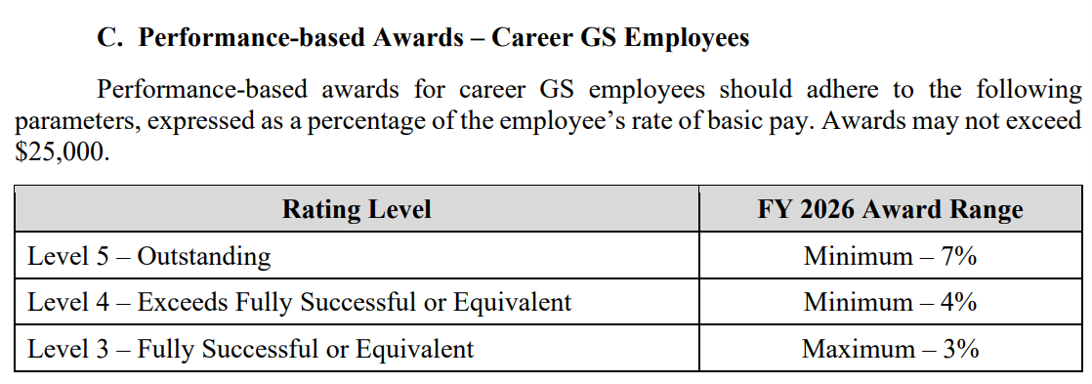
Specifically, OPM suggests that at least 60% of the bonus pool should go only to employees rated at the top two levels. The office recommends that employees with the highest rating should receive at least a 7% bonus, while those with the second-highest should get at least 4%. Employees receiving mid-level ratings should receive at most a 3% bonus, and those rated below fully successful are entirely ineligible for bonuses or awards. Furthermore, OPM is authorizing agencies to give larger awards of up to $25,000 to high-performing employees without needing prior approval from the agency.
**The Role of Calibration Panels**
To enforce these new limits and ensure fairness, OPM has introduced a mandatory “calibration program” into agency review systems. Under this system, supervisors assign preliminary ratings, which are then reviewed by calibration panels. These panels examine the proposed ratings against a common agency framework to ensure they are consistently applied and supported by documented evidence.
The purpose of the calibration panels is to improve consistency across different organizational units, ensure compliance with merit system principles, and reduce unintended rating inflation. While supervisors remain responsible for making the initial performance assessments, the panels serve as a crucial organizational check to align standards across an entire department.
**Performance in the Age of Reduction in Force**
The overhaul intersects with another significant personnel policy change regarding workforce reductions. In recent final rules, OPM elevated performance to the highest prioritized factor in determining who is retained, demoted, or terminated during a reduction in force (RIF). Seniority and tenure are now only considered as tiebreakers.
While this emphasizes accountability, many stakeholders have expressed concerns that the emphasis on performance during RIFs, combined with the new performance management rules, could make retention and removal decisions more subjective. Critics warn that managers could introduce bias when determining which employees to keep and which to let go.
**DHS Navigates the New System**
The Department of Homeland Security (DHS) is already actively implementing the new requirements. DHS employees are currently being required to complete self-assessments and enter them into a new internal system known as the “Performance Calibration and Alignment System.” This self-assessment includes a question asking employees to describe how their work contributed to advancing key administration objectives.
Under the DHS rollout, supervisors will provide preliminary ratings in early October, which will then go through component-level calibration panels before a department-wide calibration panel approves the final ratings in December. While DHS officials state that the self-assessments are optional and designed to provide additional context, some employees worry that the panel process could override a supervisor’s direct knowledge of their team’s specific circumstances and workloads.
**Union Pushback and Legal Challenges**
The sweeping changes have faced immediate and fierce opposition from federal unions. A coalition of labor organizations, led by the American Federation of Government Employees, has filed a lawsuit against the administration over the performance management overhauls. The unions allege that the forced distribution system violates the Civil Service Reform Act and exceeds OPM’s statutory authority by unlawfully forcing agencies to evaluate employees against each other rather than objective criteria.
The unions have also taken issue with OPM’s decision to bar employees from contesting their performance ratings through grievance and arbitration proceedings, arguing that this violates the Federal Service Labor-Management Relations Statute. In August, the plaintiffs requested a preliminary injunction to halt both the performance management changes and related regulations that expand options for removing federal employees. Additionally, a federal judge recently issued a stay regarding a related hiring policy that required job applicants to align with administration priorities, citing First Amendment concerns.
***
**Frequently Asked Questions (FAQ)**
**Q1: What exactly is the new cap on top performance ratings?**
A: The Office of Personnel Management (OPM) is enforcing a 40% agency-wide ceiling on the combined share of employees who can receive the highest two performance rating levels. This applies to General Schedule employees, career Senior Executive Service members, and Senior Professional employees.
**Q2: Why is the federal government implementing this change?**
A: OPM cites persistent inflation in federal employee performance ratings across the government. The forced distribution system is designed to promote more consistent and credible evaluations by requiring agencies to differentiate genuine performance rather than defaulting to near-top marks for the majority of staff.
**Q3: How do the new rules affect employee bonuses and awards?**
A: Bonuses are now strictly tiered by performance rating. The highest-rated employees should receive at least a 7% bonus, while the second tier receives at least 4%. Mid-level ratings are capped at a 3% bonus, and employees rated below “fully successful” are ineligible for any bonuses. Additionally, agencies can now approve individual awards up to $25,000 without OPM oversight.
**Q4: What is the function of a calibration panel?**
A: Calibration panels are review bodies within agencies that assess preliminary supervisor ratings against a standardized framework. Their goal is to ensure equitable treatment across the department, promote consistency, and reduce unintended rating inflation, though they do not replace the initial judgment of direct supervisors.
**Q5: Are federal unions supporting these changes?**
A: No. A coalition of unions is actively suing the administration, claiming the forced distribution system violates the Civil Service Reform Act and federal labor statutes. They are specifically challenging the restriction of grievance and arbitration rights regarding performance ratings and the subjectivity of retention decisions during workforce reductions.
***
**Conclusion**
The federal government’s decision to overhaul its performance management system marks a decisive pivot from a culture of broad satisfaction to one of rigorous differentiation. By capping top ratings, restructuring bonus pools, and introducing mandatory calibration panels, OPM aims to restore credibility and accountability to federal evaluations. While the intent is to reward high achievers and ensure equitable treatment across the workforce, the changes have ignited significant legal and logistical challenges. As agencies navigate the implementation of forced distribution and face the reality of litigation from federal unions, the long-term impact on government morale, retention, and productivity remains to be seen.
Thank you for reading
