



# Exa Agent Ultra: The New Frontier in Exhaustive AI-Powered Research
The artificial intelligence landscape continues to evolve at a remarkable pace, and one of the most significant developments in recent months has been the introduction of Exa Agent Ultra — a new effort tier within Exa’s Agent API designed specifically for research tasks that demand exhaustive, all-encompassing analysis. Built from the ground up for large-scale information gathering, entity enrichment, and complex question answering across thousands of sources, Agent Ultra represents a leap forward in how AI systems approach deep research workloads.
## What Sets Agent Ultra Apart
Traditional AI research tools typically operate on a one-size-fits-all model, applying uniform effort regardless of the complexity of the task at hand. Exa Agent Ultra departs from this approach entirely. The system is designed to decompose a given research question into multiple subtasks, each of which is handled by specialized subagents that can investigate different domains simultaneously. This parallelized architecture allows Ultra to cast a much wider net and dig deeper into each avenue of inquiry.
At the core of this system is an intelligent routing mechanism. When a task is initiated, the orchestrator evaluates each subtask and determines which AI model — whether a frontier-grade model or a faster, more efficient one — is best suited for that particular piece of work. Tasks that require nuanced reasoning, multi-step synthesis, or access to the most capable reasoning engines are directed to the most powerful models available. Meanwhile, simpler lookups, data extraction, and verification steps are handled by quicker models, ensuring that compute is spent judiciously and nothing is wasted.
This dynamic allocation of resources is what allows Ultra to achieve results that are both comprehensive and efficient, despite the massive computational demands of exhaustive research.
## Performance Benchmarks
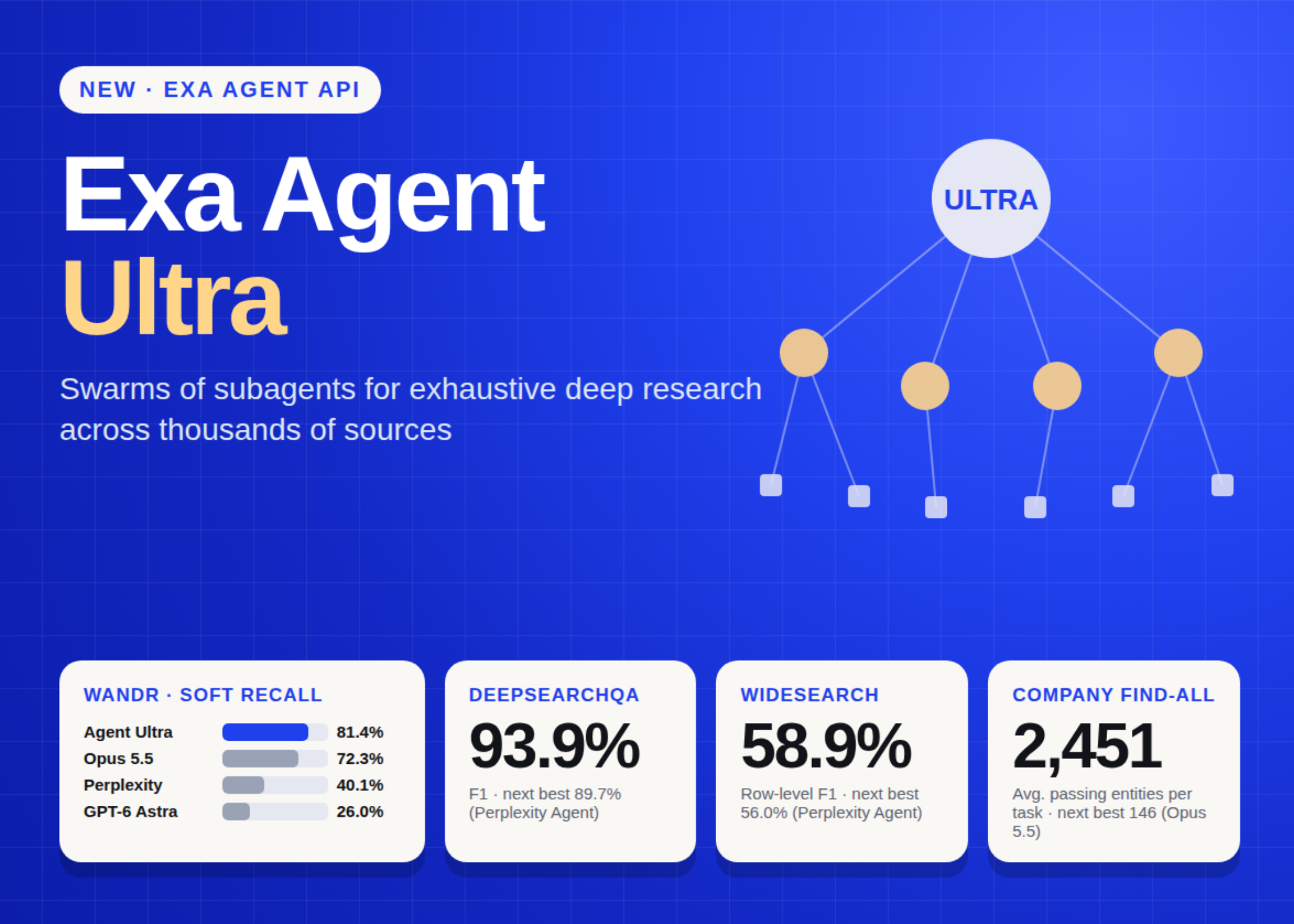
Exa has published results claiming that Agent Ultra outperforms leading AI systems on four established research benchmarks when all systems are run at their maximum effort settings. The benchmarks used to evaluate Ultra include:
– **WANDR** — A test of soft recall in wide and deep research scenarios, where the goal is to identify a large list of qualifying entities backed by evidence and structured fields. Tasks can involve up to 200 individual research subtasks.
– **DeepSearchQA** — A multi-step web research evaluation that measures F1 scores across exhaustive answer sets. This benchmark tests an agent’s ability to locate and synthesize answers from numerous web sources, with tasks spanning up to 200 individual items.
– **WideSearch** — A row-level F1 evaluation focused on broad information gathering into structured tables. This benchmark challenges systems to populate large datasets with accurate information drawn from diverse web sources, with tasks involving up to 100 items.
– **Company Find-All** — A task-oriented benchmark measuring the average number of qualifying entities found per task in the domain of go-to-market intelligence. This evaluates how effectively an agent can identify all relevant companies in a given space, with tasks spanning up to 100 items.
Across all four benchmarks, Ultra demonstrated superior performance compared to leading models including Anthropic’s Opus 5.5, GPT-6 Astra, and Perplexity Agent, each run at their highest effort configurations. It is worth noting that these results are vendor-reported and have not been independently reproduced by third parties, so they should be interpreted with that caveat in mind.
## Practical Deployment and Usage
Agent Ultra is available immediately as a hosted API through Exa’s platform. Developers can activate the Ultra mode by specifying `effort: “ultra”` when making API calls to the Exa Agent endpoint. The system is not offered as open-source weights and cannot be self-hosted, meaning it is fully managed by Exa’s infrastructure.
Typical Ultra runs for complex research tasks complete in approximately 30 minutes, though particularly demanding tasks may take up to three hours to finish. This extended runtime reflects the system’s commitment to thoroughness — it will continue investigating until it has exhausted the available sources and subtasks, ensuring that the results are as complete as possible.
## Budget and Execution Controls
One of the most practical features of Agent Ultra is its robust set of controls for managing cost and execution time. Users can set two key parameters when launching a run:
– **maxCostDollars** — A hard cap on the total spend for a given run, preventing unexpected costs from runaway research tasks.
– **maxDurationSeconds** — A time limit that controls how long the run is allowed to execute. This is an Ultra-specific control not available in lower effort tiers, reflecting the longer-running nature of exhaustive research.
When either limit is approached, the system gracefully stops initiating new work and returns the results it has gathered so far. There are four possible stop conditions:
1. **Task finishes early** — The agent completes the research under both the cost and time limits, which often results in lower-than-expected spend.
2. **Budget cap reached** — The agent hits the maximum cost threshold and returns findings up to that point.
3. **Time limit reached** — The elapsed time hits the duration cap, and the agent returns results collected so far.
4. **Manual stop** — The user explicitly calls the stop endpoint, retaining all results gathered to that point and being billed accordingly.
This granular control makes Ultra suitable not just for one-off research projects but also for integration into production pipelines where cost predictability and time guarantees are essential.
## Who Benefits Most from Agent Ultra
Agent Ultra is ideally suited for use cases that require breadth and depth of research at scale. Common applications include:
– **Market intelligence and competitive analysis** — Building comprehensive lists of companies in a specific sector, enriched with funding data, founder information, customer references, and product details.
– **Academic and scientific literature review** — Gathering evidence across thousands of papers, patents, and preprints to support systematic reviews or meta-analyses.
– **Due diligence and investigative research** — Exhaustively mapping out a topic, organization, or market landscape where missing a key data point could have significant consequences.
– **Entity resolution and enrichment** — Taking a large set of entities and augmenting each one with verified, source-cited information pulled from across the web.
## Frequently Asked Questions
**Q: How is Agent Ultra different from the standard Exa Agent?**
A: Agent Ultra is the highest effort tier of Exa’s Agent API. While the standard agent also uses subagents and model routing, Ultra spends significantly more compute time and runs longer to ensure maximum coverage and completeness of results. It is specifically optimized for tasks where “more” — more sources, more entities, more verification — is the explicit goal.
**Q: Can Agent Ultra be self-hosted?**
A: No. Agent Ultra is available exclusively as a hosted API on Exa’s platform. It is not offered as open weights and cannot be deployed on private infrastructure.
**Q: How long does a typical Ultra run take?**
A: Most complex tasks complete in approximately 30 minutes. Very difficult tasks involving thousands of sources or extensive entity lists can take up to three hours.
**Q: What benchmarks does Agent Ultra beat?**
A: According to Exa’s reporting, Ultra outperforms Opus 5.5, GPT-6 Astra, and Perplexity Agent at their maximum effort settings on four benchmarks: WANDR, DeepSearchQA, WideSearch, and Company Find-All.
**Q: Can I control how much an Ultra run costs?**
A: Yes. You can set a `maxCostDollars` parameter to cap spending, and a `maxDurationSeconds` parameter to limit runtime. The run will stop gracefully when either limit is reached and return the results gathered so far.
**Q: Is Agent Ultra available now?**
A: Yes, Agent Ultra is live and can be accessed through the Exa API by setting `effort: “ultra”` in your requests.
**Q: How does Ultra handle source verification?**
A: Ultra routes subagents to search multiple web sources in parallel, then verifies each entity against hard criteria. Results include cited URLs as evidence, ensuring that outputs are traceable and auditable.
## Conclusion
Exa Agent Ultra represents a significant step forward in the capabilities of AI-powered research systems. By combining parallel subagent architectures, intelligent model routing, exhaustive search strategies, and robust budget controls, it addresses one of the most persistent challenges in AI research: how to scale depth and breadth without sacrificing accuracy or breaking the bank. For organizations that need comprehensive, evidence-backed research at scale — whether for market intelligence, due diligence, or academic investigation — Ultra offers a compelling and practical solution that is available today through Exa’s hosted API.
As the broader AI ecosystem continues to push toward more autonomous and thorough research capabilities, developments like Agent Ultra point toward a future where AI systems don’t just answer questions — they systematically investigate entire domains and surface every relevant insight. For now, Ultra stands as one of the most powerful tools available for those who demand nothing less than exhaustive results.
Thank you for reading.
