



# Autonomous Ground-Based Fire Suppression: How Robotic Launchers Could Reshape Wildfire Defense
## The Gap Between Detection and Action
Wildfire technology has made remarkable strides in recent years. Camera networks, satellite monitoring, and sensor grids can now detect wildfires within minutes of ignition. Yet the moment a fire is spotted, the burden of response still falls overwhelmingly on human crews and aerial tankers — resources that are finite, slow to mobilize, and spread thin across multiple fronts.
This gap between detection and meaningful action is precisely the problem that FireDome, a California-based startup, has set out to close. The company is developing an autonomous, ground-based launcher system designed to sit quietly at the edges of communities and critical infrastructure, waiting to act the instant wildfire threatens.
## Why Embers Are the Real Enemy
Conventional thinking about wildfire destruction often centers on walls of flame consuming everything in their path. The reality is far more insidious. Research and recent fire events — including major incidents in the Los Angeles area — show that approximately 85% to 90% of structure losses in the wildland–urban interface are caused by wind-driven embers, not direct flame contact.
Embers can travel well ahead of a fire front, landing on rooftops, decking, and siding. When a single home ignites, it becomes a massive generator of its own embers, lofting burning debris into neighboring properties and creating a cascading domino effect that can destroy entire neighborhoods in a matter of hours.
FireDome’s core thesis is that breaking this chain early — before embers find dry fuel — can dramatically reduce the scale of community-level losses. Rather than waiting for a flame front to arrive, the system aims to create pre-treated zones around structures so that when an ember lands on a retardant-coated surface, it simply cannot ignite.
## The Launcher System: How It Works
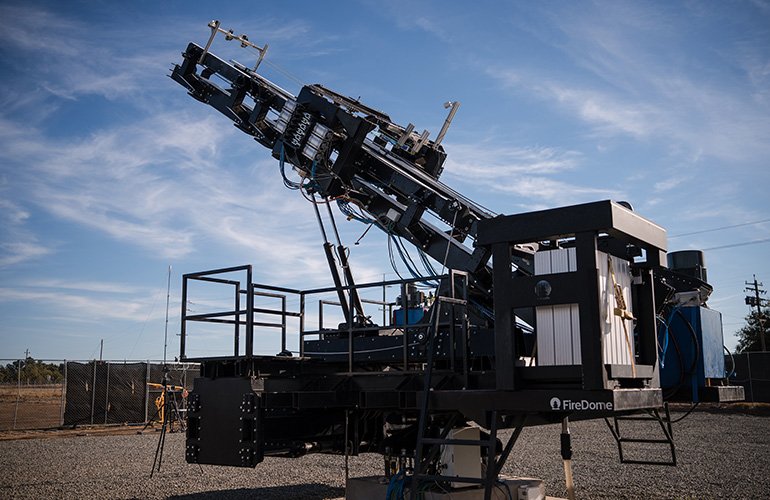
At the center of FireDome’s approach is a ground-based, fully autonomous launcher unit. The system is mounted on a concrete pad and provides 360° coverage, capable of protecting up to 70 acres depending on terrain geometry. Each unit is fitted with a protective cover that shields the mechanism during idle periods and opens automatically when an alert or relevant environmental condition triggers the system.
The launcher uses a mechanical — not explosive — mechanism to propel its payloads. This design choice prioritizes safety and long-term reliability, particularly important for systems that may sit dormant for extended periods in harsh outdoor conditions.
Payloads come in the form of flexible “smart capsules,” each holding approximately 10 gallons (37.8 liters) of liquid. These capsules can carry standard or eco-friendly fire retardant formulations, or plain water where appropriate. Crucially, the capsules are given a specific geographic address within the property. They are activated — opening to release their payload — at a predetermined altitude of a few to several dozen feet above the ground, not upon impact with the surface.
When a capsule opens, it creates an elliptical coverage zone roughly 15 to 25 feet long and 7 to 12 feet wide, depending on the release height. By launching multiple capsules in a coordinated pattern, the system can lay down continuous firebreaks or uniformly coat roofs and other vulnerable surfaces. Because activation occurs close to the ground, the company claims minimal material is lost to aerosolization — a significant advantage compared to aerial drops from high-altitude tankers, where much of the suppressant disperses before reaching the ground.
## Three Layers of Protection
FireDome’s defense concept is structured around three sequential layers, each activated at a different phase of a wildfire event.
**Layer 1 — Perimeter Firebreaks (Pre-Arrival):** When the system receives an external alert that a wildfire is approaching, it begins deploying retardant-based firebreaks around the perimeter of the protected property. Multiple pre-programmed scenarios account for the direction of the incoming fire, prevailing wind conditions, and other environmental variables. The system autonomously selects the best scenario and executes it without requiring human input.
**Layer 2 — Coating Critical Structures (Pre-Arrival):** Before embers arrive, the system targets key structures identified during an initial site survey. Roofs, walls, and other surfaces most vulnerable to ember ignition are coated with retardant. By treating these structures in advance, the system directly attacks the ember-to-ignition pathway that drives most WUI fire spread. Preventing the first structure from catching fire significantly reduces the likelihood of house-to-house fire propagation.
**Layer 3 — Spot Fire Detection and Suppression (Reactive):** Once the perimeter and structures are protected, the system shifts to monitoring for spot fires. Onboard cameras and environmental sensors continuously scan the protected area. When a small fire is detected — for example, an ember that landed on dry vegetation — the system triangulates its position, evaluates wind speed and direction, temperature and humidity, and local topography, then dispatches capsules to suppress it in a prioritized sequence based on the threat level to the property.
## Who Is This For?
FireDome’s initial target customers are property owners and organizations with significant exposure to wildfire risk and a clear economic incentive to invest in automated protection.
– **Residential communities and homeowners associations** in high-risk wildfire regions, particularly those pursuing or maintaining “Firewise Community” designation to support insurance eligibility.
– **Resorts and hospitality properties** situated in forested or wildland–urban interface locations, where fire disruption carries both reputational and financial consequences.
– **Critical infrastructure and industrial sites**, including data centers, oil and gas facilities, solar farms, and other energy installations where fire could trigger cascading grid or operational impacts.
The common thread among these customers is that they manage large, spatially distributed properties where a single launcher unit can justify its cost by protecting assets worth far more than the system itself.
## Broader Applications Beyond Wildfires
While wildfire suppression is the immediate focus, the underlying approach has clear applicability to industrial fire scenarios. Remote sections of large manufacturing plants, outdoor equipment yards, tank farms, and energy facilities all face fire risks that are difficult for human responders to address quickly.
FireDome envisions its launcher as an outer defensive layer complementing existing code-mandated indoor sprinkler and suppression systems. In this role, it could detect and suppress fires at their outdoor origin, create wet or retardant-coated buffer zones to contain spread, and serve as a robotic force multiplier alongside human firefighting teams and fixed infrastructure.
## Service Model and Accessibility
To lower the barrier for adoption, FireDome is offering its system primarily through a service-based model for early customers. The pricing ranges from approximately $10,000 to $15,000 per month and includes a comprehensive fire risk survey, system design and siting, professional installation and commissioning, and annual maintenance and testing.
For customers who prefer to own the hardware outright, the company also provides a capital expenditure model with a lower ongoing fee for maintenance and service support. This dual approach is intended to make the technology accessible to a range of property owners, from large HOAs to industrial operators.
## From Demonstration to Production
As of the most recent updates, FireDome has built and deployed its first complete demonstration system at a site in Yuba County, California. The testbed is being used to showcase the system to fire agencies, potential customers, and industry partners while generating real-world performance data and design feedback.
The company is advancing toward final design refinement and manufacturing, with plans to begin deploying production units in spring 2027. Early-adopter customer sites are being actively sought ahead of the next major fire season.
## Frequently Asked Questions
**Q: Is the FireDome launcher a weapon or does it use explosives?**
A: No. The launcher is entirely mechanical and does not use any explosive charges. It propels flexible capsules containing fire retardant or water using a safe, reliable mechanical mechanism designed for sustained outdoor deployment.
**Q: How large an area can one FireDome unit protect?**
A: A single launcher unit can protect up to approximately 70 acres (28.3 hectares), though the exact coverage depends on the geometry and topography of the property. The effective launch radius is roughly 1,000 feet (304.8 meters).
**Q: What happens during a fire event — does someone need to activate the system?**
A: By default, FireDome operates fully autonomously. When conditions meet predefined criteria — such as receiving an external fire alert — the system initiates its response automatically based on pre-planned scenarios agreed upon with the property owner. Neither the property owner nor firefighters need to give a last-minute authorization. However, both parties retain the ability to intervene remotely or shut the system down if needed.
**Q: What kind of liquid does the system use?**
A: Each smart capsule can carry approximately 10 gallons (37.8 liters) of liquid. The formulation can be standard fire retardant, eco-friendly retardant, or plain water, depending on the specific needs and environmental considerations of the site.
**Q: How does the system compare to aerial tanker drops?**
A: Aerial tankers drop suppressant from high altitude, where significant material is lost to wind drift and aerosolization before reaching the ground. FireDome activates capsules at low altitude — a few to several dozen feet above the surface — resulting in minimal material loss and more precise coverage of targeted areas.
**Q: Can the system integrate with existing fire department operations?**
A: Yes. FireDome is working with California fire chiefs to embed its units directly into incident command workflows. During a wildfire, fire bosses would see FireDome launchers as an additional resource on their coordination screens alongside ground crews, engines, and aerial assets.
**Q: What is the cost of the system?**
A: For early adopters, FireDome offers a “protection as a service” model at approximately $10,000 to $15,000 per month, covering the full lifecycle from risk survey through maintenance. A capital purchase option is also available for customers who prefer to own the hardware outright.
**Q: When will production units be available?**
A: FireDome plans to begin manufacturing its first production units in early 2027, with initial deployments targeted for the spring of that year.
## Conclusion
FireDome represents a compelling new category within field robotics — one that applies autonomous systems to climate resilience rather than general-purpose automation. The approach is tightly scoped, mission-specific, and designed to integrate with existing human firefighting ecosystems rather than replace them. By focusing on the ember-driven destruction mechanism that is responsible for the vast majority of WUI property losses, FireDome addresses a specific and measurable failure mode in current wildfire defense.
As the system moves from prototype to production, its real-world performance will be closely watched by property owners, insurers, fire agencies, and the broader robotics community alike. The promise is straightforward: a system that may sit quiet for long stretches, but when the worst happens, it is already in place, already awake, and already working to protect what matters most.
Thank you for reading
