



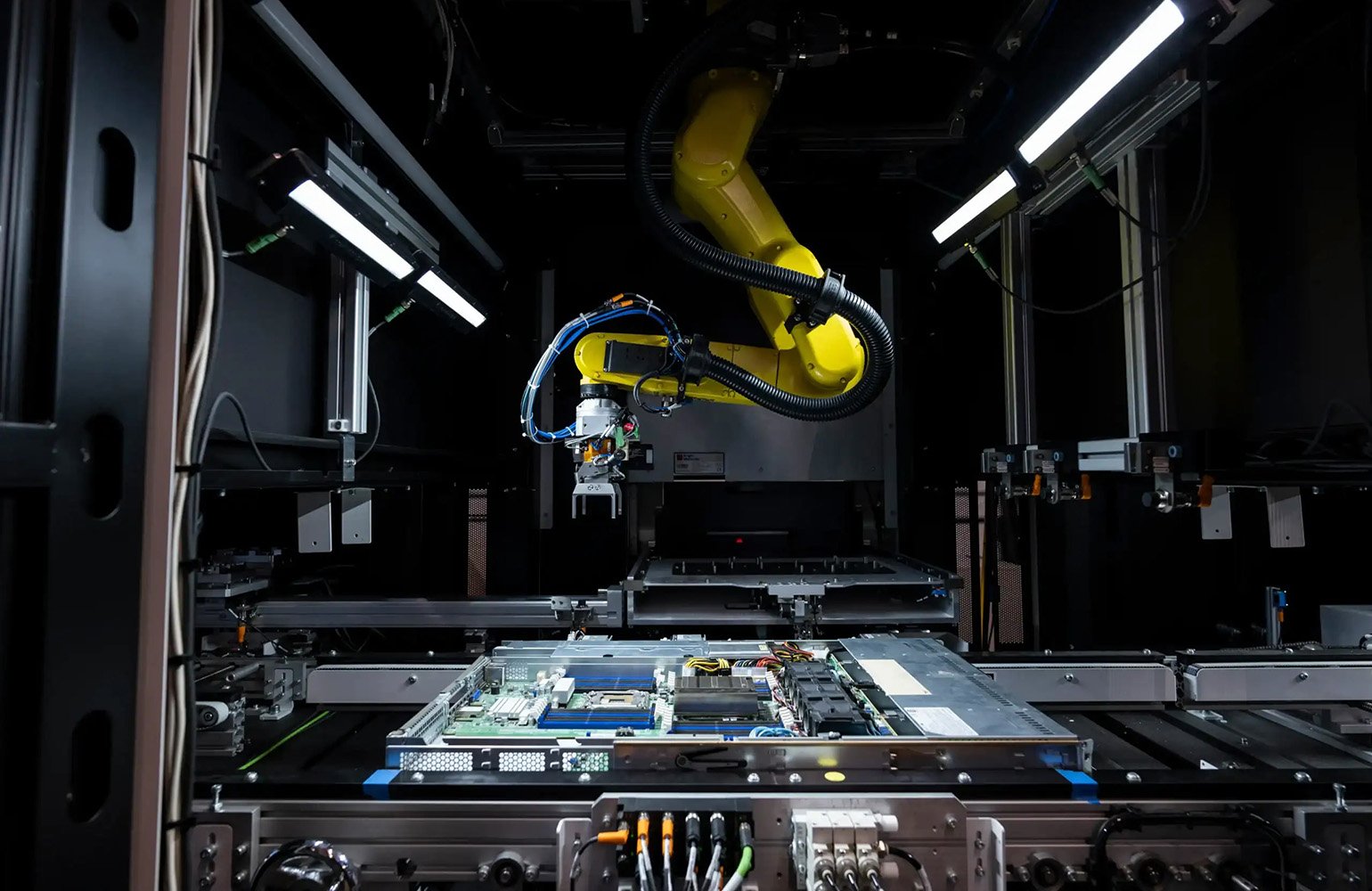
# Teradyne Backs Bright Machines in Strategic Partnership to Power AI Hardware Production
A major technology alliance is taking shape as Teradyne commits capital and technical resources to Bright Machines, a company specializing in intelligent manufacturing systems. The collaboration aims to reshape how AI computing hardware moves from concept to finished product.
## Investment and Strategic Vision
Teradyne, headquartered in North Reading, Massachusetts, has positioned its financial commitment alongside a broader partnership. The investment reflects Teradyne’s growing conviction that artificial intelligence will be the defining force in next-generation factory operations. The company, which recently posted its fifth consecutive quarter of revenue growth, has pointed to AI as the primary engine behind that performance.
Bright Machines, based in Burlingame, California, operates a software-driven manufacturing ecosystem. Its platform integrates design workflows, robotic assembly, automated inspection, material logistics, and real-time production analytics. The company has rolled out more than 130 modular production facilities across more than a dozen nations, with active deployment in the United States supporting AI infrastructure projects.
## How the Partnership Works
Under the collaboration, Teradyne’s robotic systems and electronic testing equipment will be woven into Bright Machines’ production environments. Key integration points include:
– Precision robotic arms performing assembly tasks with force and power sensitivity
– Automated loading and unloading of circuit board testing equipment
– Self-directed transport of materials between workstations
– Combined data collection from assembly, inspection, and electrical validation stages
The goal is to create a seamless production floor where every manufactured unit carries a complete digital record—from initial design choices through final electrical performance results.
## Why This Matters Now
The demand for AI computing hardware has triggered one of the largest expansions in electronics manufacturing in years. Hyperscale data center operators, AI research labs, semiconductor firms, and original equipment manufacturers are all racing to increase output. In this environment, the speed at which a manufacturer can retool a production line for a new product design directly affects market competitiveness.
James Davidson, Teradyne’s chief AI officer, highlighted a critical bottleneck: the engineering effort required to program robots for new tasks. “If a robot can learn a new job in hours rather than requiring weeks of reprogramming, then high-variety, short-lifecycle manufacturing becomes practical,” Davidson explained. Closing the loop between build data and test data on the same platform allows production lines to self-correct in near real time.
Bright Machines CEO Sviat Dulianinov emphasized that the partnership validates a software-defined, data-rich approach to manufacturing. “Teradyne brings decades of robotics and test expertise that complements what we’ve built. Together, we can reduce the complexity of integration, speed up deployment timelines, and give customers full visibility into their production data,” Dulianinov stated.
## The Bigger Picture
Both companies see the alliance as a response to a fundamental shift in electronics manufacturing. Buyers of AI infrastructure no longer just want volume—they want agility, traceability, and quality assurance embedded in every step. An integrated system that combines design intelligence, robotic precision, and automated testing under one software umbrella is increasingly seen as the standard rather than the exception.
Teradyne’s existing customer base includes electronics manufacturing service providers, original design manufacturers, OEMs, and hyperscalers. The company supplies both robotics and testing solutions tailored for high-mix, high-value production scenarios. Bright Machines’ footprint across multiple countries and its track record with AI infrastructure production in the U.S. positions the combined entity to serve a wide range of industrial customers.
## FAQ
**What is Bright Machines?**
Bright Machines is a software-defined manufacturing platform company that connects design, robotics, automation, inspection, material handling, and production intelligence. It has deployed over 130 microfactories in more than 10 countries.
**Why did Teradyne invest in Bright Machines?**
Teradyne sees AI infrastructure as a fast-growing segment of electronics manufacturing. The investment allows Teradyne to deepen its partnership with a platform leader while integrating its own robotics and test technologies into a modern, data-driven production environment.
**What technologies are being combined?**
The collaboration merges Bright Machines’ manufacturing software and microfactory hardware with Teradyne’s Universal Robots cobots and board-level test systems. The integration covers robotic assembly, automated material movement, and electrical testing—all feeding into a unified data layer.
**Who benefits from this partnership?**
Manufacturers of AI computing hardware, including hyperscalers, semiconductor firms, AI laboratories, EMS providers, and OEMs, stand to benefit from faster, more flexible, and more traceable production lines.
**How does this affect production speed?**
By reducing the engineering overhead needed to reprogram robots and by keeping build and test data in a single feedback loop, the partnership aims to make high-mix, short-lifecycle production more efficient and responsive to design changes.
## Conclusion
The Teradyne–Bright Machines alliance represents a significant step toward fully integrated, AI-powered electronics manufacturing. By combining Teradyne’s robotics and test expertise with Bright Machines’ software-driven production platform, the partnership addresses the core challenges of modern AI hardware fabrication: complexity, speed, quality, and reconfigurability. As demand for AI infrastructure continues to surge, partnerships like this one will likely set the template for how advanced hardware moves from design to mass production.
Thank you for reading
