



# How the U.S. Army is Turning a Key Electronics Command into an Artificial Intelligence Powerhouse
The Army’s Communications-Electronics Command, widely known as CECOM, is emerging as a central force in the military’s broader artificial intelligence transformation. By embedding AI into the communications, cybersecurity, and intelligence-gathering systems that already form the backbone of Army operations, the command is redefining how soldiers access, process, and act on critical information — both in garrison and on the battlefield.
—
## A Command Built on Connections Now Embraces Machine Intelligence
CECOM manages the vast portfolio of software, hardware, and networks that enable soldiers to communicate, gather battlefield intelligence, and execute cyber operations. Rather than treating AI as a separate initiative, the command is weaving machine-learning capabilities directly into those existing platforms. Much of this innovation is being driven by in-house developers housed within the Army Software and Innovation Center, a dedicated team that works at the intersection of software engineering and military requirements.
At the strategic level, CECOM is building AI tools that streamline bureaucratic processes and free up human resources for higher-value work. One notable creation helps the Army Auditing Agency identify instances where government funds may have been misused on travel-related expenses — dramatically reducing a previously overwhelming backlog of travel voucher fraud reviews. Another tool automates the risk-assessment phase that software must pass through before being deployed on secure military networks, significantly shortening the timeline for delivering new capabilities to the warfighter.
—
## From Office Desks to the Tactical Edge
Beyond administrative efficiency, CECOM is exploring AI applications at the tactical level. One program, referred to internally as AI-Assisted Maintenance, tackles a persistent problem in military logistics: human error in equipment documentation.
When service members perform preventive maintenance on vehicles, weapons systems, or communications gear, they often rely on handwritten logs. Over time, those logs can become nearly impossible to decipher — creating delays when parts need to be ordered or when the same equipment breaks down months later.
AI-Assisted Maintenance is designed to remove that friction. By automating the logging of maintenance issues, flagging faulty components, and standardizing the way repair requests are documented, the system promises to cut the time between identifying a problem and getting the right replacement parts in hand. According to advocates within the command, the process could shrink from weeks or months to less than seven days.
—
## Putting Soldiers at the Center of Development
A distinguishing feature of CECOM’s approach is its commitment to involving the end users — the soldiers themselves — throughout the design and testing process. Rather than developing a tool in isolation and then handing it over for feedback weeks later, developers have adopted an iterative, soldier-driven model.
During a recent training rotation in California, a group of troops tested AI-Assisted Maintenance in a realistic operational environment. Their feedback was collected on-site and used to refine the program in real time, allowing developers to make targeted adjustments without waiting to return to their labs in Maryland. The result was a faster development cycle and a product that better reflected what soldiers actually needed.
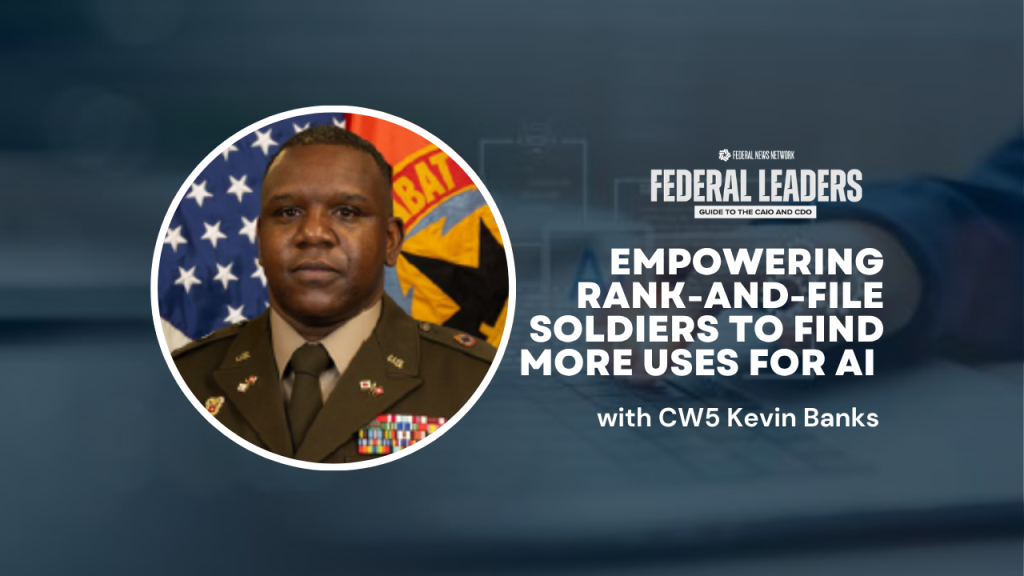
Chief Warrant Officer 5 Kevin Banks, who serves as the command’s chief warrant officer, described this as a way to give soldiers a sense of ownership over the technology they use. “The goal is to make these capabilities so relevant that troops don’t just accept them — they demand them,” he explained.
—
## Overcoming Resistance to Adoption
Despite the promise of these tools, CECOM faces a familiar challenge: not everyone in the force is ready to embrace AI. Banks acknowledged that skepticism remains a real obstacle, particularly among personnel who see little connection between machine intelligence and their day-to-day duties.
The command’s strategy is to make AI tangible and mission-relevant rather than abstract. Banks pointed to the example of a cavalry scout responsible for calling in a fire mission. With AI assistance, the scout no longer needs to relay long, detailed descriptions of a target’s location. Instead, they can communicate a compact grid coordinate, and the AI handles the heavy lifting — calculating trajectories, validating data, and passing the information through the chain of command. A human operator still validates the final output, preserving accountability while dramatically accelerating the process.
Banks also suggested that learning to craft effective prompts — the instructions given to an AI system — can sharpen a person’s communication skills in general. “It forces you to rethink how you’re asking questions,” he noted. “Without even realizing it, you’re training yourself to communicate more clearly.”
Across the broader military, senior leaders are echoing this message. Senior enlisted leaders have publicly encouraged personnel to treat AI literacy as a core competency, warning that those who ignore the technology risk falling behind peers and peer nations.
—
## Looking Ahead: Scaling AI Fluency Across the Force
Banks expressed hope that every member of CECOM will eventually be comfortable using AI as part of their routine work. Achieving that goal, he said, will require addressing three distinct groups: personnel who resist AI until an explicit policy gives them permission to use it, those who avoid it because they don’t understand its benefits, and those nearing retirement who may be less inclined to adopt new workflows.
One unconventional tactic Banks floated was challenging skeptics to try outperforming an AI agent for a full week. By setting that kind of hands-on test, skeptics often discover firsthand where AI adds value and where it still falls short — prompting constructive feedback rather than blanket resistance.
He also emphasized the importance of policy alignment. “If you can change policy to reflect that, ‘Yes, this is the way we’re going to conduct business from now on,’ you’ve got a good amount of the people in your organization already on board,” he said. The remaining holdouts — those he called “naysayers and antibodies” — represent a small but vocal minority that leaders must continue to engage with patience and practical demonstrations.
—
## Frequently Asked Questions
**What is the Communications-Electronics Command (CECOM)?**
CECOM is a major subordinate command of the U.S. Army responsible for developing, acquiring, and sustaining the communications, electronics, and cybersecurity systems that soldiers use worldwide. Its work spans everything from battlefield radio networks to enterprise software used in administrative offices.
**What kinds of AI tools has CECOM developed?**
CECOM has built several AI-powered tools, including a system to help audit travel voucher fraud for the Army Auditing Agency, a tool that accelerates software risk assessments before deployment to military networks, and a tactical maintenance program called AI-Assisted Maintenance that reduces human error in equipment repair documentation.
**How does AI-Assisted Maintenance work?**
The system automates the logging of maintenance tasks, identifies faulty or degraded components, and standardizes repair documentation. By removing the reliance on handwritten logs and inconsistent phrasing, it dramatically reduces the time it takes to order replacement parts and complete repairs.
**Why is soldier involvement important in AI development?**
By incorporating feedback directly from troops during field exercises, developers can refine tools in real time, ensuring the final product is practical, intuitive, and aligned with actual mission needs. This approach also builds a sense of ownership and trust among users.
**How does the Army plan to overcome AI skepticism?**
Through a combination of policy changes, hands-on demonstrations, and education initiatives. Leaders are encouraging personnel to test AI tools directly, attend training, and see how AI can make their specific jobs faster and more effective rather than more threatening.
—
## Conclusion
CECOM’s push to become an AI development hub reflects a broader realization within the Army: that artificial intelligence is not a futuristic experiment but an operational necessity. By embedding machine learning into the systems soldiers already rely on — and by making those tools more efficient, accurate, and soldier-friendly — the command is helping to reshape how the Army prepares for modern challenges. The path forward will require continued investment in people, processes, and policies that encourage adoption while addressing legitimate concerns about accountability, training, and trust. The early results, however, suggest that the effort is already paying dividends in speed, accuracy, and mission readiness.
Thank you for reading
