



# Microsoft Unveils MAI-Transcribe-2-Streaming: A New Era for Real-Time Speech Recognition
*Published November 2026*
—
## The Promise of Real-Time Transcription
Imagine a voice assistant that doesn’t just hear you after you finish speaking — but starts understanding your words the instant they leave your mouth. That is the promise behind Microsoft AI’s latest release: MAI-Transcribe-2-Streaming, a speech-to-text engine designed to process audio as it arrives, delivering partial and final transcripts while the speaker is still talking.
Launched on October 1, 2026, this model marks Microsoft’s first entry into the streaming transcription space. It arrives alongside two complementary text-to-speech models — MAI-Voice-2.1 and MAI-Voice-2.1-Flash — completing a full voice-loop stack for developers building conversational AI products.
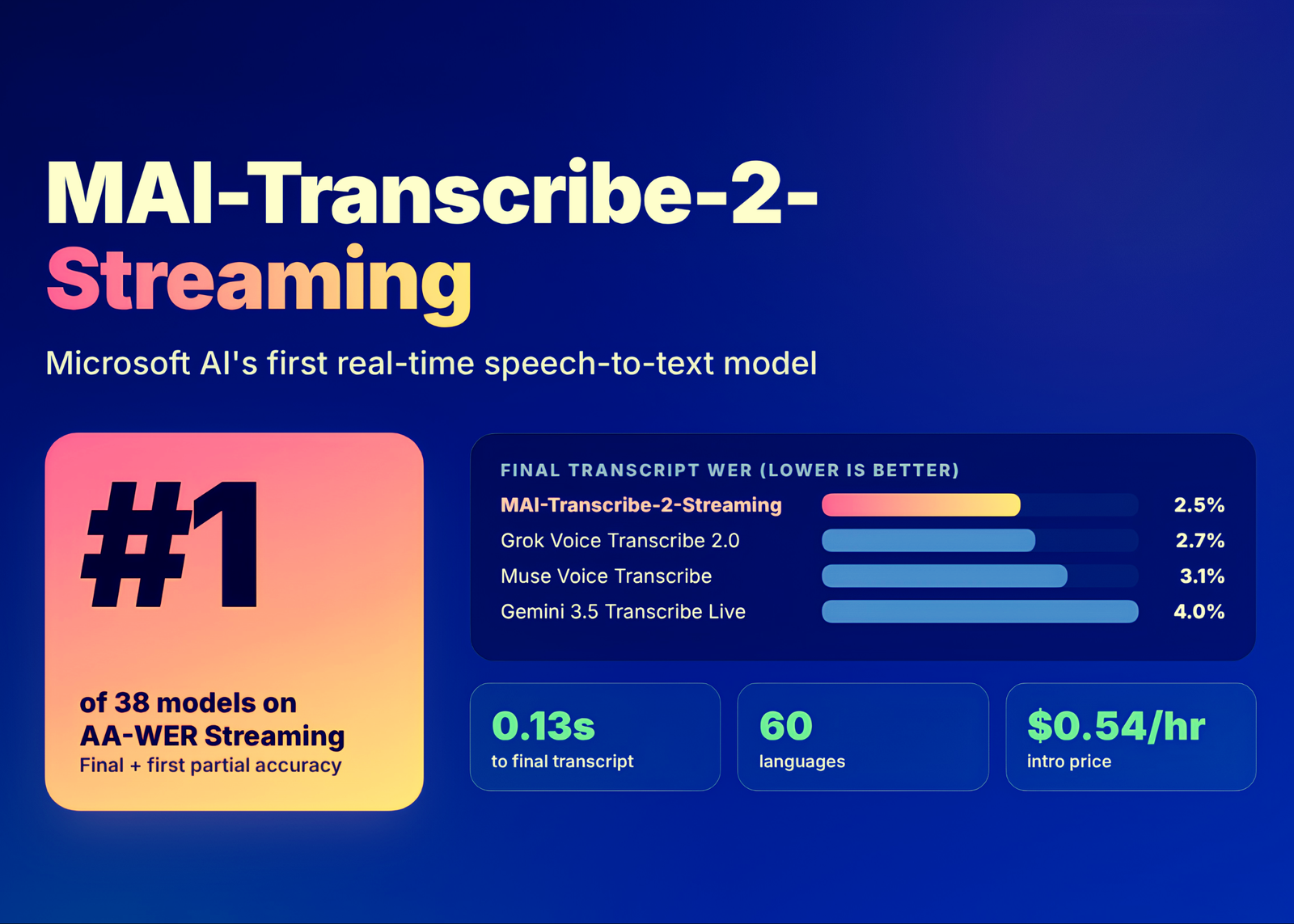
What makes this release particularly notable is not just that it exists, but how well it performs. In one of the most comprehensive streaming speech benchmarks available, it claimed the top position among 38 evaluated models, achieving both the highest accuracy and a compelling balance between speed and precision.
—
## How It Works: Transcribing as You Speak
Traditional transcription systems operate in batch mode. They collect an entire audio file, wait for it to finish, and then process the complete recording. This works well for post-production captions or recorded dictation, but it falls short for live applications like voice agents, assistive listening tools, or real-time meeting summaries.
MAI-Transcribe-2-Streaming changes this paradigm. Audio enters the system continuously, and text flows back continuously. The model generates its first word-level hypotheses — referred to as partials — within approximately 100 milliseconds of receiving the audio signal. As more of the speaker’s words arrive, these partials get refined and corrected, and once the model is confident in its output, it commits a stable final transcript.
The practical consequence is significant: an AI agent can begin reasoning, searching databases, or invoking tools mid-sentence, rather than waiting for the user to finish their entire thought. This compresses the latency budget for conversational applications and makes interactions feel dramatically more responsive.
According to Microsoft’s internal testing, words from this model appear roughly twice as fast as its nearest rival, giving developers a meaningful edge in time-sensitive deployments.
—
## What the Benchmark Shows
An independent evaluation using approximately eight hours of diverse audio — drawn from agent conversations, public voice samples, and earnings call transcripts — placed the model at the top of the ranking. The test measured two key metrics: word error rate (WER) for accuracy, and the time elapsed between the end of speech and the delivery of a transcript.
| Metric | MAI-Transcribe-2-Streaming | Runner-Up (Grok) | Second Runner-Up (Muse) |
|——–|—————————|——————-|————————|
| Final transcript WER | 2.5% at 0.13s | 2.7% at 0.49s | 3.1% at 0.16s |
| First partial WER | 2.5% at 0.12s | — | — |
Several observations stand out from these results. First, the partial transcript — the one delivered before the speaker finishes — is just as accurate as the final transcript. This is unusual and highly valuable; most streaming models trade early speed for early accuracy, but this model appears to have minimized that tradeoff.
Second, while the model is not the absolute fastest — another service returns final transcripts in roughly 70 milliseconds — that speed comes at a cost: a significantly higher error rate of 4.0% WER. Microsoft’s model sits on the accuracy-versus-latency Pareto frontier, meaning no other model offers both better accuracy and lower latency simultaneously.
—
## Multilingual Support at Scale
One of the model’s most practical strengths is its coverage. It supports 60 languages with continuous automatic language detection built directly into the streaming pipeline. This means developers do not need to pre-configure which language to expect; the model identifies and switches languages on the fly as the speaker changes.
For global applications — multilingual customer support, international meetings, or cross-border communication tools — this eliminates a significant layer of complexity in the development workflow.
—
## Pricing and Availability
Microsoft offers MAI-Transcribe-2-Streaming at an introductory rate of $0.54 per hour of audio. This pricing tier is set to remain in effect through the end of 2026. For context, the batch version of the same underlying model — MAI-Transcribe-2 — costs $0.10 per hour, reflecting the simpler processing pipeline of non-real-time transcription.
The streaming price is higher than offerings from competitors xAI and Meta, and roughly on par with Google’s estimated rate for its streaming transcription service. Developers should weigh this cost against the model’s accuracy and latency advantages when making architectural decisions.
The model is currently in public preview and accessible through several integration paths: a Realtime API compatible with WebSocket-based applications, the Azure Speech SDK for connection management and audio streaming, and the MAI Playground for experimentation. Availability through Vercel and Azure Voice Live is confirmed, and LiveKit support is on the roadmap.
—
## The Full Voice Stack
Transcription is only one half of a voice agent’s pipeline. Microsoft has paired its transcription model with two text-to-speech options to close the loop.
MAI-Voice-2.1-Flash generates up to 45 seconds of audio with a 150-millisecond end-to-end latency, priced at $15 per million characters. MAI-Voice-2.1 offers broader coverage with 23 languages and 26 locales at $22 per million characters. Together, these models allow developers to build complete voice experiences — from hearing the user, to processing their intent, to speaking a response — all within a single, coherent pipeline.
—
## How Developers Are Using It
The primary use cases highlighted by Microsoft and the broader developer community include:
– **Voice agents**: Enabling real-time conversational AI that can respond before the user finishes their utterance.
– **Live captions**: Providing accessibility features for presentations, streams, and public events with minimal delay.
– **Dictation**: Powering productivity tools where speed of transcription directly impacts user workflow.
– **Multilingual meeting assistants**: Automatically detecting and transcribing speakers switching between languages during international calls.
—
## FAQ
### Is MAI-Transcribe-2-Streaming available outside of preview?
As of its October 2026 release, the model is in public preview. Full production-level service level agreements (SLAs) have not yet been published.
### Does the model support speaker diarization in streaming mode?
The current documentation does not confirm speaker diarization for the streaming configuration. Developers who require this feature should evaluate alternative models or monitor future updates.
### Can I use this model with open-source frameworks?
The model is not available as open weights. Access is provided through Microsoft’s proprietary APIs and SDKs.
### How does the intro pricing work?
The $0.54 per hour rate is an introductory tier and is scheduled to remain through the end of 2026. Pricing adjustments beyond that date have not been announced.
### What makes the partial transcript so fast?
The model generates its first hypotheses within roughly 100 milliseconds of receiving audio. This is achieved through a streaming architecture that processes incoming audio chunks incrementally rather than waiting for a complete utterance.
### Is the model suitable for low-resource languages?
While the model supports 60 languages, specific performance characteristics for low-resource languages have not been individually benchmarked. Developers working with less common languages should conduct their own evaluations.
—
## Conclusion
MAI-Transcribe-2-Streaming represents a significant advancement in real-time speech recognition. By delivering top-tier accuracy at a latency that enables mid-sentence agent reasoning, it addresses one of the most persistent bottlenecks in voice AI: the gap between hearing a user and acting on their words.
Its combination of 60-language coverage, continuous language switching, and a competitive introductory price makes it a compelling choice for developers building the next generation of voice-first applications. While it is not the cheapest option on the market, nor the fastest, its position on the accuracy-latency frontier — and its matching partial and final transcript quality — sets a new standard for what streaming transcription can achieve.
For teams looking to integrate real-time speech understanding into their products, this release marks an important moment in the evolution of voice AI.
Thank you for reading
