



# The Next Frontier for Autonomous Ride-Hailing: Why the “Between Rides” Problem Will Make or Break the Industry
Robotaxis have reached a remarkable milestone. Major autonomous vehicle operators have collectively logged hundreds of millions of miles on public roads, with safety records that consistently outperform human drivers. Millions of paid rides are now being completed every week, and service areas are expanding rapidly.
But here is the question that keeps founders, investors, and city planners awake at night: How does this move from a handful of pilot cities to a truly global operation?
The answer, it turns out, is not about better sensors, smarter algorithms, or faster vehicles. It is about something far less glamorous — what happens to the car the moment a passenger steps out.
## The Hidden Bottleneck
Consider this: one major mobility platform processes more rides per week than what some autonomous operators deliver in an entire month — and it does so every single day. The comparison is not meant to diminish the technology. It is meant to highlight a gap.
Every autonomous vehicle on the road needs something between rides that no one has fully solved at scale: a thorough cleaning, a full charge or energy top-up, a mechanical inspection, and sometimes a simple wipe-down of a spilled coffee. Each of these resets takes time. In some cases, a vehicle that just dropped off a passenger may need to drive a significant distance to reach a servicing facility — all while earning zero revenue.
The numbers are sobering. Even with massive investment in autonomous fleets, a substantial share of every vehicle’s total mileage is spent empty — either repositioning for its next passenger or making its way to a service depot. Those empty miles represent lost capacity, lost revenue, and lost momentum.
## Why Centralized Depots Are Not the Answer
Early autonomous programs relied on centralized service depots, similar to the way traditional car-sharing or fleet operations handled maintenance. A vehicle finishes its shift, drives back to a facility, gets cleaned and inspected, and heads out again. It works — up to a point.
The problem is that this model was built for a handful of locations, not for thousands. Scaling it requires enormous amounts of industrial land, heavy electrical infrastructure, and months — sometimes years — of permitting and construction in every single city where the service operates.
The land itself has become a scarce resource. Across major metropolitan areas, developers competing for the same industrial parcels that autonomous operators need are often well-capitalized technology and energy companies with equally pressing demands. An operator looking to launch in a new city quickly discovers it is competing for the exact same zoned, powered real estate that hyperscale data centers and energy companies want.
Permitting timelines make the situation worse. In some regions, simply getting a new electrical circuit approved can take half a year. A new substation? Nearly two years. A full new substation build-out? Close to three years. Multiply that across dozens or hundreds of cities, and the timeline for a centralized depot model stretches into decades.
Then there is the question of diversity. No two cities are alike. One might have vast open parking lots and abundant sunshine; another might be a dense historic district with narrow streets and strict preservation rules. A third might face extreme heat, dust, and conditions that accelerate wear on sensors and battery systems. Designing a custom depot for every city means custom engineering, custom permitting, and custom timelines — a recipe for a model that collapses under its own complexity as soon as you try to replicate it.
## The Industry Is Fragmenting — and That Changes Everything
The early days of autonomous vehicle development saw a handful of companies build everything from the sensor stack to the vehicle to the operating software. That model is shifting fast.
Today, multiple companies specialize in autonomous driving systems — selling their software and hardware platforms to vehicle manufacturers who embed them into production cars. Meanwhile, ride-hailing platforms are opening their networks to dozens of autonomous partners, each running different vehicle types from different manufacturers.
The result is a rich and competitive ecosystem, but it also creates a new challenge. Instead of one fleet operating out of one type of vehicle with one maintenance protocol, there are now dozens of fleets with different vehicles, different charging needs, different cleaning requirements, and different inspection checklists.
This fragmentation makes the infrastructure problem even more acute. A servicing station that works for one vehicle type may not work for another. A charging solution designed for one battery chemistry may be incompatible with a neighboring fleet’s vehicles. The servicing layer must become universal — fleet-agnostic, modular, and fast to deploy — or it becomes a bottleneck that throttles the entire industry.
## Learning From Battery Swapping and Shared Mobility
The autonomous ride-hailing industry is not the first to face this kind of operational scaling problem. Years ago, a battery-swapping network for electric scooters faced an identical challenge: hundreds of operators, a few vehicle manufacturers, and thousands of cities. No single operator won because they had a better scooter. They won because they could charge, repair, and reposition tens of thousands of vehicles every single day. The vehicle was never the hard part. The operations were.
Autonomous ride-hailing is essentially the same business — except at a hundred times the capital intensity, a hundred times the regulatory complexity, and a hundred times the public visibility. The lesson from that earlier era is clear: the vehicle will eventually become a commodity. The operations layer is where value, differentiation, and scale live.
## What a Solution Could Look Like
The global shipping industry did not become possible because someone made a faster ship. It became possible because someone standardized the container. A standardized shipping container fits in any port, on any ship, on any truck, in any train — and the entire global supply chain was redesigned around that simple, modular unit.
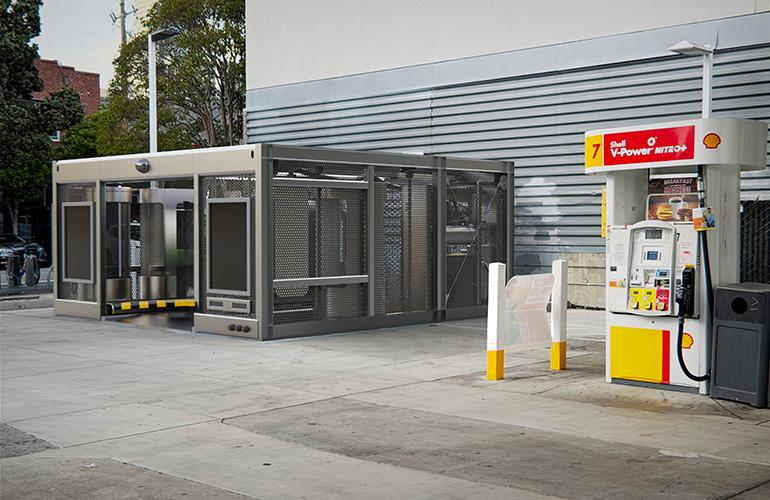
The autonomous vehicle industry needs its own version of the shipping container: a standardized module of servicing infrastructure that can be dropped into a parking spot, a loading bay, or a vacant lot, deployed in days rather than years, and configured for the specific needs of each city without requiring a ground-up rebuild.
Imagine a unit that arrives flatbed-loaded, connects to existing power sources, and within hours is operational — capable of charging multiple vehicle types, running automated cleaning cycles, performing basic inspections, and swapping out consumables. No construction permit for a new building. No substation upgrade. No industrial zoning battle. Just a self-contained, modular pod that serves any fleet on any network — like a cell tower that serves every carrier.
This is not a hypothetical. Companies across the mobility and robotics ecosystem are actively developing such solutions, and the first commercial deployments are already underway in select markets. The technology is early, the competition is just beginning, and the argument rests on a simple arithmetic reality: if building a traditional depot takes years and costs millions in every city, then an industry that needs thousands of service points has no path to scale under the old model.
## The Investment Blind Spot
Venture capital and institutional money have poured billions into autonomous driving software and vehicle manufacturing. These investments are well justified — the technology is advancing rapidly, and the safety case is compelling. But a strikingly small share of total capital flowing into the autonomous mobility ecosystem has gone toward the physical infrastructure required to keep vehicles in service between rides.
One of the most prominent venture firms in the world recently raised over a billion dollars specifically for the physical buildout of AI and robotics infrastructure. The message from the industry’s top investors is clear: they recognize that software alone does not scale. The hardware, the facilities, and the operations layer are where the real bottleneck sits.
The autonomous vehicle is the most sophisticated robot to reach commercial scale. And like every robot before it, it will discover that the demo was never the hard part. Driving itself was always the easy part. Keeping it clean, charged, inspected, and back on the road at the right time — that is the engineering and operational challenge that will define whether autonomous ride-hailing becomes a global utility or remains a niche novelty.
## FAQ
**Q: Why can’t autonomous vehicles just service themselves?**
A: Current autonomous vehicles are not yet capable of self-cleaning, self-charging, or self-inspection at the level required for commercial ride-hailing operations. While some vehicles can autonomously navigate to a charging point, the full reset cycle — cleaning, inspection, and preparation for the next passenger — still requires specialized equipment and, in many cases, human oversight.
**Q: How long does a typical vehicle reset take between rides?**
A: A full reset cycle, including cleaning, charging, and inspection, typically takes around two hours depending on the vehicle type and the condition it is returned in. Speeding up this process is critical for fleet utilization and revenue generation.
**Q: Why is land so hard to find for autonomous vehicle service facilities?**
A: The industrial-zoned, electrically powered parcels that service facilities require are the same parcels that data center operators, logistics companies, and energy infrastructure developers are competing for. In many major markets, this has driven up land costs and made it increasingly difficult for autonomous operators to secure suitable locations.
**Q: How long does it take to get permitting and construction done for a new service facility?**
A: Timelines vary widely by city and jurisdiction. Getting a standard electrical connection approved can take six months or more. Building a new electrical substation can take two to three years. In some cases, the regulatory timeline alone makes a traditional depot model impractical for rapid scaling.
**Q: What makes a modular service unit different from a traditional depot?**
A: A traditional depot is a permanent building constructed on-site, often taking months or years to build and requiring extensive zoning and permitting. A modular service unit arrives as a pre-built, self-contained unit that can be deployed in days, connected to existing utilities, and reconfigured or relocated as operational needs change.
**Q: Are autonomous ride-hailing fleets all the same type of vehicle?**
A: No. The industry is moving toward a multi-fleet model where different companies operate different vehicle types from different manufacturers, all serving passengers through shared platforms. This diversity makes the servicing infrastructure more complex but also more important — a universal, fleet-agnostic solution is essential.
**Q: What does “fleet-agnostic” mean in this context?**
A: Fleet-agnostic means the servicing infrastructure is designed to work with any autonomous vehicle, regardless of the manufacturer, battery type, or operating system. This allows a single service unit to support multiple fleets simultaneously, maximizing utilization and reducing costs.
**Q: Who is funding the physical infrastructure for autonomous ride-hailing?**
A: Currently, much of the funding is directed toward software and vehicle development, with relatively less capital allocated to the physical infrastructure layer. However, there is growing recognition among investors and operators that the infrastructure is the critical missing piece for scaling beyond pilot cities.
## Conclusion
The autonomous ride-hailing industry has solved the hardest technical problem: building vehicles that can drive themselves safely and reliably in complex urban environments. The next challenge is not a technology problem — it is a logistics and infrastructure problem. Every vehicle that completes a ride needs to be cleaned, charged, inspected, and redeployed quickly. Without a scalable, standardized solution for this “between rides” process, the industry will remain confined to a small number of cities, unable to reach the scale needed to transform urban transportation.
The shipping container analogy is more than poetic. It is a blueprint. Modular, standardized, and universally adaptable infrastructure is the key that can unlock autonomous ride-hailing at a global scale. The companies and investors who recognize this — and act on it — will define the next era of mobility. The cars can already drive themselves. Now the industry needs to build the pit stops that will keep them running.
Thank you for reading
