



# How Agricultural Robotics Is Helping Farmers Navigate an Era of Unprecedented Challenges
American farming faces a convergence of pressures that would test even the most seasoned operators. Rising input costs driven by global trade disruptions have squeezed margins, while volatile crop prices make long-term planning difficult. Meanwhile, unpredictable weather patterns are making consistent harvests harder to guarantee than ever before. In response, the agricultural industry is turning to an unlikely ally — robotics and automation — to help growers do more with less.
## The Labor Crisis at the Heart of Modern Farming
One of the most pressing concerns voiced by growers today is the chronic shortage of skilled labor. Critical farming operations — from planting and spraying to harvesting — demand significant manpower, yet fewer workers are available each season. This gap drives up costs and threatens productivity.
Luca Ferrari, a senior manager of robotics and breakthrough technologies at CNH Industrial, says customer feedback consistently highlights labor as a primary pain point. “Our users need to get more done with fewer resources,” he explained. “Labor availability is one of the main challenges that our farmers and growers are experiencing, especially during some critical operations like planting, spraying, and also harvesting.”
Ferrari emphasized that farmers don’t adopt technology for its novelty. They adopt it because it demonstrably improves their operations year after year. “They want something that is solving a real problem, that is easy to use, and that can create value,” he said.
## From Single-Task Automation to Intelligent, Agentic Systems
Farms have been using forms of advanced technology and autonomy for years, but a significant shift is now underway. According to Ferrari, the industry is moving toward what he calls “agentic” systems — platforms that go far beyond assisting a human operator with individual tasks.
A truly agentic system, in Ferrari’s view, is one that can sense its environment, make autonomous decisions, and execute entire operations from start to finish. Breakthroughs in sensing technologies, machine vision, and artificial intelligence have made this vision increasingly practical.
“We can really transform this data that we perceive from the environment in real operation,” Ferrari noted.
CNH Industrial’s FieldOps platform, offered through its New Holland subsidiary, is one example of this philosophy in action. FieldOps is a farm management web and mobile platform that delivers real-time monitoring and remote display viewing. It allows farmers to move beyond focusing on a single task or machine, instead giving them a holistic view of their entire operation by connecting multiple machines and data streams.
## Data: The New Currency of Agriculture
As farming operations become more connected and intelligent, the volume of data generated grows exponentially. Ferrari described data as “the new oil,” but stressed that the real challenge lies in extracting meaningful value from it.
CNH takes a layered approach to data utilization. On the machine level, data is used to refine how individual equipment performs. At the operational level, data from multiple machines and processes is analyzed to improve how everything works together. Over multiple seasons, this accumulated information can be transformed into actionable recommendations for farmers.
“In the longer term, there is a path to be able to connect more and more data coming from third-party accessories,” Ferrari said. “We can connect machine data, soil data, weather data, crop data, and through AI we can also provide more and more insights and suggestions for when to plant, when to spray, when to harvest, and so on.”
Interoperability plays a vital role in this ecosystem. Growers often use equipment from multiple manufacturers, and the ability for robots and machines to share data seamlessly across brands maximizes the value of every data point collected in the field.
## Protecting Soil Through Precision Agriculture
As farmers strive to produce more with fewer resources, the health of their soil has become a central priority. Ferrari called soil “the most important asset” for any farmer, noting that it is the foundation upon which future harvests depend.
Precision agriculture powered by robotics offers a path to protecting and improving soil quality. One significant application is precision weeding. By using robotic systems to apply herbicides only where needed — rather than blanket spraying entire fields — farmers can dramatically reduce chemical usage. Ferrari noted that precision weeding can reduce herbicide use by up to 80%, a figure with major implications for both cost savings and environmental impact.
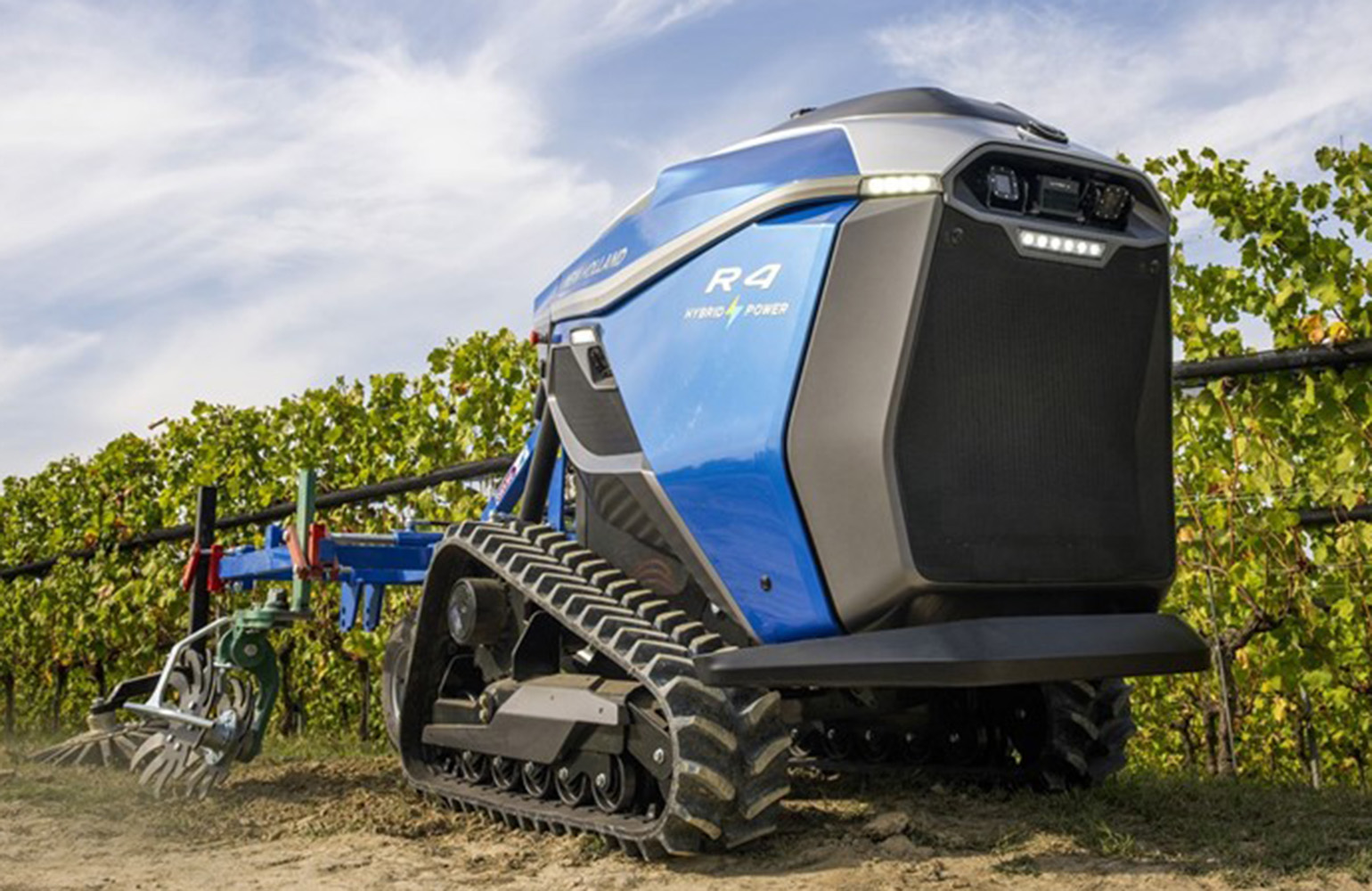
CNH Industrial also designs lighter, more compact systems like its autonomous R4 robot, which minimizes soil compaction during operations — a critical consideration since heavy machinery can degrade soil structure over time.
## Introducing the R4: Built for Specialty Crop Growers
The R4 robot represents CNH Industrial’s investment in autonomous technology tailored specifically for the unique demands of vineyard, orchard, and specialty crop farming.
Designed from the ground up to be fully autonomous and AI-powered, the R4 combines GPS with lidar technology for precise navigation across uneven terrain. It is equipped with cameras that detect obstacles and environmental features, enabling it to execute field operations with a high degree of accuracy.
The R4 is capable of performing a range of tasks that are common in specialty crop operations, including mowing, tillage, and spraying. Its compact design and autonomous capabilities make it particularly well-suited for the tight rows and delicate environments found in vineyards and orchards.
## Balancing Technical Complexity with User-Friendly Design
Operating in real-world fields presents enormous challenges. The terrain is rarely flat — it includes slopes, irregularities, and varied ground conditions. Weather can shift from sunny to overcast to rainy in a single day. Dust, changing crop growth stages, and the presence of other people and equipment add further complexity.
To handle these variables, a farming robot requires an impressive array of hardware and software: GPS receivers, lidar sensors, high-resolution cameras, sophisticated AI algorithms, and advanced control software. Yet Ferrari stressed that all of this complexity must remain invisible to the end user.
“We really need to develop machine and autonomous tech that are able to cope with all these different challenges, but at the same time, develop something that is easy to use for our customers,” he said. The goal is to make powerful autonomous systems accessible to growers regardless of their technical background.
—
## Frequently Asked Questions (FAQ)
**Q: What specific farming tasks can agricultural robots like the R4 perform?**
A: Robots designed for specialty crop operations, such as the R4, can handle mowing, tillage, spraying, and other repetitive field operations. Their autonomous capabilities allow them to work consistently across large areas without constant human oversight.
**Q: How much can precision agriculture reduce chemical usage?**
A: According to industry insights, precision weeding techniques enabled by robotic systems can reduce herbicide use by up to 80%. This is achieved by targeting specific weeds rather than applying chemicals across entire fields.
**Q: Why is interoperability important in farming robotics?**
A: Growers frequently use equipment from different manufacturers. Interoperability ensures that data collected by one machine or robot can be shared and utilized across the entire fleet, maximizing the value of insights and enabling more coordinated farm operations.
**Q: What makes “agentic” systems different from traditional automation?**
A: Traditional automation assists a human operator with individual tasks. Agentic systems, by contrast, are capable of sensing their environment, making autonomous decisions, and executing complete operations end-to-end without requiring step-by-step human guidance.
**Q: What are the biggest environmental challenges for farm robotics?**
A: Farms present highly variable environments — uneven terrain, slopes, shifting weather conditions, dust, different crop states, and the presence of people and other machinery. Robots must be engineered to navigate all of these factors reliably.
**Q: How does data collected by farm robots improve future operations?**
A: Data accumulated over multiple growing seasons — including machine performance, soil conditions, weather patterns, and crop outcomes — can be analyzed through AI to generate recommendations. These insights help farmers optimize when and how to plant, spray, and harvest for better results each year.
—
## Conclusion
Agriculture is at a pivotal moment. Environmental uncertainty, economic pressures, and persistent labor shortages are forcing the industry to rethink traditional approaches. Robotics and intelligent automation offer a compelling path forward — one that promises greater efficiency, reduced environmental impact, and more sustainable farming practices. While significant engineering challenges remain, the combination of advances in AI, machine vision, and autonomous systems is bringing the vision of truly intelligent farm operations closer to reality every day.
Thank you for reading
