



# Cohere Unveils North Small Translate: A Landmark Open-Weight Machine Translation Model
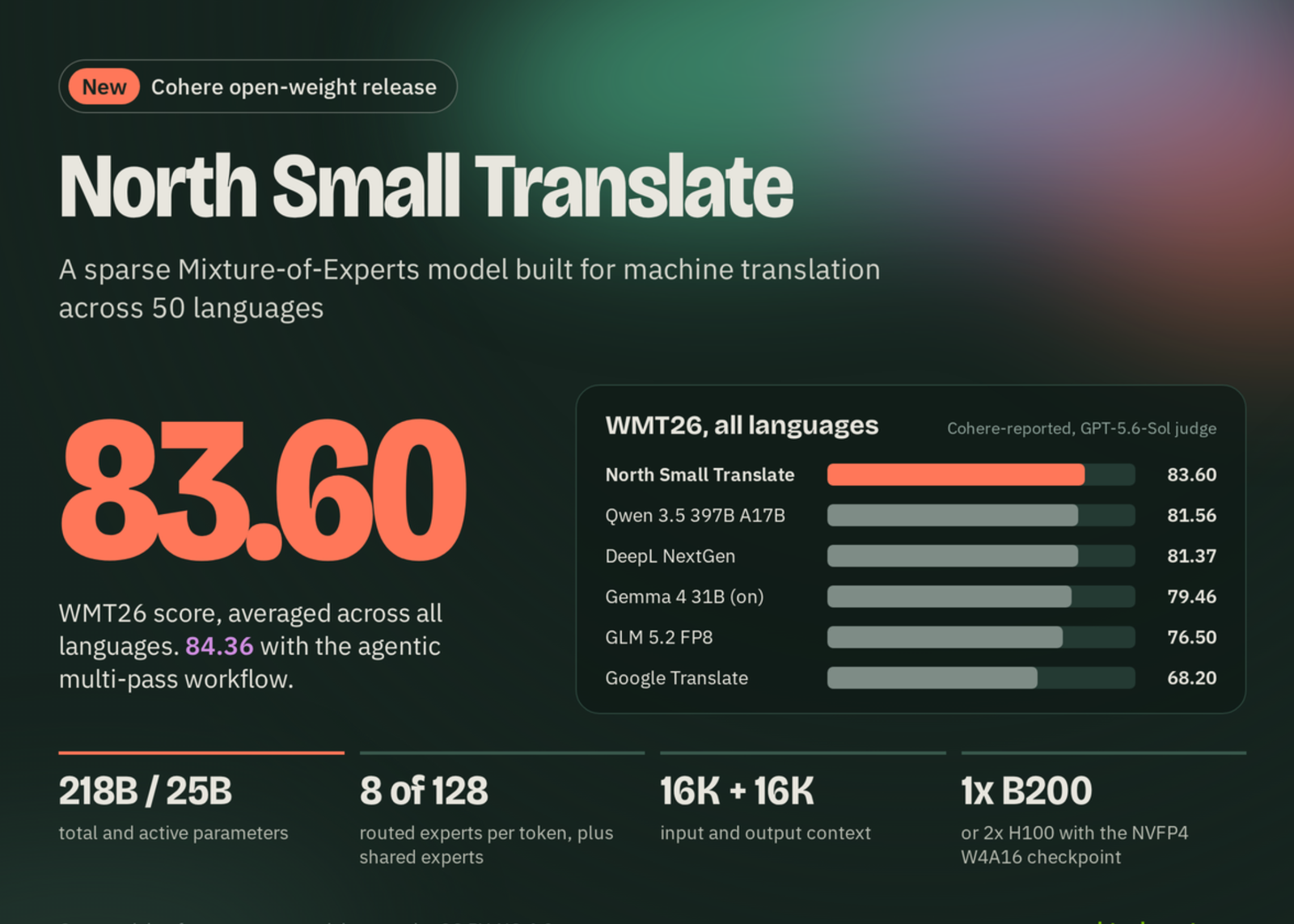
The landscape of multilingual language processing has reached a significant milestone with the release of North Small Translate, a dedicated machine translation model built from the ground up by Cohere. Sporting a massive Mixture-of-Experts architecture with 218 billion total parameters and 25 billion active parameters per token, the model covers an impressive 50 languages spanning from Albanian all the way to Vietnamese. According to internal benchmarks on the WMT26 evaluation suite, North Small Translate achieves an average score of 83.6 across all supported languages, reportedly surpassing industry benchmarks set by DeepL, Google Translate, and prominent open alternatives such as GLM 5.2 and Mistral Large 3.
## Returning to Translation’s Roots
The Transformer architecture was first introduced to the world in 2017 through the landmark paper “Attention Is All You Need,” which demonstrated breakthrough results primarily on English-to-German and English-to-French translation tasks at the WMT 2014 conference. Nearly a decade later, Cohere is making a deliberate return to this foundational problem by building a model purpose-built for translation rather than treating it as a secondary capability of a general-purpose language model.
Cohere has framed this development as a matter of digital sovereignty. The argument is straightforward: organizations that cannot communicate fluently across global languages cannot maintain true independence in international operations. North Small Translate is the first model in Cohere’s growing North family, which also includes earlier releases like Tiny Aya and Command A Translate in Cohere’s multilingual development lineage.
The model was developed in collaboration with RWS, a global leader in translation and localization services. Language Weaver scientists and domain experts from RWS played a pivotal role in shaping the model’s real-world translation quality, ensuring that it performs well not just on benchmark metrics but also on practical, industry-relevant text.
## Understanding the Architecture
At its core, North Small Translate is a decoder-only sparse Mixture-of-Experts Transformer. This design choice is central to its ability to handle such a large parameter count while remaining computationally feasible for deployment. Here is a closer look at the key architectural decisions:
**Expert Routing:** The model contains 128 individual expert networks, of which 8 are activated for each incoming token. In addition, a set of shared experts is applied universally to every token, ensuring baseline coverage across all inputs. A sigmoid-based router scores all 128 experts and normalizes the weights of the top 8 selections, allowing the model to dynamically specialize its computation per token.
**Sparse Activation:** Roughly 11.5% of the model’s total weights are active during any single forward pass. This means that while memory must accommodate all 218 billion parameters, the computational cost per token tracks the 25 billion active parameters — a crucial efficiency gain that makes large-scale translation more practical.
**Attention Design:** The model uses an interleaved attention scheme where sliding-window layers and global layers alternate in a 3:1 ratio. The sliding-window layers employ Rotary Positional Embeddings (RoPE) with a window size of 4,096 tokens, while the global layers have no positional embeddings and can attend to the full context. This hybrid approach balances local precision with long-range coherence — a design first introduced in Cohere’s Command A model and now refined for translation tasks.
**Context Length:** The model supports 16,000 input tokens and 16,000 output tokens, and operates exclusively on text data. This substantial context window is well-suited for translating documents, articles, and other longer-form content without fragmentation.
The model underwent dedicated post-training specifically optimized for translation quality, distinguishing it from general-purpose models that add translation as a downstream capability.
## Deployment Options and Accessibility
One of the most compelling aspects of North Small Translate is its flexibility in deployment. Organizations have several pathways to access the model:
– **Free API Access:** Developers can call the model through Cohere’s API at no cost up to the platform’s rate limits, making it accessible for experimentation and prototyping.
– **Non-Commercial Self-Hosting:** The model weights are available on Hugging Face under a Creative Commons BY-NC 4.0 license, enabling academic researchers and non-profit organizations to run the model on their own infrastructure without licensing fees.
– **Commercial Licensing:** For enterprises that need production-grade deployment, Cohere offers commercial licensing through its Model Vault, providing isolated and secure deployment environments.
Three model checkpoints are available, with varying levels of quantization to match different hardware configurations. The model can run on NVIDIA H100 Hopper GPUs or next-generation Blackwell GPUs, with GPU requirements scaling based on the chosen precision level.
## Performance Across Regions
North Small Translate shows notable regional variation in its translation quality. In European language pairs, the model leads its closest open-weight competitor by a substantial margin. In South Asian language pairs, results are more competitive, with a rival model maintaining a slight edge in some configurations. The model also outperforms DeepL and Google Translate by meaningful margins in regions including the Middle East, Southeast Asia, and East Asia, where specialized translation resources have historically been scarcer.
## Practical Benchmarks
Beyond WMT26 scores, Cohere has published additional benchmarks that paint a practical picture of the model’s capabilities. When generating 1,000 tokens under low concurrency conditions, North Small Translate achieves a throughput of approximately 112 tokens per second on equivalent hardware, compared to 81 tokens per second for a competing 31 billion parameter model. Under high concurrency, the model maintains a throughput advantage. For long-form content such as book chapters, the model achieves a score of 48.9 on paragraph-level evaluation, compared to 21.3 for a widely-used general-purpose translator and 19.4 for another competitor.
The estimated monthly cost for organizations processing large volumes of translation tasks is competitive with the industry standard, making the model financially viable for enterprise-scale adoption.
## Frequently Asked Questions
**What is North Small Translate?**
North Small Translate is an open-weight machine translation model developed by Cohere and Cohere Labs. It is a sparse Mixture-of-Experts Transformer designed specifically for translating text across 50 languages, with 218 billion total parameters and 25 billion active parameters per token.
**How many languages does it support?**
The model covers 50 languages, ranging from Albanian to Vietnamese, spanning multiple language families and regions worldwide.
**How does it compare to DeepL and Google Translate?**
On Cohere’s WMT26 evaluation, North Small Translate achieves an average score of 83.6 across all languages, which reportedly outperforms both DeepL and Google Translate on the same benchmark.
**Can I use this model for free?**
Yes. You can call North Small Translate for free through Cohere’s API until rate limits are reached. The model weights are also available for non-commercial self-hosting on Hugging Face.
**What hardware is needed to run the model?**
Depending on the chosen precision and checkpoint, the model requires between 1 and 8 NVIDIA H100 Hopper GPUs or 1 to 4 Blackwell GPUs. Lower-quantization variants are more hardware-friendly.
**Is the model suitable for commercial use?**
Yes. Cohere offers commercial licensing through its Model Vault for enterprises that need production deployment. RWS also offers a commercial translation platform built on this model.
**What makes this model different from general-purpose language models?**
Unlike general-purpose models that handle translation as one of many capabilities, North Small Translate was post-trained specifically for translation quality. Its architecture — including the 3:1 interleaving of local and global attention layers and the expert routing mechanism — is optimized for the unique demands of multilingual translation.
**What is the context window?**
The model supports 16,000 input tokens and 16,000 output tokens, which is sufficient for translating lengthy documents without splitting them into smaller chunks.
**Who trained the model?**
Cohere built and trained North Small Translate in partnership with RWS (Revenue World Services), whose Language Weaver team contributed domain expertise and real-world evaluation data to ensure practical translation quality.
**What is the WMT26 evaluation?**
WMT26 is a widely recognized benchmark suite for machine translation that evaluates translation quality across multiple language pairs. North Small Translate scored 83.6 on a Cohere-conducted evaluation of this benchmark, averaged across all 50 supported languages.
## Conclusion
North Small Translate represents a significant step forward in making high-quality machine translation both open and accessible. By combining a sparse Mixture-of-Experts architecture with dedicated translation post-training, Cohere has created a model that rivals or exceeds proprietary alternatives across a wide range of languages and use cases. The flexibility in deployment — from free API access to commercial licensing — ensures that organizations of all sizes can benefit from state-of-the-art translation technology.
The model’s lineage, rooted in the original Transformer architecture from 2017 and refined through years of multilingual development, speaks to a broader trend in the AI industry: building specialized tools that excel at specific tasks rather than relying solely on general-purpose models. As global communication needs continue to grow, dedicated translation models like North Small Translate play an increasingly vital role in bridging language barriers and supporting organizational sovereignty.
Thank you for reading
