



**The Modern Automotive Interior: From Driver-Centric Cockpit to Integrated Passenger Experience**
The automotive interior is undergoing a profound transformation. For decades, the design of a car’s interior was fundamentally centered on the driver. The steering wheel, instrument cluster, gearshift, and physical switches were arranged primarily for visibility, direct control, and ergonomic efficiency. However, the rise of electric vehicles (EVs) and advanced driver-assistance systems (ADAS) is dismantling this long-standing paradigm. The modern interior is evolving from a collection of individual controls into a sophisticated, integrated communication environment that must convey complex information seamlessly while redefining the passenger experience.
### A Shift from Control to Communication
In the past, the cockpit was designed around the act of driving. Every interface was placed with the driver’s immediate physical control in mind. Today, as vehicles assume greater responsibility for tasks like acceleration, braking, and steering, the cabin’s role has expanded dramatically. It must now present significantly more information to occupants without overwhelming them. Designers are no longer simply adding larger screens; they are reimagining how vehicles sense, decide, and communicate.
A crucial challenge lies in this transition of responsibility. In Level 2 and Level 2+ semi-autonomous vehicles, the driver remains ultimately responsible, even when the system handles core driving functions. The interior must therefore make the vehicle’s status instantly understandable. It must communicate what the car is sensing, what it has decided, and the limits of its functionality. This requires a move beyond screen-based HMIs (Human-Machine Interfaces) toward a more layered, multi-sensory interaction model that uses sound, touch, and environmental cues.
### Designing for Different Levels of Automation
The design priorities shift considerably as automation levels increase. In Level 2+ vehicles, interfaces must clearly indicate when assistance is active, define the system’s operational boundaries, and alert the driver when attention is required. The cabin becomes a constant stream of status updates that must be digestible at a glance.
At Level 3 automation, the vehicle can manage the dynamic driving task under specific conditions, but it must hand control back to the human when it encounters situations beyond its capabilities. This creates a critical need for a hierarchy of alerts within the cabin. Designers must craft visual, auditory, and haptic cues that distinguish a routine notification from a high-urgency takeover request, ensuring the driver can respond appropriately without confusion.
The transition to Level 4 robotaxis represents an even more radical shift. In these vehicles, which operate within defined areas without a human driver, the traditional instrument panel becomes largely obsolete. Occupants no longer need to monitor speed or engine revs; instead, they care about route confirmation, pickup instructions, door operation, and journey progress. The interior must be designed to build trust, offering reassurance that the automated system remains in control while accommodating passengers with diverse physical needs.
### The Integrated and Immersive Interior
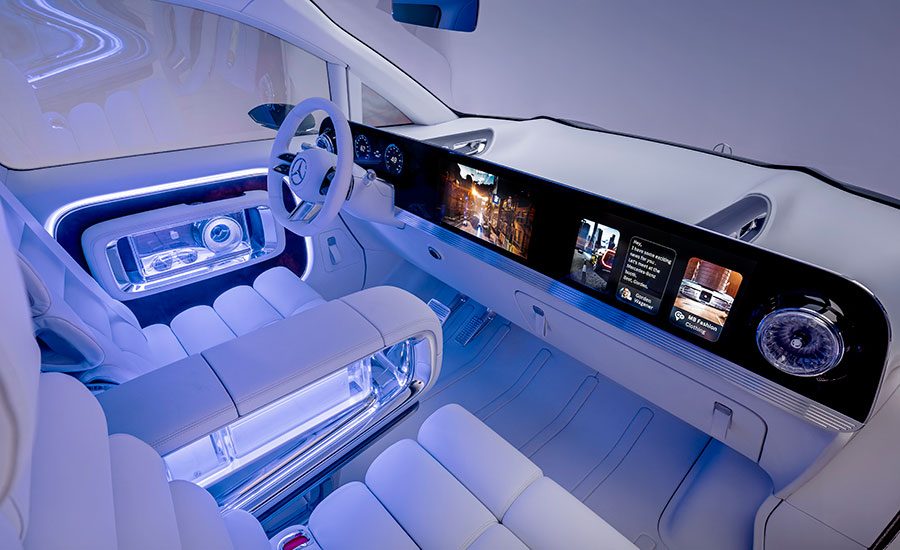
This evolution is leading to interiors that are more flexible, multifunctional, and integrated than ever before. Concepts like Mercedes-Benz’s Vision V illustrate this future, featuring a “private lounge” that separates the passenger compartment from the cockpit. Equipped with reclining seats, a retractable 65-inch cinema screen, and a 42-speaker surround sound system, it demonstrates how an EV’s packaging freedom can create an adaptable space for entertainment, work, or relaxation.
The trend is toward dissolving the boundaries between trim, electronics, and software. Displays, lighting, seating, and sensors must work together as a coordinated “cabin language” to reduce uncertainty and support passenger acceptance. This is exemplified by large-format digital interfaces, like the “super screen” in Mercedes’ CLA Shooting Brake, which combines multiple displays under a continuous glass surface. The future is not about touchscreens everywhere, but about integrating broad glass surfaces with computing hardware while retaining tactile controls where they make functional and ergonomic sense.
### The Role of Advanced Materials and Integration
This new paradigm also places a heavy emphasis on materials and sustainability. Electrification allows for innovative material use, such as Mercedes-Benz’s CLA, which uses four times more secondary material in its thermoplastics as the previous model, with half coming from post-consumer sources. Recycled materials are now integrated into seat covers, foam, and substructures, pushing for a circular design approach rather than a decorative afterthought.
Furthermore, the consolidation of functions is key to simplifying assembly and improving efficiency. Companies like TactoTek are pioneering injection-molded structural electronics (IMSE), where physical controls, lighting, and sensing capabilities are embedded within a single, thin molded structure. This move from a collection of components to an integrated functional module reduces part count, inventory, and assembly steps, while also freeing up valuable interior space.
### The Centralization of Intelligence
The intelligence behind these interfaces is also migrating. Rather than being distributed across dozens of local microcontrollers, the smarts are moving into centralized and zonal computing systems. This reduces wiring complexity and allows for more flexible interior configurations, such as movable seats, swiveling displays, and motorized vents. However, it also means that engineering complexity is shifted earlier in the development process, requiring unprecedented collaboration between styling, mechanics, electronics, and software teams from the very beginning.
### Conclusion
The transformation of the automotive interior is redefining the relationship between the vehicle, the driver, and the passenger. The era of the isolated, driver-focused cockpit is giving way to a holistic, integrated environment that prioritizes communication, experience, and adaptability. Success in this new landscape requires automakers and suppliers to treat the interior not as a series of separate parts, but as a unified system where hardware, software, materials, and design converge. The ultimate goal is to create cabins that are intuitive, trustworthy, and capable of delivering the seamless, personalized mobility experience that the future demands.
