



## Understanding AI Career Pathways: Which Role Fits You?
The world of artificial intelligence offers exciting opportunities, but breaking into the field can feel overwhelming. Many aspiring professionals enter the space with enthusiasm yet confusion, unsure which direction to pursue. Over three years of mentoring data science students across more than a thousand sessions, one consistent pattern emerges: before writing a single line of code, it’s essential to understand the distinct paths available in AI. Treating “AI career” as a single monolith leads to mismatched expectations, wasted effort, and frustration. Instead, think of AI as a diverse landscape with multiple viable routes, each suited to different strengths and interests.
### What Does “A Career in AI” Actually Mean?
The term “AI career” covers an enormous range of roles, responsibilities, and skill sets. One position labeled “AI Engineer” might involve adapting large language models for production, while another with the same title focuses on API integration. Similarly, “Data Scientist” can mean anything from building statistical models to designing recommendation engines or conducting advanced mathematical research. This ambiguity creates a common pitfall: people optimize for a fictional average role rather than a concrete path, leading them to develop irrelevant skills.
To avoid this, it’s crucial to identify which orientation aligns with your background, goals, and tolerance for depth versus breadth. The field generally rewards three distinct approaches, and understanding these helps you locate where you fit rather than assuming there’s one correct route. No path is superior; each simply serves different strengths.
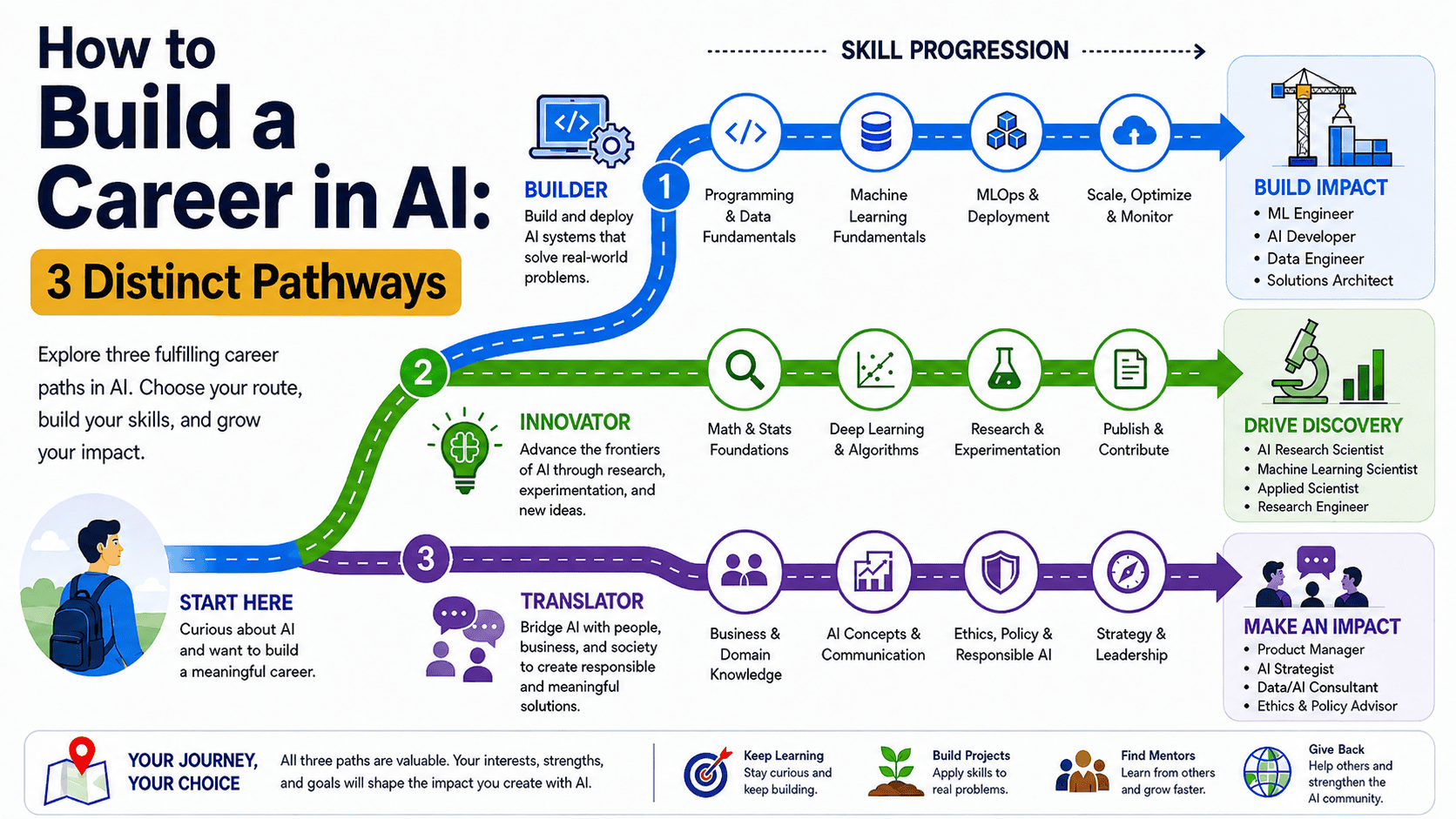
### Three Distinct AI Career Pathways
### Pathway 1: The Builder (Engineering and Deployment)
The Builder focuses on taking existing AI models and making them reliable, scalable, and production-ready. This path centers on software engineering principles, system stability, and efficient data pipelines. If you enjoy solving logical problems and seeing tangible outcomes from what you ship, this pathway is likely a good match.
Common roles include:
– **Machine Learning Engineer:** Responsible for deploying and scaling predictive models into live applications, such as recommendation systems or fraud detection tools.
– **Data Engineer:** Designs and maintains the data infrastructure that feeds into AI models, ensuring quality, accessibility, and performance.
– **AI Developer:** Integrates external AI services and APIs, like large language models or vision tools, into end-user applications.
A frequent misconception is that this path requires inventing new algorithms. In reality, most Builder roles emphasize engineering excellence over theoretical innovation. I once mentored a student who achieved strong benchmark scores but lacked experience with version control, model monitoring, or data validation. During interviews, he discovered these practical skills were just as critical as accuracy metrics. For this pathway, solid foundations in software development are paramount.
Recommended starting points include Python, scikit-learn, PyTorch, and exposure to at least one major cloud platform.
### Pathway 2: The Innovator (Research and Science)
The Innovator path is about advancing the state of the art. Professionals on this trajectory work on discovering new methods, designing novel architectures, and tackling unsolved problems. This is the most mathematically intensive pathway, relying heavily on linear algebra, probability theory, and optimization techniques.
Typical roles in this space include:
– **Research Scientist:** Engages in cutting-edge development of AI methods, often within academic institutions or advanced research labs. This role typically requires a Ph.D. and deep theoretical knowledge.
– **Data Scientist:** Analyzes complex datasets to uncover patterns, build early-stage models, and support decision-making.
– **Deep Learning Specialist:** Focuses specifically on neural network design and applications, frequently in domains like natural language processing or computer vision.
Unlike the Builder path, enthusiasm alone isn’t sufficient here. The entry barrier is steep, and many people underestimate the mathematical rigor required. It’s common for aspiring researchers to be fascinated by AI concepts while lacking the necessary background in advanced math. This gap leads to frustration and stalled progress. If this path interests you, test your preparedness by working through the DeepLearning.AI Machine Learning Specialization and fast.ai resources.
### Pathway 3: The Translator (Product, Strategy, and Ethics)
The Translator pathway is often overlooked, yet it represents a major opportunity for many professionals. Translators bridge the gap between technical capabilities and business needs. They don’t necessarily write code but must understand how AI works, where it fails, and what risks it poses.
Common roles include:
– **AI Product Manager:** Defines product strategy by balancing user requirements, business objectives, and technical constraints.
– **AI Governance and Ethics Lead:** Ensures AI systems are fair, compliant, and safe, and evaluates whether projects should proceed.
– **Prompt Engineer:** Crafts and optimizes inputs for large language models to generate accurate, reliable, and safe outputs.
Some professionals assume this path is a compromise, but that reflects a cultural bias within parts of the AI community. In practice, the most valuable work in many organizations is determining which problems AI can genuinely solve and how to integrate it effectively. Clinical experience, domain expertise, or business knowledge often becomes a significant advantage rather than a hindrance. If this description resonates, the Hugging Face LLM Course offers an excellent way to build practical fluency.
### Choosing the Path That Fits You
The most common mistake across countless mentoring sessions is selecting a path based on prestige or surface-level appeal rather than genuine fit. AI career discussions often highlight glamorous outcomes while obscuring the day-to-day reality of each role. Without honest self-assessment, it’s easy to pursue a direction that doesn’t align with your strengths, experiences, or timeline.
Before committing, consider the following steps:
– Identify your strongest existing background: engineering, mathematics, or domain expertise.
– Read real job descriptions for each pathway and compare daily responsibilities.
– Talk to people currently working in these roles to understand the actual experience.
– Be realistic about your available time and the preparation each path requires.
– Focus on one coherent path instead of trying to sample multiple directions.
– Reevaluate your choice after several months of dedicated practice, not a few weeks.
At a glance, the pathways compare as follows:
| Pathway | Best For | Typical Background | Skill Focus |
|———|———-|——————-|————-|
| The Builder | Those who enjoy building and shipping systems | Computer science, software engineering | Python, PyTorch, cloud platforms |
| The Innovator | Those who love math and open-ended problems | Graduate study in math, statistics, or computer science | Linear algebra, probability, optimization |
| The Translator | Those skilled at communication and strategy | Business, law, design, or domain fields | Product sense, user experience, domain expertise |
### Final Thoughts
Across thousands of mentoring sessions, I’ve seen students thrive on all three pathways—but only after they stopped treating these options as interchangeable. Each path emphasizes different strengths and requires distinct preparation. Choosing wisely means aligning with where you stand now and where you want to go, rather than following trends or perceived prestige.
Your choice matters less for how impressive it sounds and more for how well it matches your current foundation and future aspirations. You can choose to build the engine, design the fuel, or steer the vehicle. Once you select the path that fits, commit to it long enough to develop genuine competence. Clarity of direction accelerates progress far more than breadth of exploration.
—
### Frequently Asked Questions (FAQ)
**Q: Do I need a Ph.D. to work in AI?**
Not necessarily. While research scientist roles typically require advanced degrees, many positions—such as machine learning engineer, data scientist, AI product manager, and prompt engineer—are accessible with practical skills, project experience, and relevant coursework. The Builder and Translator pathways often do not require graduate study.
**Q: How can I test which pathway suits me?**
Start by evaluating your strengths and interests. Try short exploratory projects in each area: build a small model and deploy it (Builder), work through theoretical exercises in linear algebra and probability (Innovator), and practice framing AI problems within a business context (Translator). Reading job descriptions and speaking with professionals in each role also provides valuable insight.
**Q: Is coding required for all AI careers?**
Not all roles demand expert-level coding. Builder roles typically require strong programming skills, while Innovator roles emphasize theoretical understanding. Translator positions focus more on communication, product sense, and strategic thinking, though basic technical literacy is essential.
**Q: How long does it take to switch into an AI career?**
Timelines vary based on your starting point and chosen pathway. Building skills for the Builder path might take several months to a year of focused study and practice. The Innovator path often requires more time for deep mathematical preparation and possibly formal education. The Translator path may be accessible more quickly if you already have domain expertise.
**Q: Can I switch between pathways later?**
Yes, pathways aren’t permanent labels. Many professionals move between roles as they gain experience. Starting with a clear understanding of your initial orientation, however, helps you build a coherent foundation and make informed adjustments over time.
### Conclusion
Choosing a career in AI begins with recognizing that the field is not a single profession but a collection of distinct pathways. Whether you are drawn to building scalable systems, advancing theoretical research, or translating technology into business value, the key is to align your natural strengths and goals with the right direction. Avoid the trap of chasing an idealized average role; instead, commit to a path that fits your current foundation and long-term aspirations. With clarity, focused effort, and realistic expectations, you can build a meaningful and successful career in AI.
