



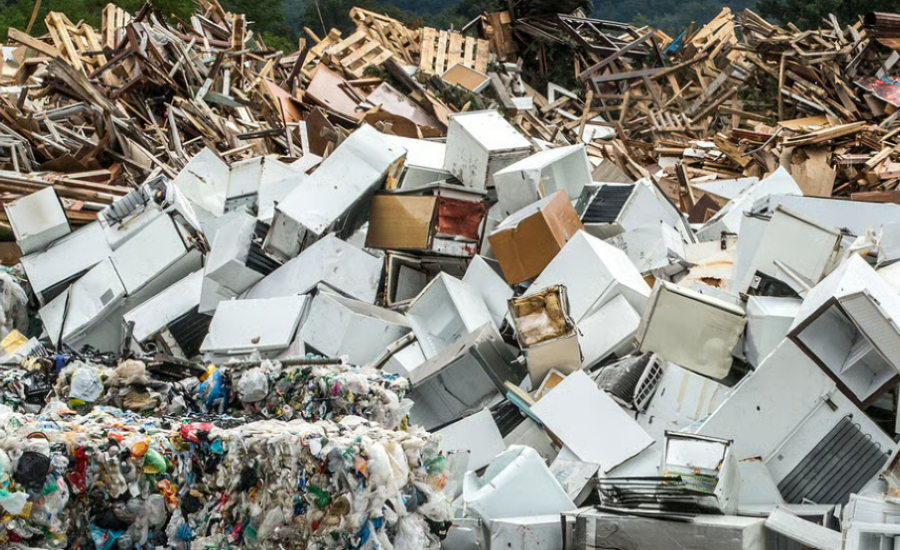
Each year, countless household appliances are swapped out and thrown away. As these used goods accumulate, they’re piling up in landfills and creating a serious environmental challenge.
To tackle this growing problem, manufacturers are rolling out sustainability initiatives centered on recycling and reuse. The aim is to build a circular economy featuring closed-loop systems where disassembly operations are placed close to final assembly lines.
Panasonic Corp. is one of the companies at the forefront of this effort. While the company is widely recognized for its batteries and consumer electronics, it also manufactures a broad range of home appliances — air conditioners, dishwashers, microwave ovens, refrigerators, toasters and washing machines among them.
Engineers at Panasonic’s R&D center in Osaka, Japan, have recently created an automated disassembly process that leverages robots to accurately sort metals, plastics and other materials. This effort falls under the company’s Green Impact initiative.
“The circular economy represents a shift from a make-use-dispose approach to systems that maximize value for customers while reducing reliance on virgin resources,” says Andrea Murphy, director of environmental affairs and sustainability at Panasonic North America.
According to Murphy, disassembly is becoming increasingly critical for manufacturers for several reasons, including:
- Regulatory pressure. “Worldwide regulatory demands are growing, and there are competitive benefits to being an early adopter that can help shape thoughtful and actionable regulation,” Murphy explains.
- Risk avoidance. “The availability and cost of critical materials continue to climb,” Murphy notes. “We need to make sure we’ll have the materials our businesses require. Recovering key materials — such as copper, cobalt, nickel and rare earth metals — lowers risk and lessens exposure to price swings and supply disruptions.”
- Customer convenience. “Consumer convenience is essential,” Murphy asserts. “We can cut costs and help secure a sustainable future for society. But these efforts won’t succeed if they don’t deliver added value to the customer.”
Robots handle the removal and installation of heat pumps used in washing machines. Photo courtesy Panasonic Corp.
Streamlining Disassembly
Panasonic’s disassembly CPS (cyber-physical system) models and refines processes using 3D CAD tools. The data generated informs both new product design and automation strategies, supporting efficient part reuse and remanufacturing.
Need quick answers on assembly and manufacturing topics?
Try Ask ASM, our new smart AI search tool.
Ask ASM
“Careful, precise disassembly allows for high-purity material separation, making it possible to produce top-quality recycled materials and push the recycling process forward,” says Murphy. “By embedding design principles that improve maintainability, [we can] extend product lifespans and recover more resources.
“A disassembly CPS is a cross-industry technology solution that brings together advanced tools like generative AI, IoT and sensors to digitally replicate physical environments, enabling visualization, standardization and optimization,” Murphy explains.
“These insights are then leveraged to create new value — including better efficiency, productivity and quality,” Murphy adds. “Rooted in [our] manufacturing expertise, we can apply this across many areas to drive fundamental, root-cause-focused problem solving, such as autonomous disassembly.”
Murphy describes autonomous disassembly as “robotic or hybrid human-robot workcells that identify parts, select tools and carry out safe removal sequences without needing to be preprogrammed for a single, fixed product state. They can adjust in real time using artificial intelligence and machine vision technology.”
Panasonic’s circular economy approach includes designing for disassembly as well as designing for repair and maintenance.
“We work to refine our designs by making it easier to reach components that need maintenance or replacement — through features like better tool access and the use of mechanical fasteners rather than adhesives,” says Murphy. “[We are also] tapping into simulation and AI-driven optimization to further advance the design for robotic disassembly.
“By running extensive trial-and-error simulations with AI, we can pinpoint the most effective design configurations for both assembly and disassembly,” Murphy notes. “With some of our home appliances, for example, we’re exploring redesigns that would allow robots to carefully take them apart so that valuable components can be recovered for recycling or potential reuse.”
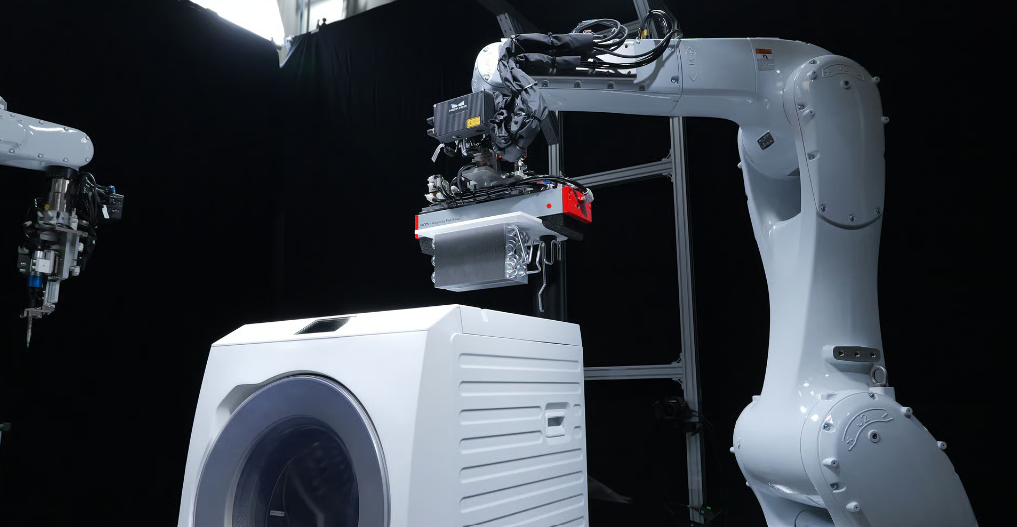
Technicians at Panasonic are employing six-axis robots to take apart air conditioners, microwave ovens, and washing machines. Photo courtesy Panasonic Corp.
Designing for repair or maintenance involves creating products that last longer and allow for easier component replacement.
“By studying repair records and existing product designs, we’ve introduced improvements that support circularity,” notes Murphy. “One excellent example is the heat pumps found in washing machines.”
Panasonic was the first to adopt heat pump technology to improve drying efficiency. Engineers relocated the unit from the bottom to the top of the machines, making this critical part much simpler to reach for servicing.
Now, the heat pump can be readily cleaned and maintained, helping the entire washing machine last longer. This redesign also cut repair time by half.
The Importance of Robots
Panasonic’s engineering team is teaching six-axis robots to disassemble air conditioners, microwave ovens, and washing machines. Magnetic grippers lift appliance covers, while built-in screwdrivers take out fasteners. Specialized end effectors with various tools cut wires and gently extract parts.
“Robots play a key role in automating disassembly, particularly when handling large volumes,” explains Murphy. “From a human perspective, assigning repetitive, physically demanding tasks to robots helps avoid workplace injuries.
“Moreover, robots keep workers away from electrical, thermal, and chemical hazards when removing batteries and capacitors,” Murphy adds. “With AI, these robots can learn on their own and adjust as needed. They can simulate different disassembly methods or discover better ways to design appliances for easier teardown.”
AI technology identifies the best method to disassemble a product without harming delicate parts. Control systems give feedback so components can be smoothly removed, reused, or fixed. They also enable robots to position themselves with precision, mimicking manual techniques.
A disassembly database keeps detailed information on every model. This data helps boost equipment efficiency and sets the stage for further automation.
“The automated disassembly systems use machine vision to take pictures,” says Murphy. “Thanks to AI, the cameras can accurately spot screws even if they’re covered in dirt or rust. Then, a robotic arm fitted with a screwdriver is positioned to remove the fasteners.”
ASSEMBLY ONLINE
To learn more about sustainable manufacturing, visit www.assemblymag.com to read related articles.
