



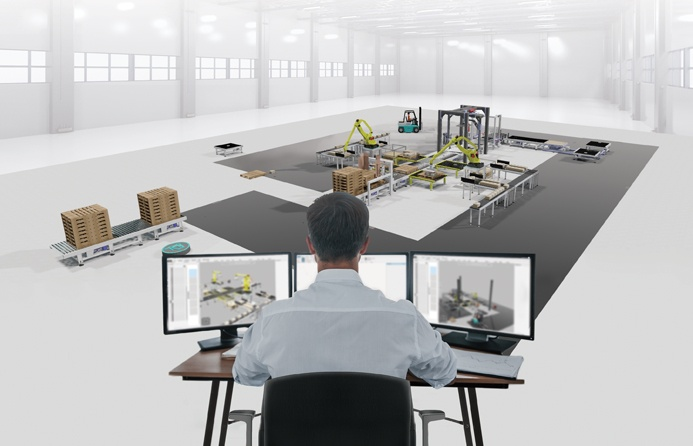
During the early stages of factory layout design, discrete event simulation and digital twin technology are essential tools. Source: Visual Components
As more manufacturers adopt virtual tools, the aim goes beyond mere visualization. The real objective is to understand, test, and refine processes long before they hit the production floor. Although simulation and digital twin technologies are now key pillars of digital transformation, many manufacturers still struggle to tell them apart when considering virtual solutions for their operations. Understanding these differences—and knowing where each technology fits within the system design, planning, and operational lifecycle—is essential for making smart decisions that drive tangible results.
At their core, both simulation and digital twin methods create realistic virtual versions of real-world situations. However, they differ in purpose, how deeply they integrate with actual data, and the breadth of what they represent. With a clear grasp of these distinctions, manufacturers can more effectively match their technology choices to their business goals.
Simulation: A controlled virtual environment
Fundamentally, simulation is a controlled virtual setup that models how a particular scenario unfolds over time, guided by predefined rules and assumptions. In manufacturing, this usually means discrete event simulation, where elements such as machines, conveyors, robots, and tasks are depicted symbolically and interact based on set logic to illustrate how the scenario might perform.
Digital twin: Real-time continuity between virtual and physical environments
Unlike static or predictive simulations and digital models, digital twins belong to a unique category of virtual systems. A digital twin isn’t just a digital copy—it’s a dynamic, real-time mirror of a physical system that constantly shares data with its real-world counterpart.
This focus on two-way data flow is what sets digital twins apart from traditional digital models and what some refer to as “digital shadows.” With a digital shadow, data may move from the physical system to the virtual one, keeping information current. But without feedback that influences the physical process, the model stays one-directional and limited in capability.
A genuine digital twin goes further:
- It connects virtual and physical systems through continuous data exchange.
- It enables monitoring, control, prediction, and optimization using live data.
- It allows for ongoing adjustments as production variables change in real time.
In manufacturing, digital twins can take many forms—from individual machine or cell twins to full plant or process twins that represent entire factories. These virtual counterparts evolve alongside the physical system, mirroring current conditions and helping stakeholders grasp not only what’s happening, but why it’s happening.

How simulation and digital twins relate, and where they differ
While simulation and digital twin technologies share common ground—especially in their reliance on virtual models—they address different stages of the manufacturing lifecycle and serve distinct functions.
| Feature | Simulation | Digital twin |
|---|---|---|
| Connection to real data | No | Yes, bi-directional |
| Typical usage | Planning and design | Ongoing operation and optimization |
| Feedback to physical scenario | No | Yes |
| Level of continuity | Static or scenario-based | Dynamic, real-time |
| Primary benefit | Testing and validating designs | Monitoring, prediction, optimization |
In practice, some differences may seem subtle, but the underlying goals and integration levels are distinct: simulation is a purposeful experiment conducted in a controlled setting, while digital twins are living systems that grow and adapt alongside their physical counterparts.
Simulation lays the groundwork. It allows manufacturers to explore options, test design alternatives, and build confidence before systems are linked to real-world data streams. Without a solid simulation foundation, digital twins risk duplicating complexity without true understanding.
In many ways, simulation is where the critical thinking occurs—where hypotheses are tested and insights are uncovered—while digital twins are where those insights are put into action in the real world.
When to use each approach in manufacturing environments
Recognizing the specific strengths of simulation and digital twins helps manufacturers determine where to focus their time and resources.
Simulation for early decisions
Simulation is especially useful when the physical system is still changing—during planning, layout design, or automation assessment. For instance:
- A manufacturing team considering a new plant layout can simulate different configurations to assess material flow, cycle times, and capacity. This exposes design issues early and improves communication among engineers, managers, and production staff.
- Simulation can reveal bottlenecks that static CAD models miss, since CAD lacks dynamic behavior.
Simulation provides a safe way to evaluate scenarios and lets teams confirm assumptions before investing capital.
Digital twins for operational insight
Digital twins deliver the greatest value once a system is up and running and generating
data. The simulation is further enhanced by:
- Offering immediate, real-time feedback on operational performance
- Facilitating flexible decision-making that adjusts to changing conditions
- Enabling predictive maintenance strategies and system optimization
For instance, a digital twin can assist manufacturers in the continuous refinement of conveyor systems, the identification of throughput inconsistencies, and the adjustment of production workflows in response to real-time operational data.
This continuous interplay between virtual and digital environments allows businesses to transition from sporadic assessments to a model of ongoing enhancement, powered by live data streams.

Visual Components says simulation is important to planning manufacturing.
How both strategies lead to improved manufacturing results
Although simulation and digital twins possess unique features, they are united by a common goal: the reduction of uncertainty, the enhancement of efficiency, and the promotion of more intelligent decision-making.
Simulation illuminates uncertainties and certainties. By modeling diverse scenarios, planners can evaluate the impact of design choices under various conditions long before any equipment is procured, installed, or reconfigured.
Digital twins bring clarity to ongoing operations. Once systems are operational, continuous real-time data empowers operators and managers to assess performance, detect emerging problems, and act in a proactive manner.
Combined, they establish a seamless continuum: Simulation typically lays the groundwork for a digital twin, preparing systems for integration and ensuring that the underlying models are both robust and relevant. Digital twins subsequently advance simulation into real-time application, connecting the model with live operations to allow for constant refinement.
This progression empowers manufacturing teams to shift away from reactive problem-solving and toward an agile, data-driven posture—where changes are anticipated rather than feared, and improvements are a continuous journey, not isolated events.
While simulation and digital twin technologies are frequently discussed as if they are the same, they are distinct in their specific objectives, integration methods, and inherent value. A clear understanding of these distinctions is vital for making informed technology investments. Simulation allows for controlled experimentation, the validation of designs, and the early discovery of viable solutions. A digital twin transitions these insights into the operational sphere, integrating live data to close the feedback loop and support dynamic, adaptive decisions.
Leveraging the unique capabilities of each allows manufacturers to construct a tiered digital transformation strategy—one that starts with understanding and culminates in sustained improvement. In this model, simulation is not made obsolete by digital twins; instead, it serves as the essential foundation for constructing more interconnected, robust, and intelligent manufacturing systems.
 About the Author
 About the Author
Graham Wloch is the Director of Business Development at Visual Components.
Established by a team of simulation specialists with 25 years of industry experience, Visual Components is a pioneer in the domain of 3D manufacturing simulation. The company reports serving as a technology partner to more than 2,400 prominent brands and 40 global partners, delivering a streamlined, efficient, and cost-effective platform for designing, simulating, and optimizing production processes. Visual Components also provides offline robot programming (OLP) technology for the swift and precise programming of industrial robots. Visual Components has operated as a member of the KUKA Group since 2017.
