



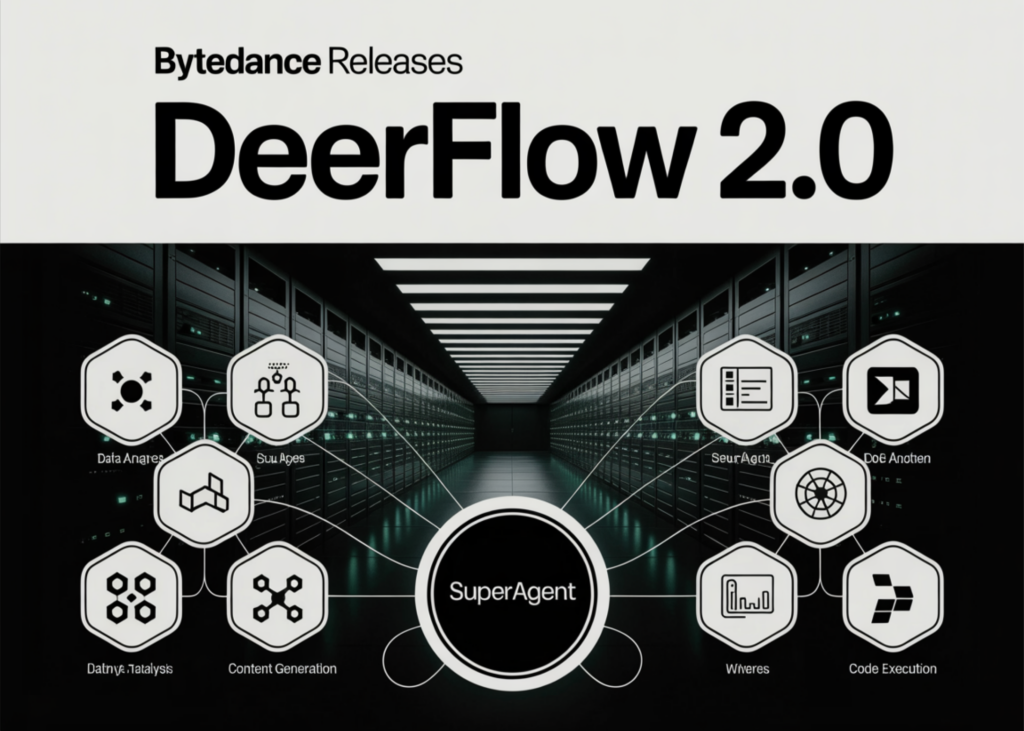
The period of the ‘Copilot’ is formally getting an improve. Whereas the tech world has spent the final two years getting comfy with AI that implies code or drafts emails, ByteDance group is transferring the goalposts. They launched DeerFlow 2.0, a newly open-sourced ‘SuperAgent’ framework that doesn’t simply counsel work; it executes it. DeerFlow is designed to analysis, code, construct web sites, create slide decks, and generate video content material autonomously.
The Sandbox: An AI with a Pc of Its Personal
Probably the most important differentiator for DeerFlow is its strategy to execution. Most AI brokers function throughout the constraints of a text-box interface, sending queries to an API and returning a string of textual content. If you need that code to run, you—the human—have to repeat, paste, and debug it.
DeerFlow flips this script. It operates inside a actual, remoted Docker container.
For software program builders, the implications are huge. This isn’t an AI ‘hallucinating’ that it ran a script; it’s an agent with a full filesystem, a bash terminal, and the flexibility to learn and write precise information. Whenever you give DeerFlow a activity, it doesn’t simply counsel a Python script to research a CSV—it spins up the atmosphere, installs the dependencies, executes the code, and arms you the ensuing chart.
By offering the AI with its personal ‘computer,’ ByteDance group has solved one of many largest friction factors in agentic workflows: the hand-off. As a result of it has stateful reminiscence and a persistent filesystem, DeerFlow can bear in mind your particular writing kinds, challenge constructions, and preferences throughout completely different periods.
Multi-Agent Orchestration: Divide, Conquer, and Converge
The ‘magic’ of DeerFlow lies in its orchestration layer. It makes use of a SuperAgent harness—a lead agent that acts as a challenge supervisor.
When a posh immediate is acquired—for instance, ‘Research the top 10 AI startups in 2026 and build me a comprehensive presentation‘—DeerFlow doesn’t attempt to do it multi functional linear thought course of. As an alternative, it employs activity decomposition:
- The Lead Agent breaks the immediate into logical sub-tasks.
- Sub-agents are spawned in parallel. One may deal with internet scraping for funding knowledge, one other may conduct competitor evaluation, and a 3rd may generate related photos.
- Convergence: As soon as the sub-agents full their duties of their respective sandboxes, the outcomes are funneled again to the lead agent.
- Remaining Supply: A last agent compiles the info into a refined deliverable, reminiscent of a slide deck or a full internet software.
This parallel processing considerably reduces the time-to-delivery for ‘heavy’ duties that will historically take a human researcher or developer hours to synthesize.
From Analysis Device to Full-Stack Automation
Curiously, DeerFlow wasn’t initially meant to be this expansive. It began its life at ByteDance as a specialised deep analysis software. Nonetheless, as the inner group started using it, they pushed the boundaries of its capabilities.
Customers started leveraging its Docker-based execution to construct automated knowledge pipelines, spin up real-time dashboards, and even create full-scale internet functions from scratch. Recognizing that the group wished an execution engine moderately than only a search software, ByteDance rewrote the framework from the bottom up.
The result’s DeerFlow 2.0, a flexible framework that may deal with:
- Deep Internet Analysis: Gathering cited sources throughout your complete internet.
- Content material Creation: Producing stories with built-in charts, photos, and movies.
- Code Execution: Working Python scripts and bash instructions in a safe atmosphere.
- Asset Technology: Creating full slide decks and UI parts.
Key Takeaways
- Execution-First Sandbox: In contrast to conventional AI brokers, DeerFlow operates in an remoted Docker-based sandbox. This provides the agent an actual filesystem, a bash terminal, and the flexibility to execute code and run instructions moderately than simply suggesting them.
- Hierarchical Multi-Agent Orchestration: The framework makes use of a ‘SuperAgent’ result in break down advanced duties into sub-tasks. It spawns parallel sub-agents to deal with completely different parts—reminiscent of scraping knowledge, producing photos, or writing code—earlier than converging the outcomes right into a last deliverable.
- The ‘SuperAgent’ Pivot: Initially a deep analysis software, DeerFlow 2.0 was totally rewritten to develop into a task-agnostic harness. It might probably now construct full-stack internet functions, generate skilled slide decks, and automate advanced knowledge pipelines autonomously.
- Full Mannequin Agnosticism: DeerFlow is designed to be LLM-neutral. It integrates with any OpenAI-compatible API, permitting engineers to swap between fashions like GPT-4, Claude 3.5, Gemini 1.5, and even native fashions by way of DeepSeek and Ollama with out altering the underlying agent logic.
- Stateful Reminiscence & Persistence: The agent encompasses a persistent reminiscence system that tracks consumer preferences, writing kinds, and challenge context throughout a number of periods. This enables it to perform as a long-term ‘AI employee’ moderately than a one-off session software.
Try GitHub Repo. Additionally, be at liberty to observe us on Twitter and don’t neglect to hitch our 120k+ ML SubReddit and Subscribe to our E-newsletter. Wait! are you on telegram? now you may be a part of us on telegram as effectively.
