



Picture by Editor
# Introduction
Making a product necessities doc (PRD) is a typical course of in product administration and a commonplace process in sectors like software program growth and the tech business as an entire. A number of the sometimes discovered difficulties and arduous necessities in making a PRD embrace making certain readability, stopping scope creep, and preserving stakeholder alignment.
Fortunately, AI instruments have risen to assist navigate these challenges extra successfully, with out utterly delegating the strategic decision-making underlying the PRD creation course of — in different phrases, with the human nonetheless within the loop. One instance is Google’s NotebookLM, which synthesizes grounded uncooked knowledge or supplies to reply questions, thereby turbocharging the workflow for creating grounded, helpful PRDs.
This text will navigate you, primarily based on a beginner-friendly use case, by the method of utilizing NotebookLM’s options to show uncooked, generally chaotic info right into a grounded PRD in a matter of minutes. Spoiler: it will not be nearly chatting with an AI assistant.
# From Messy Notes to a Structured PRD Draft
Let’s think about the next situation. You’re the newly employed product supervisor for a startup that wishes to develop a brand new cell app referred to as FloraFriend. The purpose of the app is to assist individuals cease by chance killing their houseplants.
The crew, together with you, has collected a set of three “messy” paperwork that include descriptions for what the potential app ought to be like:
interview_transcript_matt.txt: a 30-minute interview with a consumer referred to as Matt, who’s the proprietor of over 50 vegetation. In these interview notes, Matt says present apps are “overly complicated” and make it tough to retain in thoughts features like “which fertilizer to use.”competitor_research_notes.txt: a tough record of bullet factors made after analyzing competitor apps like “PictureThis” and “Planta”, highlighting their paywalls and interface drawbacks.brainstorming_whiteboard.jpg: random however considerably “cool” concepts which were talked about by the crew throughout lunch breaks and different informal conversations, e.g. “spotify playlists for plants”, “watering reminders”, and so forth.
Think about full paperwork containing the entire content material described above. Manually turning these right into a clear PRD that properly brings all of it collectively might sound like a ache, proper? Enter NotebookLM!
Log in to NotebookLM along with your Google Account and click on “Create New Notebook“. Give your new pocket book a reputation, one thing like “FloraFriend PRD.”
As soon as the brand new pocket book has been created, you will be welcomed to the primary NotebookLM interface, which seems like this:
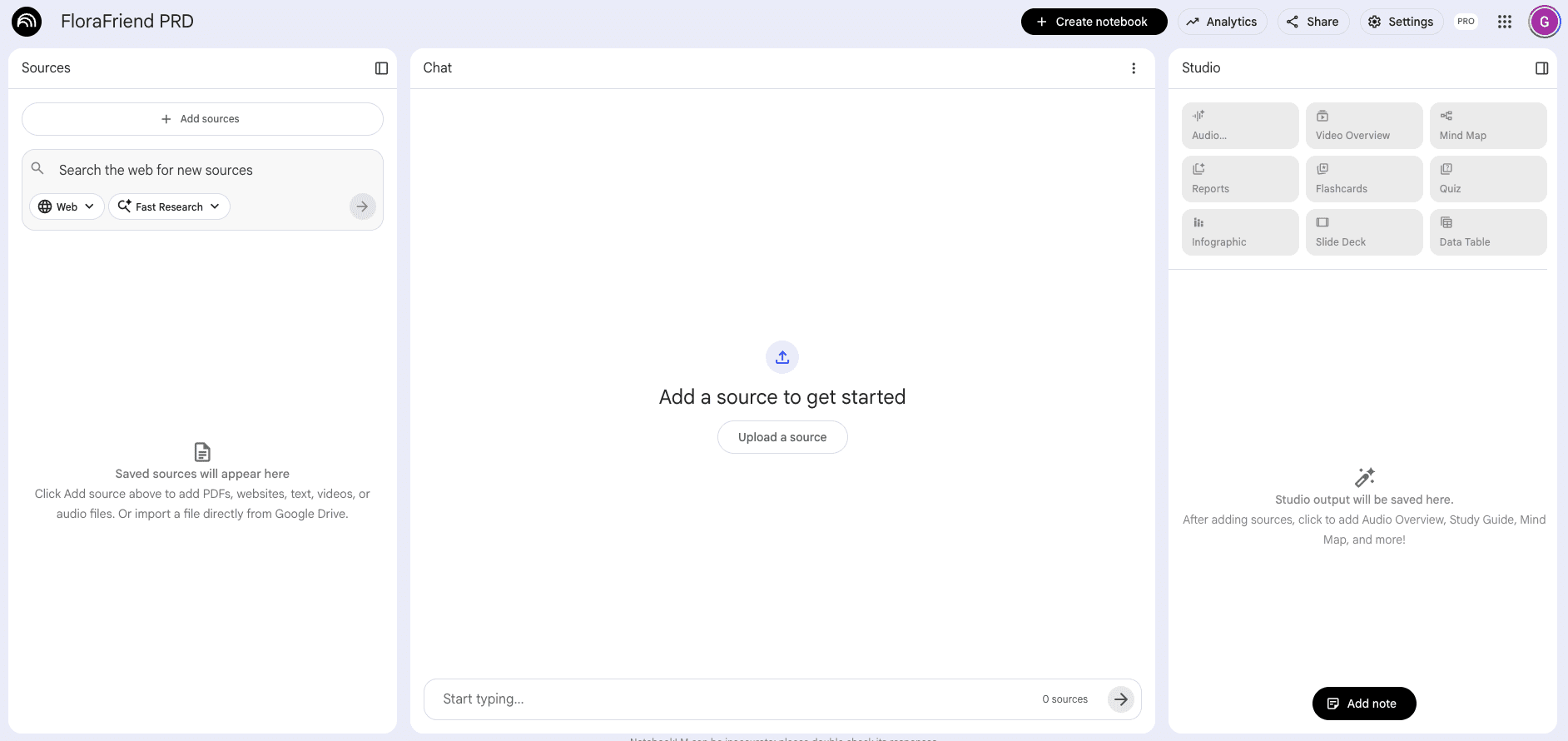
NotebookLM Interface
A phrase of warning: this newly created pocket book shouldn’t be clever per se. It’s not an everyday massive language mannequin (LLM); it doesn’t know plant care or some other particular matters. However we’re about to show it an “express” Grasp’s diploma about it with our messy — but enlightening for the device — notes.
Suppose you’ve gotten the three above talked about recordsdata with some content material associated to the plant care app, or some other uncooked info recordsdata of your individual. You possibly can add them to the NotebookLM canvas by utilizing the add button in the primary, central part.
As soon as uploaded, you possibly can consider your pocket book as one thing much like a tiny, toy-sized retrieval-augmented era (RAG) system that may begin pondering and behaving AI-like primarily based on the data it has entry to. In reality, with out asking it, by clicking on both one of many uploaded recordsdata on the left-hand facet, NotebookLM generates a concise, well-organized abstract of the contents in that file: that is referred to as a file’s Supply information.
Now comes the important thing half. We might merely ask within the chat field on the backside one thing like “Write a PRD”, and that is it. However we need to do that correctly and supply clear, particular directions, and that entails some immediate engineering, specifically to pressure the newly born AI to prioritize what we would like our PRD to replicate: prioritizing the consumer issues over the random concepts generated by the crew (with out completely neglecting them). Here’s a well-crafted immediate that works:
I’m the product supervisor for FloraFriend. Primarily based solely on these sources, draft a PRD.
Essential constraints:
1. Prioritize options that resolve the ache factors talked about in interview_transcript_matt.txt.
2. Exclude any ‘brainstorming’ concepts that do not straight handle a consumer downside.
3. Construction the output with these headers: Drawback Assertion, Core Options, Non-Useful Necessities (UI/UX), and Success Metrics.
Strive adapting this immediate to your individual enterprise downside or use case. As soon as despatched, chances are high you’re going to get a pleasant and clear PRD with key sections like Drawback Assertion, Core Options, Non-Useful (UI/UX) Necessities, Success Metrics, and so forth.
Apparently, the PRD accommodates one thing that appears like numerical citations you possibly can hover on. For those who accomplish that, you will notice the supply (one of many supply recordsdata) pop up:
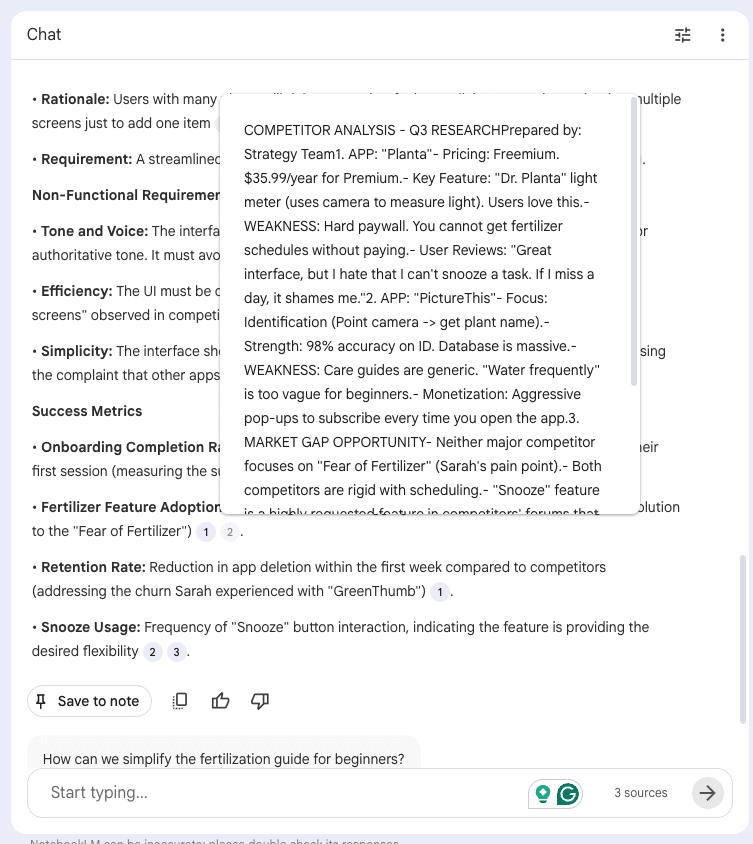
Earlier than accepting this primary PRD as it’s, do not forget that a primary draft is never excellent. Preserve partaking in dialog to progressively refine it, e.g. when you discover there’s a lacking monetizing part, ask: “Based on the competitor_research_notes.txt, what monetization models are our competitors using, and what should we avoid?“. After that, manually test the outputs, be certain they’re in keeping with the remainder of the primary PRD draft, and incorporate the primary monetization insights into it, both manually or by asking NotebookLM’s AI to take action — when you go for the latter, at all times test what you get earlier than blindly approving it. Bear in mind: AI could make errors!
The icing on the cake is the Audio Overview part on the right-hand panel (Studio). By simply clicking on it, you’ll generate an audio overview of the data contained within the supply recordsdata. This is a wonderful technique to soak up info when studying is perhaps much less interesting, e.g. while you’re in your every day commute.
# Subsequent Steps
This text introduces NotebookLM’s capabilities to generate grounded PRD specs from uncooked, messy paperwork in a matter of minutes, taking very simple steps. From right here, a worthwhile subsequent step might be resorting to Google’s Antigravity to show your PRD specification right into a purposeful software program prototype.
Iván Palomares Carrascosa is a frontrunner, author, speaker, and adviser in AI, machine studying, deep studying & LLMs. He trains and guides others in harnessing AI in the actual world.
