




Amazon’s acquisition of Fauna Robotics seems to be extra like a platform transfer than a client robotics play. This makes Fauna’s humanoid, Sprout, important past the deal itself. The system affords an early view of what a reputable developer-facing humanoid stack seems to be like earlier than higher-level autonomy is mature.
Velocity over hypothesis
A technical report revealed by Fauna earlier in 2026 affords a glimpse right into a platform constructed round constrained realized management, whole-body VR teleoperation, together with a pipeline designed to show autonomy failures into coaching knowledge. The timeline right here is aggressive. Fauna was based in early 2024. It raised between $16.6 million, per its SEC submitting, and $30 million, per CNBC reporting, from buyers together with Kleiner Perkins and Lux Capital.
It launched Sprout to R&D companions in January 2026 and was acquired by Amazon two months later. Reaching a working humanoid platform and an acquisition on that timeline is spectacular. The report reads much less like a long-horizon analysis program than a targeted effort to construct a system that may enhance rapidly below real-world constraints.
Designing for the developer, not the demo
Sprout is small by humanoid requirements. It stands 1.07 meters tall and weighs 22.7 kg, with 29 levels of freedom. The scale selection shapes the remainder of the system. It has delicate exteriors, minimized pinch factors, backdrivable motors, conservative torque limits, and a single DoF gripper. The design appears to prioritize retaining bodily interplay manageable over delivering probably the most spectacular demo.
Sprout makes use of a head-mounted ZED 2i stereo digital camera, torso-mounted time-of-flight sensors, IMUs, and a four-microphone array, with no wrist-mounted cameras. Fauna argues that teleoperation fills the sensing gaps, and the mixture covers sufficient analysis use instances to be sensible. That simplification comes with limits in close-range manipulation. These are the tradeoffs of a bounded system meant to be protected sufficient, low-cost sufficient, and modifiable sufficient for builders to make use of now.
Most of Sprout’s subsystems depend on established strategies. The motor insurance policies are skilled in NVIDIA Isaac Sim. It makes use of normal client VR {hardware} with inverse-kinematics retargeting for the teleop interface. The mapping stack fuses visible, inertial, and leg-motion knowledge and builds dense 3D maps utilizing volumetric fusion. Navigation makes use of acquainted planning and monitoring strategies, and the voice pipeline depends on off-the-shelf speech recognition and synthesis suppliers.
In my expertise, robotics merchandise break on integration, failure dealing with, and misplaced confidence in immature autonomy, not as a result of the underlying algorithms lack novelty.
The place the combination truly issues
To make sure deterministic management, the system intentionally isolates application-level workloads from time-critical loops. Whereas a Jetson AGX Orin runs high-level notion and planning software program, a customized board depends on embedded controllers for energy distribution, sensor acquisition, and motor management.
Fauna applies the identical self-discipline to the place studying lives within the system. An end-to-end realized coverage sounds nice in a pitch deck, however Fauna went in a unique path. They constructed totally separate RL insurance policies for distinct actions, whether or not that’s strolling, crawling, kneeling, sitting, or dancing. Commonplace PD management and exhausting energy limits act as the mandatory guardrails to maintain that execution bounded. It is perhaps much less conceptually bold, nevertheless it’s a much better short-term wager for retaining the system dependable throughout messy, real-world circumstances.
Transitions between management modes have their very own realized monitoring controllers, skilled from motion-capture and animated trajectories. There are additionally separate security constraints and abort logic when posture or actuator limits drift out of vary. That’s important as a result of transition failures are the place humanoids are inclined to get most brittle.
Turning failures into knowledge
The teleoperation knowledge loop often is the most beneficial a part of the stack. The underlying DAgger coaching framework is an {industry} normal, however Fauna considerably improved its operational utility. When an autonomous conduct drifts, the operator pauses. They see the robotic’s frozen pose projected as a ghost in VR house. Then they’ll align their controllers to that ghost and resume from the identical bodily state. Each failure turns into labeled coaching knowledge captured in the meanwhile it issues most, as an alternative of being discarded with a tough reset.
Small bipeds pose particular mapping issues that the workforce needed to deal with. Foot contacts are intermittent, place estimates can drift, and depth high quality might be unpredictable. To deal with this, Fauna divides the surroundings into domestically constant volumetric submaps, or maplets, so a localized sensor glitch corrupts just one area moderately than your entire map. International correction runs asynchronously. Fauna says this diminished compute load by roughly 30% in comparison with an industry-standard open-source baseline. On a robotic operating every part onboard, even modest compute financial savings widen the margin for every part else the developer desires to run.
Fauna constructed a slot-based conduct hierarchy that orchestrates lights, audio, head pose, eyebrows, and physique movement by per-slot precedence guidelines. If a security alert triggers, the robotic instantly drops its present expression. When working safely, idle and interactive behaviors merge. For a machine geared toward builders and non-expert operators, observability is a key requirement.
What ships and what doesn’t
Fauna seems to have optimized Sprout for velocity to deployment moderately than for any broad declare of normal intelligence. Whenever you take a look at what ships on the $50,000 value level, you get a stable basis in navigation, teleoperation, and developer instruments. Fauna’s personal structure diagrams strip reasoning and social context from the preliminary SDK totally. Slightly than transport a totally built-in autonomy stack out of the field, they constructed a extremely modular bodily vessel. It depends closely on normal ROS 2 interfaces and a Mannequin Context Protocol server to interface with exterior brokers.
Protected sufficient will not be licensed
Security is the place the hole between platform and product turns into noteworthy. Fauna describes three layers – {hardware} safeguards, an impartial embedded security subsystem, and application-level compliant management. The paper doesn’t present the proof wanted to judge a certification case. The proximity sensing seems to depend on consumer-grade elements. The grip power is managed by software program, and there’s no point out of power or torque sensing within the kinematic chain. None of that negates the platform’s worth. However a protected developer system and a certifiable client product are nonetheless very various things.
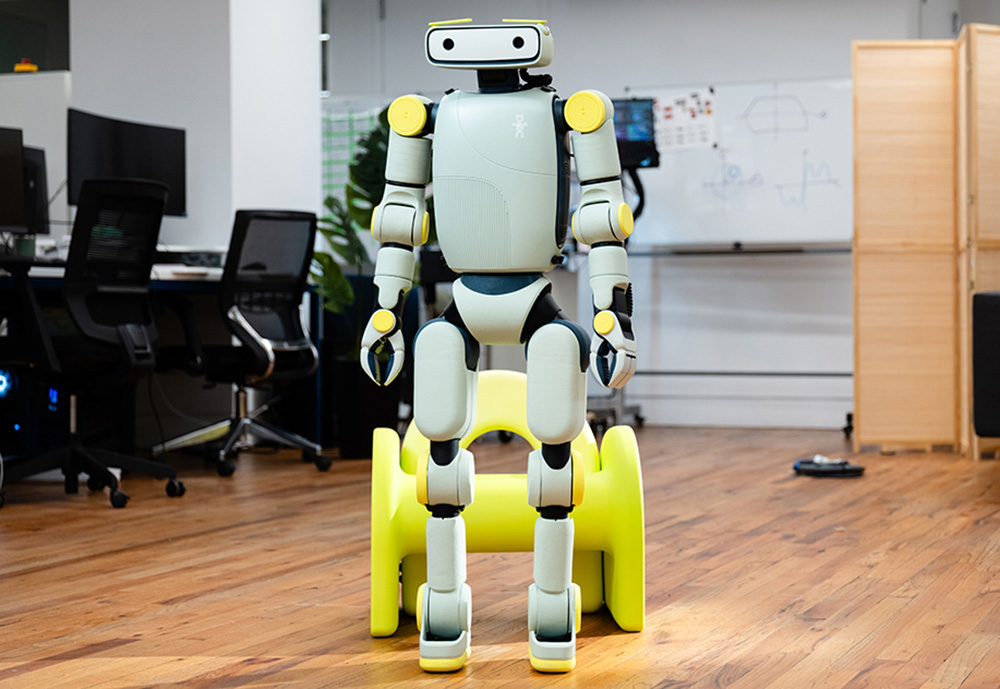
Fauna Robotics’ Sprout humanoid robotic is small, light-weight, and delicate to the touch, making it safer than the typical humanoid robotic. | Supply: Fauna Robotics
Shopping for the sandbox
Amazon has spent years constructing warehouse robotics, whereas its client robotics efforts have but to provide a sturdy product line. Astro by no means broke by as a client product, and Astro for Enterprise was discontinued inside a 12 months. Amazon had additionally just lately shelved its Blue Jay warehouse robotic.
Sprout won’t be strolling round your lounge folding laundry anytime quickly. Amazon didn’t purchase Fauna to ship a client humanoid. It acquired the tooling to construct one. The mixing decisions round security, supervision, knowledge assortment, and operator restoration are what make Sprout exhausting to duplicate rapidly, and none of these present up in a demo reel. Most firms on this house are racing to point out what their robotic can do. Amazon simply paid for a system that’s optimized for studying what its robotic can’t do but. In robotics, that is perhaps the extra helpful place to begin.

Concerning the writer
Deepak Jayaraj is the vp of {hardware} engineering and manufacturing at 4 Growers, an agricultural robotics firm based mostly in Pittsburgh. With over 15 years of expertise spanning house robotics, medical gadgets, and AgTech, he focuses on guiding robotics firms by the important transition from prototype to scaled deployment and the economics of {hardware} enterprise fashions.
The publish What Amazon noticed in Fauna Robotics’ humanoid technique appeared first on The Robotic Report.
