



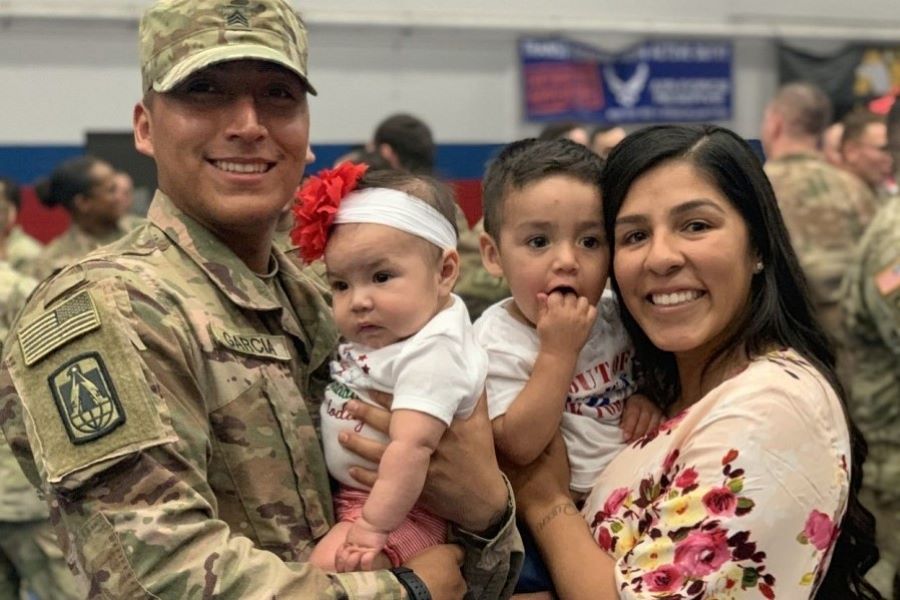
Terry Gerton We’re coming up on the end of May, which is Military Appreciation Month, and Blue Star Families has just published its yearly Military Families Snapshot report with some truly significant news. Looking at this year’s findings, what are the biggest takeaways you want folks to hear?
Kathy Roth-Douquet To start with, Military Appreciation Month genuinely has a real impact. One of the major discoveries in our survey is that service members who feel well-supported by their local communities are more driven to remain in the military, they’re more resilient, and they’re far more likely to encourage others to join up. Let me explain how we arrived at that conclusion. Over the years, we’ve noticed a steady decline in how willing people are to recommend military service to others — it’s been falling from 60% to 55% to 40%, and it’s stayed below 40% since 2016. We wanted to understand why. So we examined who was having a positive experience in their community, who felt a sense of belonging, who felt valued by their neighbors, and who didn’t. When we compared the groups, those who felt connected and appreciated by their communities were enthusiastic about their military service and eager to recommend it. So the effort that everyday Americans, the government, schools, and employers put into showing genuine appreciation actually strengthens our national security.
Terry Gerton That’s a major finding. That’s really impressive and significant. Does that hold true across the country, or is it more concentrated in certain regions? Interestingly, it holds true everywhere.
Kathy Roth-Douquet A lot of people assume that certain cities are especially military-friendly — San Diego, Norfolk, maybe Washington D.C. — but someone relocating to a new area who doesn’t know anyone won’t feel that sense of support unless they’re building real connections locally. That’s exactly what Blue Star Families’ Chapters program is designed to do — make those connections easier. But it’s also the heart of our current “Do Your Part” campaign, where we’re asking all Americans to get involved. When we examined the other factors in the survey that significantly affect military life — military spouse employment, time away from family, childcare struggles, housing issues — all of these challenges, even concerns about military pay, are eased by strong community-level support.
Terry Gerton Let’s dig into some of those other specific issues you brought up, starting with financial strain and stability. I’d guess most Americans don’t think of military families as struggling with food or housing insecurity. Yet financial pressure comes through very clearly in your survey results. Tell us what you discovered.
Kathy Roth-Douquet It really does come through clearly. Overall, one in six military families has difficulty accessing healthy food throughout the month. One in six — and that includes officers and people from all backgrounds. But in some areas, like New York City, it’s one in three. The cost of living has surged across America. The burden isn’t just on the 50,000 to 60,000 deployed troops and their families — every American is dealing with rising costs. We’re also seeing housing costs climb sharply in places where military families are stationed. San Diego and Miami stand out as particularly notable examples. All of this is putting enormous financial pressure on military families. And then there’s the added challenge of high unemployment and underemployment among military spouses. These are solvable problems, but if we don’t tackle them, they seriously threaten the overall health of the force.
Terry Gerton Let’s move on to military spouse employment and childcare. Those have been top concerns for as long as I can remember the survey results. You’ve got a new survey focused on military spouses. What are you finding?
Kathy Roth-Douquet Terry, I’m really excited about this survey, and I’m especially grateful to our funders — USAA, PENFED, and Navy Federal — who made it possible for us to take a thorough, in-depth look. Since 2012, when Blue Star Families first identified military spouse unemployment as being above 20%, the number hasn’t budged. So instead of just studying the problem, we wanted to focus on solutions. When military spouses are consistently employed over time, what can we learn? What about their employers? What sets them apart? We released the findings yesterday at the Milken Institute. What we found is that flexible work arrangements, high levels of education, and remote work all make a real difference, as does mentorship. But what made our study especially revealing is that we tracked people over three years. In our group, 43% held advanced degrees — compared to just 14% of the national average. Yet of that group, only 22% were consistently employed over three years. Only 22% held a job for the full three years. So this is a highly talented, well-educated group, and that’s the reality they’re facing. It’s a very real problem driven by the demands of military life — the frequent relocations. Employers can make a real difference by offering remote work, flexible hours, and mentorship programs. I think these are critical takeaways because if we’re truly going to solve the financial challenges military families face, we’ll never be able to raise military pay enough on its own. The only way to get there is by unlocking those second incomes that two-income families need.
Terry Gerton Kathy Roth-Douquet is the CEO of Blue Star Families. Kathy, let’s come back to this — you’re talking about financial pressure, family pressure, a whole range of challenges military families are dealing with. But you make the point that these aren’t just quality-of-life issues; they’re directly tied to force readiness. Walk us through that connection.
Kathy Roth-Douquet We know that the number one reason otherwise promotable service members leave the military is concern for their family’s well-being. Often it comes down to a spouse’s career. I spoke with Secretary Hagel near the end of his time as Secretary of Defense, and he told me that on his last day in office, he had breakfast with six West Point lieutenants who were approaching the end of their service commitment. Five out of six were leaving. And the reason all five were leaving was concern about their spouses’ ability to build and maintain careers. So we know this drives talented people out of the military — people we want to keep. But we also see in our survey that military spouses who are successfully employed
Those who’ve served in the military tend to advocate for military service more actively among their children and younger generations. Consequently, the financial stability of military households represents a critical aspect of national security both in the present moment and for the sustainability of our armed forces moving forward.
Terry Gerton You’ve been observing these challenges for some time, and they appear to be persistent. Did anything emerge as a particularly noteworthy finding from this year’s surveys that you’d want to highlight? I’m especially interested in…
Kathy Roth-Douquet The actionable solutions are where my enthusiasm lies. Through our survey of military spouses, we’ve identified that employers can significantly influence outcomes by offering adaptable scheduling and remote work opportunities, alongside professional guidance programs. We’ve discovered that meaningful change often originates from local communities. Having chapters established in various regions plays a role in this, but when a community as a whole demonstrates genuine support for military resources connected to nearby installations — whether through educational systems, workplace environments, or other community activities — military families experience reduced financial hardship and express greater commitment to continuing their service and encouraging others to enlist. It appears that people largely resolve challenges through existing networks. A supportive community environment helps spouses secure employment since positions typically come through personal connections. When educational institutions and athletic programs and similar organizations are inclusive, the impact is tangible. This represents a genuine opportunity for employers, schools, community organizations, and similar institutions to actively participate in affirming that military families hold value within their communities and deserve welcoming integration.
Terry Gerton Let’s shift our focus to organizations with institutional authority to implement systemic changes. Are there legislative actions Congress could pursue or policy measures military leadership could adopt to tackle these recurring issues?
Kathy Roth-Douquet Several possibilities exist. A workforce tax credit proposal is currently advancing through Congress, which would offer tax incentives to businesses that employ military spouses. This could provide substantial motivation for employers to hire military partners. Government agencies must embrace flexibility, particularly regarding remote work options for spouse employees. Military spouses represent a segment of the federal workforce, and ensuring they can maintain employment while undergoing PCS moves and receiving scheduling flexibility during deployments would yield significant benefits. Clearly, there exist impactful policy changes capable of generating genuine improvement.
Copyright
© 2026 Federal News Network. All rights reserved. This website is not intended for users located within the European Economic Area.
