



## Evaluating Website Agent-Readiness with the Is Agentic Tool
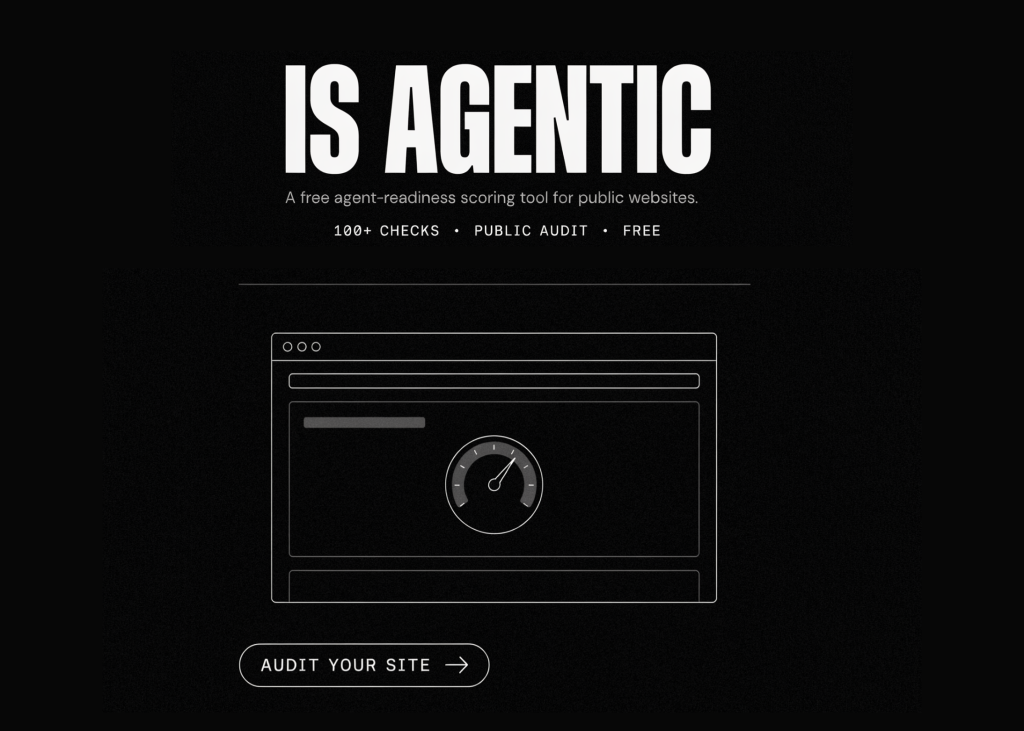
Organizations assessing how effectively AI agents can interact with their digital properties now have a free, standardized solution. The recently launched public evaluation tool measures how easily AI agents can discover, access, and utilize a website’s features. This evaluation provides development and product teams with a concrete metric for understanding agent compatibility before deploying intelligent workflows.
### Core Evaluation Methodology
The platform evaluates websites through four distinct layers that mirror real-world agent interaction sequences. Each layer represents a critical step in the autonomous agent workflow:
1. **Discovery** (20 points): Evaluates whether an agent can locate and identify key website elements, including navigation, search functionality, and content structure
2. **Access** (30 points): Tests the ability to retrieve and understand content through various access patterns and authentication flows
3. **Usability** (40 points): Measures interaction capabilities, including form completion, data input, and cross-system integration
4. **Payments** (10 points): Assesses transaction capabilities and financial interaction completion
This comprehensive approach covers 118 distinct verification checks, providing thorough coverage of common agent interaction patterns. The scoring system uses a letter-grade scale:
– **A+**: 95-100 points (Leading)
– **A**: 86-94 points (Agent-Ready)
– **B**: 70-85 points (Competitive)
– **C**: 48-69 points (Needs Work)
– **D**: 28-47 points (At Risk)
– **F**: 0-27 points (Unusable)
### Technical Integration and Deployment
Implementation requires no authentication or billing setup, lowering the barrier for immediate adoption. Organizations can initiate evaluations through multiple interfaces:
– **Browser interface**: Simply enter the target URL for instant analysis
– **Command-line interface**: Enables automation through scripts and CI/CD pipelines
– **Programmatic API**: Provides structured JSON output for integration with existing monitoring systems
– **MCP server**: Supports Model Context Protocol for direct integration with AI agent frameworks
The tool accommodates various organizational scales:
– **Startups**: Receive immediate baseline assessments without procurement processes
– **Mid-market teams**: Integrate JSON output into regression testing workflows
– **Enterprises**: Conduct cross-business-unit benchmarking of documentation portals, developer sites, and commerce platforms
### Specialized Industry Applications
The evaluation methodology applies particularly well to sectors where agent interaction represents a competitive advantage:
– **Developer tools and SaaS platforms**: Documentation portal quality and API accessibility
– **E-commerce and retail**: Product discovery and transaction completion pathways
– **Travel and hospitality**: Booking flow efficiency and information accessibility
– **Financial technology**: Account management and service integration capabilities
– **Healthcare**: Provider directory access and appointment scheduling workflows
– **Media and documentation**: Content discoverability and navigation structure
### Strategic Implementation Considerations
Organizations should view these scores as diagnostic rather than certificatory. The evaluation specifically avoids claims of security validation, accessibility compliance, or comprehensive quality assurance. Instead, it provides prioritized technical insights with actionable remediation guidance.
The platform acknowledges limitations inherent in automated evaluation. Certain specialized checks apply only to sites claiming specific functionality, ensuring marketing-only sites without APIs aren’t unfairly penalized for missing advanced features.
### Available Output Formats
Evaluation results deliver through multiple channels:
– **Human-readable HTML reports**: Visual scoring displays with interactive journey maps
– **Machine-readable JSON**: Structured data for automated processing
– **Markdown variants**: Text-based formats for documentation integration
– **Actionable recommendations**: Specific remediation steps converted into implementation briefs for development agents
As organizations increasingly rely on autonomous agents for digital interaction, establishing baseline compatibility metrics becomes essential. This evaluation framework provides the industry-standard method for quantifying agent-readiness and identifying optimization opportunities across the digital landscape.
Thank you for reading
