



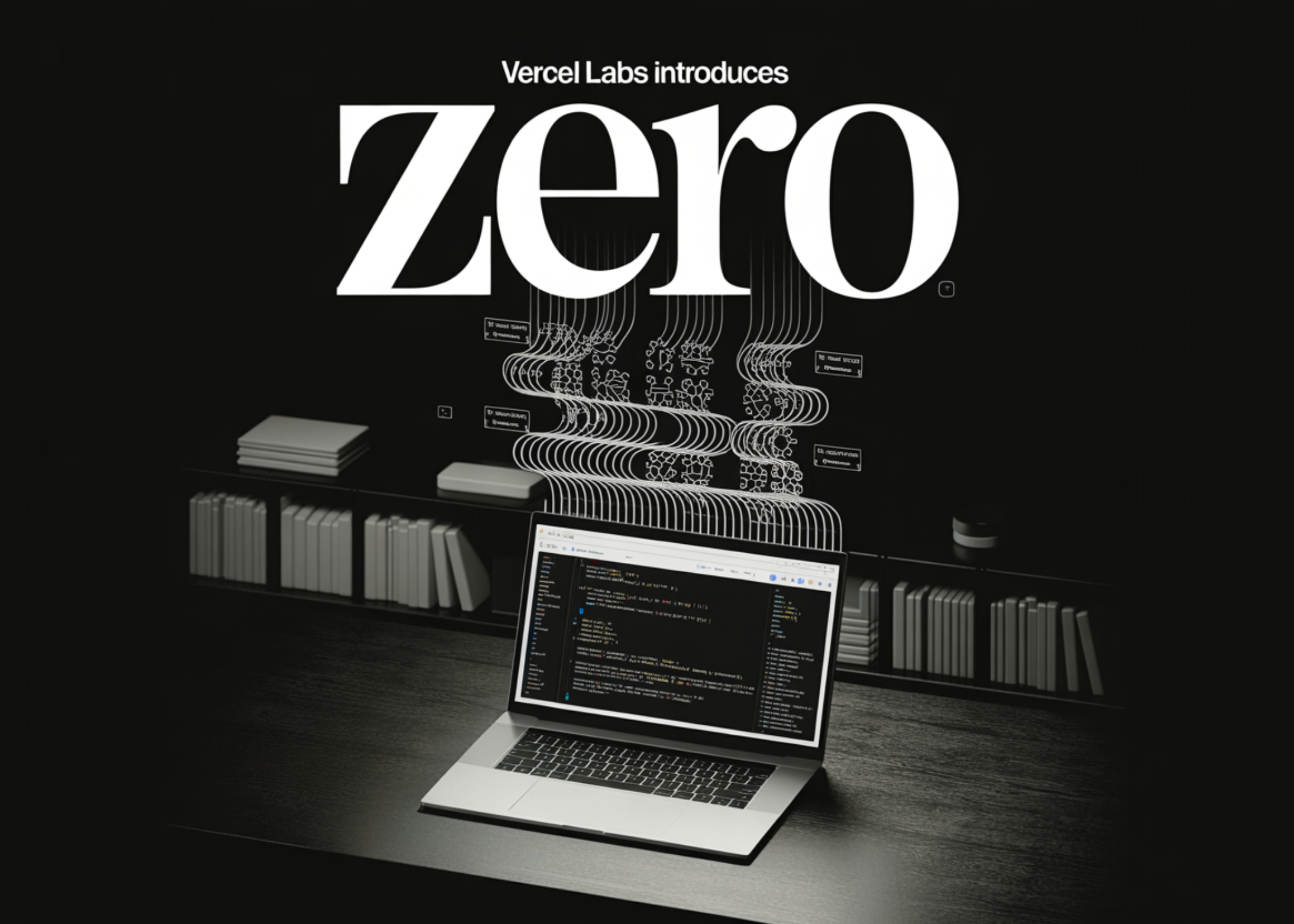
I’ll paraphrase the HTML content while keeping the HTML structure intact and maintaining the same language (English). Here’s the rewritten version:
Vercel Labs
01 / 09 · Overview
Zero
A Language Built
for AI Agents
An experimental systems-level language offering AI agents structured error reports,
typed fix metadata, and documentation that machines can read — plus native binaries under 10 KiB.
Systems Language
Agent-Native
v0.1.1
Apache-2.0
Experimental
Context
02 / 09 · Why Zero Exists
The Agent Repair Loop Problem
Traditional programming languages generate compiler messages meant for people — raw text that AI agents need to interpret to figure out what went wrong and how to correct it. This leads to a brittle cycle.
- Agent writes code — the compiler spits out an error as plain text
- Agent interprets text — error formats may shift across compiler versions
- No fix guidance — there’s no native notion of a “repair action”
- Human gets involved — the cycle demands manual help to sort out errors
Zero was built from the ground up so agents can read the source, make sense of the diagnostics, and patch the program — all without a human in the middle.
Core Feature
03 / 09 · JSON Diagnostics
Structured Compiler Output
When you run zero check ——json, you get machine-friendly diagnostics rather than freeform text. Each error carries a consistent code, a readable message, a line reference, and a typed repair identifier.
$ zero check --json
{
  "ok": false,
  "diagnostics": [{
    "code": "NAM003",
    "message": "unknown identifier",
    "line": 3,
    "repair": { "id": "declare-missing-symbol" }
  }]
}- code — a stable identifier agents can reliably match (
NAM003) - message — a clear, human-readable error description
- repair — a typed repair ID agents can use directly, no text parsing needed
Core Feature
04 / 09 · Repair Commands
zero explain & zero fix
Two CLI subcommands round out the agent repair cycle — no need for agents to sift through prose documentation.
zero explain NAM003Delivers a structured breakdown of any diagnostic code. Agents can look up NAM003 on the spot — no digging through docs.
zero fix --plan --json add.0Produces a machine-readable fix plan that spells out precisely what to change — no guesswork involved.
Combined, zero explain and zero fix --plan --json enable agents to grasp errors and take action without a human translating compiler output.
Core Feature
05 / 09 · Agent Guidance
zero skills: Version-Matched Agent Guidance
Most tools force agents to pull from external docs that might not match the installed compiler version. Zero tackles this with zero skills — guidance delivered straight from the CLI, aligned with the version you have installed.
zero skills get zero --fullProvides focused workflows covering:
- Zero syntax — core language concepts for the installed version
- Diagnostics — how to read and respond to compiler messages
- Builds & packages — manifest layout, targets, and output
- Testing & agent edit loops — patterns for validation and repair cycles
Language Design
06 / 09 · Capability-Based I/O
Explicit Effects & Capability-Based I/O
In Zero, if a function interacts with the outside world, its signature makes that clear. There’s no hidden global process object, no implicit async behavior, and no magic globals.
pub fun main(world: World) -> Void raises {
  check world.out.write("hello from zeron")
}- world: World — a capability object that unlocks access to I/O, filesystem, and network
- check — manages operations that can fail; pushes errors up the call chain
- raises — signals that the function may propagate errors — right there in the signature
- Compile-time enforcement — capabilities you don’t have are caught at compile time, not at runtime
Language Design
07 / 09 · Memory & Size
Predictable Memory & Tiny Binaries
Zero is aimed at environments where binary footprint and memory behavior need to be predictable. There’s no hidden runtime overhead.
< 10 KiB
Native executables through static dispatch, no required GC, no required event loop
zero build --emit exe
  --target linux-musl-x64
  add.0 --out .zero/out/add
zero size --json— displays artifact size information prior to code generation when available- No hidden allocator — memory allocation is fully explicit and visible within the source code
- C ABI exports — platform-specific interoperability metadata for C interface boundaries
Quick Start
08 / 09 · Getting Started
Install & Run Zero
Set up the compiler using a single curl command:
curl -fsSL  | bash
export PATH="$HOME/.zero/bin:$PATH"
zero --version
Verify, execute, and compile your first program:
zero check examples/hello.0
zero run   examples/add.0
zero build --emit exe --target linux-musl-x64
  examples/add.0 --out .zero/out/add
Scaffold a new package:
zero new cli hello
cd hello
zero check .  &&  zero test .  &&  zero run .
Status
09 / 09 · Current State
What’s Available & What’s Not
- v0.1.1 (Experimental) — the compiler, standard library, and language specification are still under active development
- No package registry — the ecosystem is in its early stages
- Cross-compilation — currently supports only the documented set of targets
- VS Code extension — syntax highlighting for
.0files is included in the repository - Contributors — Chris Tate & Matt Van Horn (Vercel Labs)
zerolang.ai
github.com/vercel-labs/zero
Zero is an active experiment worth following for AI engineers curious about agent-native toolchain design — but it is not yet ready for production use.
