



**Study uncovers key proteins in autoimmune vasculitis, paving way for improved diagnostics**
A recent study published in *Nature Portfolio* has identified a panel of seven proteins in plasma that can reliably distinguish between active disease and remission in patients with ANCA-associated vasculitis (AAV). The findings, derived from two independent cohorts, highlight the potential of proteomic profiling to improve disease monitoring and diagnosis.
**What is ANCA-associated vasculitis (AAV)?**
ANCA-associated vasculitis is a group of rare autoimmune diseases characterized by inflammation of small blood vessels. This inflammation can damage organs, particularly the kidneys, lungs, and nerves. The disease is often associated with the presence of specific autoantibodies called anti-neutrophil cytoplasmic antibodies (ANCAs), most commonly proteinase 3 (PR3) or myeloperoxidase (MPO).
**Key findings of the study**
The research team, led by scientists from the Charité – Universitätsmedizin Berlin and the General University Hospital Prague, followed a structured, multi-phase approach:
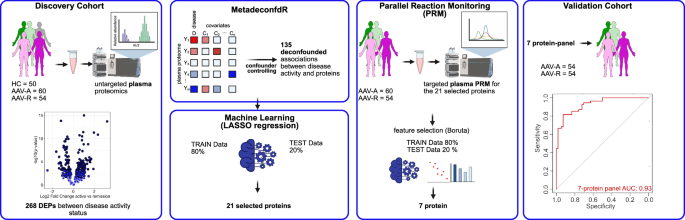
1. **Discovery Cohort:** The researchers first analyzed plasma samples from 50 healthy controls and 114 AAV patients. Using advanced mass spectrometry, they measured the abundance of over 600 proteins.
2. **Validation Cohort:** The initial findings were rigorously tested in an independent cohort of 108 AAV patients from Prague.
3. **Disease Activity Signature:** The analysis revealed 135 proteins whose levels in the blood were statistically associated with active disease, independent of common clinical factors like age, sex, or kidney function.
4. **The 7-Protein Panel:** Through sophisticated machine learning techniques, this panel was whittled down to just seven candidates. This panel was then validated in a separate set of patients, demonstrating high accuracy in distinguishing active disease from remission.
5. **Performance:** The 7-protein panel showed strong diagnostic performance, accurately classifying patients as active or in remission with an area under the curve (AUC) of up to 0.95, outperforming individual markers like CRP or ANCA status.
**What this means for patients**
Currently, AAV diagnosis and monitoring rely heavily on clinical assessment, ANCAs blood tests, and invasive tissue biopsies. This study offers a step toward a minimally invasive blood test that could provide a more objective and quantitative measure of disease activity. Such a tool could help clinicians make faster treatment decisions and more accurately monitor a patient’s response to therapy.
—
### **FAQ**
**Q: What is ANCA-associated vasculitis (AAV)?**
**A:** ANCA-associated vasculitis (AAV) is a group of autoimmune diseases that cause inflammation of small blood vessels (vasculitis). This inflammation can damage various organs, most commonly the kidneys, lungs, and nerves. The disease is often linked to specific autoantibodies called anti-neutrophil cytoplasmic antibodies (ANCAs), with the two main types being PR3-ANCA and MPO-ANCA.
**Q: What was the goal of this study?**
**A:** The primary goal was to identify specific proteins in the blood (plasma proteome) that are reliably associated with AAV disease activity. The researchers aimed to develop a protein signature that could objectively distinguish between active, inflamed disease and remission, independent of other clinical factors.
**Q: How was the study conducted?**
**A:** The study used a two-stage approach. First, a “discovery cohort” of 163 individuals (50 healthy controls and 114 AAV patients) was analyzed using a global proteomics platform to measure thousands of proteins. Second, an independent “validation cohort” of 108 AAV patients was used to confirm the findings. The researchers then applied machine learning to identify a small, robust panel of seven proteins that best predicted disease activity.
**Q: What is the potential clinical impact of this 7-protein panel?**
**A:** This protein panel shows promise as the basis for a new diagnostic test. If validated in larger studies, it could provide a more precise, blood-based method for:
* Helping to diagnose AAV.
* Determining whether a patient’s disease is active or in remission.
* Monitoring a patient’s response to treatment more objectively.
This could complement or reduce the need for more invasive procedures like tissue biopsies.
**Q: Were there any limitations to the study?**
**A:** While the results are promising, this was a research study. The 7-protein panel would need to be tested in larger, prospective clinical trials before it could be used as a standard diagnostic tool in hospitals. The study focused on patients with generalized, ANCA-positive disease.
—
### **Conclusion**
This study represents a significant advance in the understanding and potential management of ANCA-associated vasculitis. By identifying a robust 7-protein signature in plasma, the researchers have moved a step closer to an accurate, non-invasive blood test for monitoring this complex autoimmune disease. While further validation is needed, this work offers a powerful new tool that could transform how clinicians diagnose, assess, and treat AAV in the future.
