



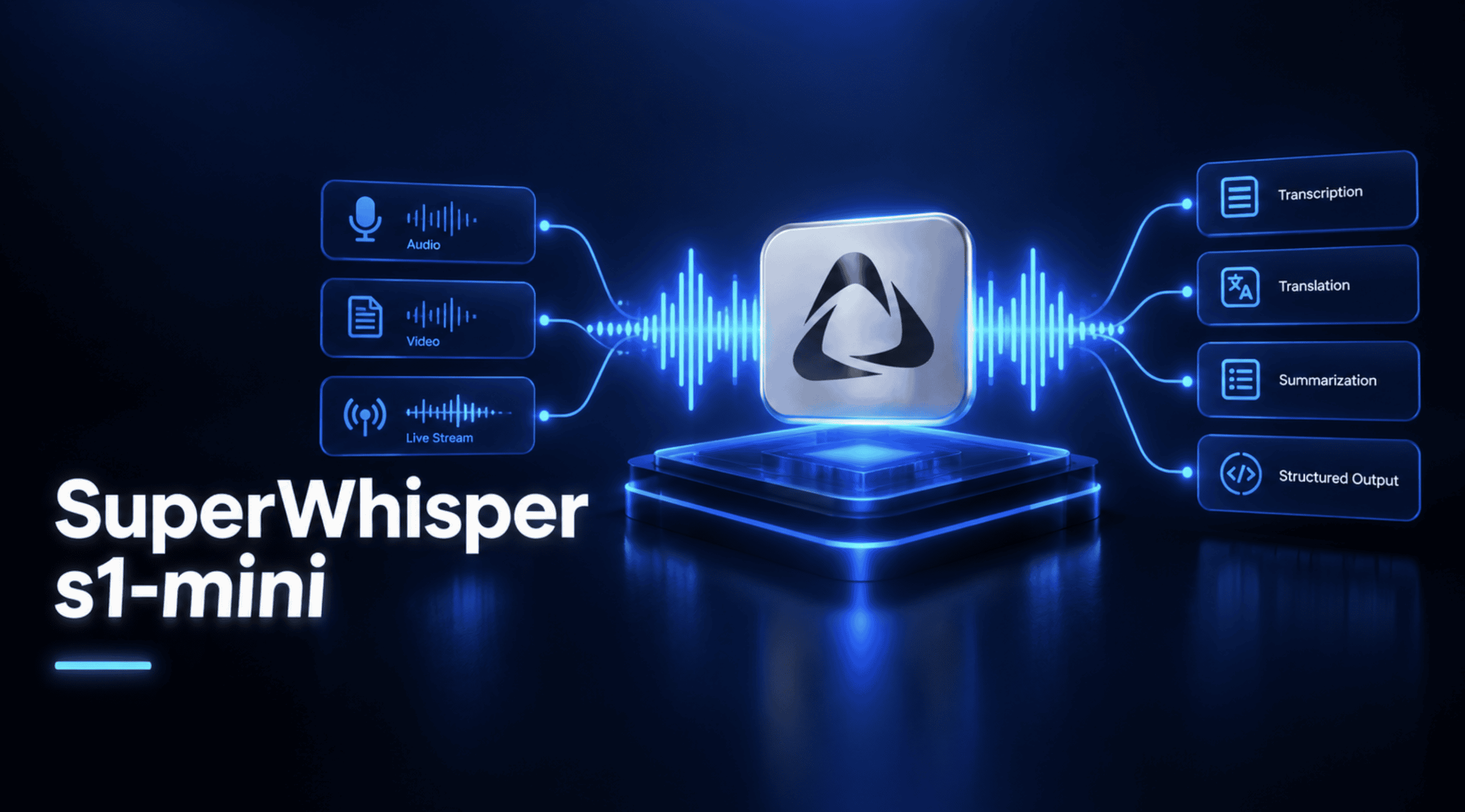
# S1-mini: A 0.6-Billion-Parameter Model That Does One Thing — And Does It Better Than Most
In the world of speech-to-text processing, the gap between raw transcription and readable text has long been a bottleneck. Teams typically rely on either general-purpose language models with cleanup prompts or much larger local models that weren’t purpose-built for the task. A new entrant challenges both approaches by choosing a path of radical narrowness.
## The Core Philosophy: Narrow Over General
The model in question, part of a three-model family, is designed with a single mission: take a raw, unpunctuated, lowercase automatic speech recognition transcript and turn it into clean written text. That’s it. No summarizing, no fact-checking, no rewriting, no softening language, no inserting opinions. The documentation describes this trait as being “ruthlessly obedient” — it reflects what you say exactly as you said it, regardless of dialect, profanity, or formatting quirks.
What makes this approach compelling is that training for a single constrained task yields measurably better results than trying to be a jack-of-all-trades at a small scale. The model hits 94.8% token accuracy on a held-out evaluation set of over 7,500 English cases spread across 104 transcripts — none of which were part of training data.
## Key Performance Highlights
– **Token accuracy**: 94.8% on a 7,519-case held-out test set
– **Text-edit error rate**: 11.6%
– **Greeting line recognition (email format)**: 99.3% accuracy
– **Sign-off recognition (email format)**: 97.9% accuracy
– **Degenerate behavior (looping or truncation)**: fewer than 1% of generations
– **Empty-string handling on noise-only input**: 98.6% correct — meaning it almost never hallucinates content to fill silence
These numbers are particularly impressive given the model’s size and the fact that it runs entirely on a standard laptop CPU with no GPU required.
## Model Size and Architecture
The model contains approximately 596 million unique parameters (noting that the commonly cited 0.8 billion figure includes tied embedding weights counted twice). It is fine-tuned from Qwen3-0.6B, but with a critical training difference: its reasoning traces were intentionally excluded. This means the model was trained with internal “thinking” disabled, and it expects that setting to remain off during inference.
## The Control Line: A Novel Input Format
Instead of relying on conversational prompts, S1-mini uses a structured control line prepended to every input. Three independent axes govern the output:
– **Styling** — ranges from casual to formal, controlling capitalization, contraction handling, and tone
– **Structure** — determines whether the output is prose or a list (the model is deliberately conservative, requiring at least three substantive items before it will format anything as a bullet)
– **Context** — general or email, which activates greeting-line and sign-off formatting
Because these three dimensions were trained independently, every combination of settings works predictably.
## A Critical Usage Note
The model inherits a chat template from its base architecture that enables “thinking mode” by default. S1-mini was trained with thinking explicitly off and has never seen reasoning traces. If you leave thinking mode enabled, the model will emit an empty think block and produce no usable output — silently, without any error message. This is the single most common source of confusion for new users and is essential to disable from the start.
## When to Use It Versus Alternatives
This model belongs in a specific workflow niche: offline transcript cleanup where privacy, latency, and resource efficiency matter more than broad conversational ability. For cloud-based transcription, the same family offers dedicated speech-to-text and instruction-following models. The recommended architecture pairs a local ASR engine with this model for offline users, and a pair of cloud-hosted models for users who need remote processing and richer formatting.
## Licensing Considerations
The model is released under Apache 2.0, but with an additional term: the model must retain its exact name and attribution wherever it is used. Before incorporating it into a commercial product, reviewing the full license file is strongly advised.
—
## Frequently Asked Questions
**Q: What hardware do I need to run this model?**
A: A standard laptop CPU is sufficient. No GPU is required, and the model can run comfortably within the memory constraints of most modern machines.
**Q: Can this model handle languages other than English?**
A: The published benchmarks cover English-language transcripts. The model’s training data and evaluation were conducted exclusively on English cases, so performance on other languages has not been officially characterized.
**Q: Why does the parameter count differ between sources?**
A: The Hugging Face model page lists 0.8 billion parameters, but the unique parameter count is approximately 596 million. The difference comes from tied embedding weights being counted twice in the larger figure.
**Q: What happens if I forget to disable thinking mode?**
A: The model will output an empty think block followed by no usable text. There is no error message — it simply appears to produce nothing. Always set the thinking flag to false before calling the model.
**Q: Is this model suitable for creative writing or brainstorming?**
A: No. It is explicitly designed not to generate, editorialize, or expand on content. It normalizes existing text and nothing more. Using it for creative tasks would be fighting against its core design.
**Q: What format should I use for input?**
A: Input must follow the control line format — three bracketed settings for Styling, Structure, and Context, followed by the raw transcript on the next line. Deviating from this exact format will degrade output quality.
**Q: Is the model available for download?**
A: Yes, the weights are published openly on Hugging Face, and a quantized GGUF build is available for users targeting llama.cpp, Ollama, or LM Studio.
**Q: Can I use this in a commercial product?**
A: Yes, under the terms of the Apache 2.0 license with the additional naming requirement that the model retain its exact name and attribution.
—
## Conclusion
S1-mini represents a compelling proof of concept in AI model design: that a sub-billion-parameter model, deliberately trained for a single narrow task, can outperform larger, more general alternatives in both accuracy and efficiency. Its ability to run entirely on a laptop CPU without any network dependency makes it uniquely suited for privacy-sensitive, low-latency, or offline-first applications like dictation tools, meeting-note processors, and transcription pipelines.
For teams that need reliable transcript cleanup without the overhead of running large language models or sending data to the cloud, this model offers a practical, well-documented, and surprisingly capable solution. Its quirks — the mandatory control line format, the thinking-mode trap — are manageable once understood, and the payoff in predictable, trustworthy output is significant.
Thank you for reading
