



# Introduction
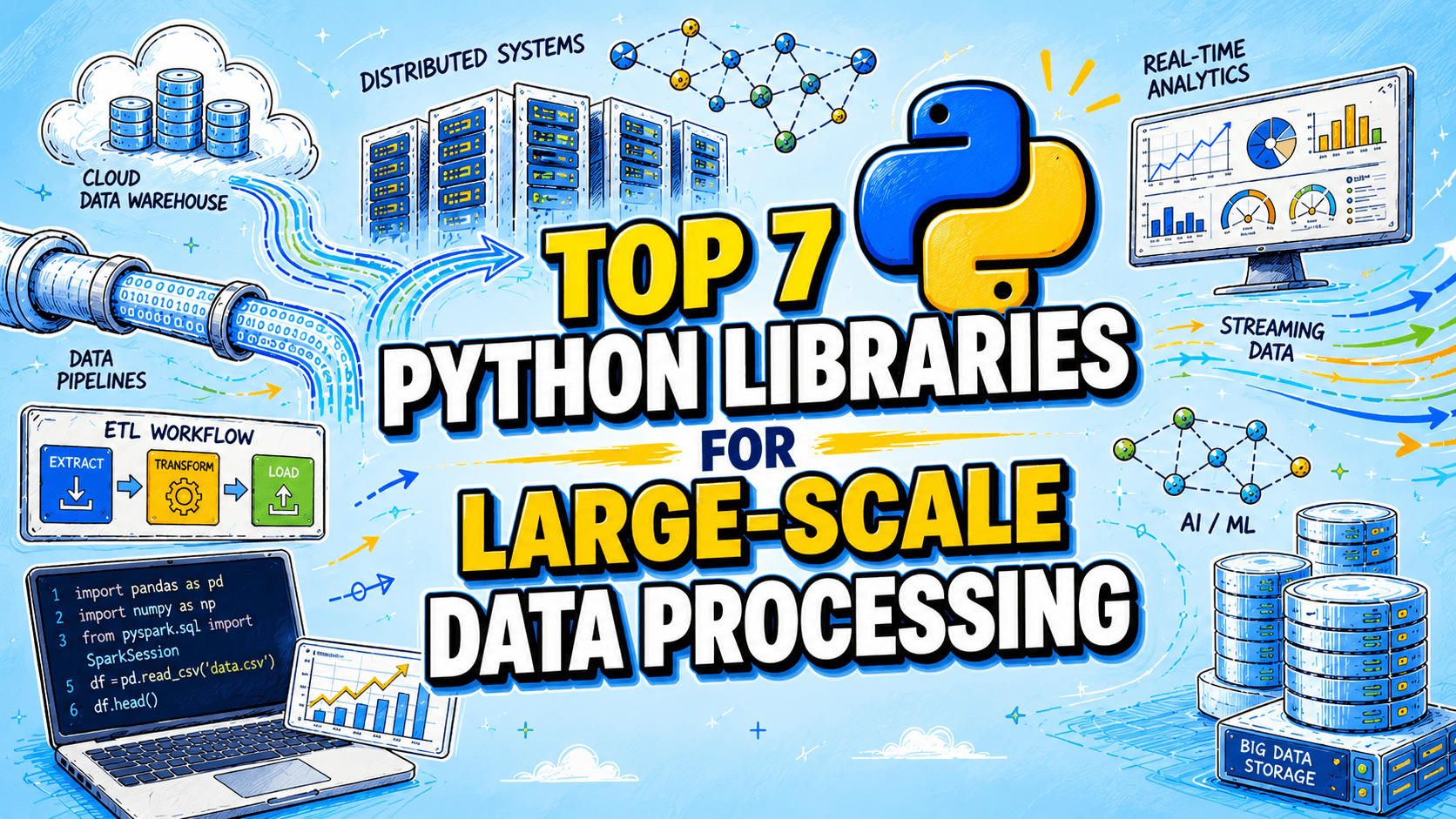
Python offers an extensive collection of libraries designed for managing data at scale. As datasets expand into gigabytes and beyond, conventional tools like pandas quickly reach their boundaries.
When handling billions of rows, executing distributed machine learning workflows, or processing live event streams, purpose-built libraries become essential. This article explores tools that address:
- Datasets too large to fit in a single machine’s RAM
- Spreading computations across multiple cores or entire clusters
- Live and streaming data processing
- Seamless connections to cloud storage and data warehouses
- Deployable production data pipelines
Let’s take a closer look at each one.
# 1. PySpark for Distributed ETL and Cluster-Scale Pipelines
PySpark is the Python interface for Apache Spark, the go-to solution for parallel large-scale data processing. It enables batch and streaming computations over clusters through an intuitive DataFrame API, with native support for HDFS, S3, Delta Lake, and other major cloud data platforms.
- A single API handles both batch jobs and structured streaming tasks.
- Parallel execution across hundreds of nodes makes processing petabyte-level datasets feasible.
- MLlib delivers distributed machine learning tightly woven into the framework.
Learning resources: “Build Your First ETL Pipeline with PySpark” guides you step by step through building a project from the ground up. The “Tutorials — PySpark 4.1.1 documentation” serves as an in-depth reference as well.
# 2. Dask for Scaling pandas and NumPy Beyond Memory
Dask is a parallel processing library that extends pandas, NumPy, and scikit-learn workflows to datasets that exceed available memory. It partitions data into smaller pieces and generates a task graph that executes on demand, whether on one machine or across a cluster.
- Closely mirrors the pandas and NumPy APIs, so your existing code needs barely any changes to scale up.
- Deferred execution constructs a computation graph before running, allowing optimization and significantly reduced memory footprint.
- Seamlessly transitions from a single laptop to a multi-node cluster via Dask Distributed.
- Works with XGBoost, PyTorch, and scikit-learn for distributed ML training.
Learning resources: The “Dask Tutorial on GitHub” provides a hands-on starting point maintained by the core development team. The official Dask documentation walks through the complete API with examples covering DataFrames, arrays, and delayed execution.
# 3. Polars for High-Performance DataFrame Transformations
Polars is a DataFrame library built in Rust and based on the Apache Arrow columnar memory format. It regularly outperforms pandas in benchmarks and offers lazy query optimization for datasets too large to fit in memory.
- Automatically runs operations in parallel, taking advantage of all available modern multi-core hardware.
- The lazy API fine-tunes queries before running them, trimming excess computation and memory consumption.
- Built on Arrow for seamless zero-copy data exchange with tools like PyArrow and DuckDB.
- A clean, expressive query syntax simplifies complex transformations without messy chained method calls.
Learning resources: “Polars vs. pandas: What’s the Difference?” and “Pandas vs. Polars: A Complete Comparison of Syntax, Speed, and Memory” are excellent starting points featuring side-by-side benchmarks and optimization breakdowns. “How to Work With Polars LazyFrames” dives deep into the lazy API in detail.
# 4. Ray for Distributed Machine Learning Training and Parallel Python
Ray is a distributed computing framework initially created at UC Berkeley, purpose-built for expanding Python workloads across clusters. Its ecosystem includes Ray Data for large-scale data ingestion and Ray Train for distributed model training.
- A straightforward task and actor model lets you parallelize any Python function using a single decorator.
- Ray Data delivers streaming, chunked, and distributed data loading tailored for ML pipelines.
- Out-of-the-box integrations with PyTorch, TensorFlow, HuggingFace, and XGBoost.
Learning resources: The Ray “Getting Started” guide walks through Core, Data, Train, and Tune using executable examples. The Ray Tutorial on GitHub covers parallel Python concepts with interactive Jupyter notebooks.
# 5. Vaex for Out-of-Core DataFrame Analysis on a Single Machine
p>
Vaex is a Python library for lazy, out-of-core DataFrames designed for exploring and processing massive tabular datasets without needing a distributed cluster. It can handle billions of rows without fully loading them into memory.
- Memory-maps data from disk instead of loading it entirely, making billion-row datasets manageable on ordinary hardware.
- Evaluates expressions lazily and only computes results when explicitly requested, keeping memory usage minimal.
- High-speed groupby, aggregation, and statistical operations fine-tuned for large datasets.
- Compatible with Apache Arrow and HDF5 for efficient storage and cross-tool interoperability.
Learning resources: The Vaex documentation features tutorials on filtering, virtual columns, and aggregations over large datasets. The official Vaex example notebooks on GitHub showcase practical real-world scenarios.
# 6. Apache Kafka for High-Throughput Real-Time Streaming
For real-time data processing at scale, Apache Kafka stands out as a widely adopted distributed event streaming platform. Python clients such as kafka-python and confluent-kafka allow you to produce and consume high-throughput data streams.
- Processes millions of events per second with minimal delay.
- A durable, distributed log architecture guarantees data persistence through failures.
- Separates producers from consumers, allowing each pipeline component to scale independently.
- Connects with Spark Structured Streaming, Flink, and other processing engines for real-time analytics.
Learning resources: The Confluent Python client documentation covers the full API, including async support and Schema Registry integration.
# 7. DuckDB for In-Process SQL Analytics on Any File Format
DuckDB is an embedded analytical database that operates directly inside your Python environment with no separate server needed. It runs fast online analytical processing (OLAP) queries on local files, and its tight integration with pandas, Polars, and Apache Arrow makes it a powerful choice for data engineers who want SQL capabilities without infrastructure overhead.
- Executes complex analytical SQL on local CSV, Parquet, and JSON files without pre-loading data into memory.
- A vectorized execution engine that competes with dedicated data warehouses for single-node workloads.
- Zero-copy integration with pandas and Arrow eliminates serialization overhead when switching between DataFrames and SQL.
Learning resources: “Getting Started with DuckDB: Installation, CLI & First Queries” is a concise guide covering the CLI, essential commands, and querying files directly. The DuckDB Engineering Blog features in-depth articles on performance, extensions, and new features authored by the core team.
# Summary
Here is the paraphrased version of your HTML content:
| Library | Main Applications |
|---|---|
| PySpark | Distributed ETL (Extract, Transform, Load) pipelines, both batch and streaming data workflows, scalable machine learning across clusters |
| Dask | Extending pandas and NumPy operations, executing parallel computations, handling mid-sized distributed workloads |
| Polars | Speedy DataFrame operations, performant single-machine analytics, a faster alternative to pandas |
| Ray | Parallelized ML model training, automating hyperparameter searches, running concurrent Python tasks at scale |
| Vaex | Handling billions of records on one machine, exploring data that doesn’t fit in memory, performing deferred aggregations |
| kafka-python / confluent-kafka | Live streaming data systems, capturing events in real time, messaging with high throughput |
| DuckDB | Running SQL queries directly on local files, rapid querying of Parquet and CSV formats, lightweight embedded OLAP analytics |
Here are some hands-on projects to help you gain practical experience:
- Design a distributed ETL pipeline using PySpark to convert raw log files into summarized reports.
- Adapt a current pandas-based analysis to handle a dataset with a billion rows by leveraging Dask or Polars.
- Develop a real-time event-driven pipeline integrating Kafka with Spark Structured Streaming.
- Compare DuckDB and pandas performance on a substantial Parquet file and document the results.
- Implement a distributed hyperparameter optimization task using Ray Train paired with a scikit-learn model.
Best of luck with your learning journey!
Bala Priya C is a software developer and technical writer based in India. She thrives at the intersection of mathematics, programming, data science, and content creation. Her primary interests and specializations span DevOps, data science, and NLP. In her free time, she loves reading, writing, coding, and savoring coffee! Currently, her mission is to expand her knowledge and share it with the broader developer community through tutorials, guides, opinion articles, and other resources. Bala also crafts in-depth resource summaries and coding walkthroughs.
