



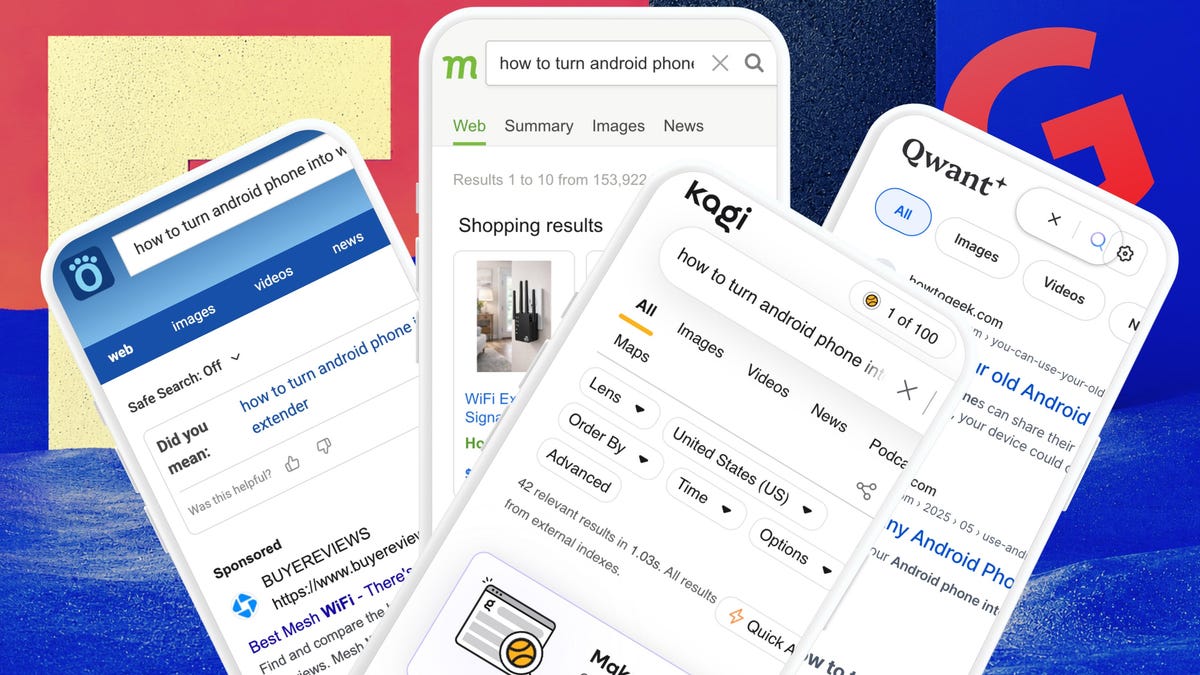
Stay updated with ZDNET: Set us as your preferred source on Google.
Important points from ZDNET
- There are still search engines like Google that barely use any artificial intelligence at all.
- Startpage and DuckDuckGo lead the pack.
- Mojeek stands out for running its own separate search index.
I’m certainly not the most vocal person against AI, but I’ll be honest—I don’t always appreciate Google condensing the entire internet into a single response for me.
Realistically, I would love a way to disable AI Overviews. Plus, having AI Mode pushed onto me with every search gets tiresome. Occasionally, I simply want to enter a handful of keywords, see a long list of traditional blue links, and pick which ones to explore on my own. Yes, there are methods to make Google behave more like its older version, but they’re awkward to use. Naturally, I’ve considered switching to another search engine—but that feels odd, doesn’t it?
Also: Google’s brand-new AI Search box arrives – paired with agents and 5 additional new features
I’ve relied on Google searches for 20 years.
This led me to ask: Are Google’s rivals diving headfirst into AI as well? So, I decided to seek out alternatives—options that rely minimally, if at all, and still operate like a traditional search engine. Turns out, that kind of web experience is becoming increasingly rare.
If my concern isn’t just AI but also how much personal data Google gathers, Startpage offers a compelling alternative.
Created about two decades ago, Startpage essentially forwards my searches to Google and Bing in a way that keeps my identity hidden, so I access standard Google-style results without ever actually visiting Google’s site.
It does not keep a record of my IP address, deploy tracking cookies, or log any user-agent information. Additionally, its Anonymous View function can further shield my IP address when I visit third-party websites. “It works similarly to a VPN,” according to Startpage.
Also: This free Chrome extension cleans up your Google searches – remove AI results, paid ads, and other clutter
Startpage emphasizes that “using AI is a choice, not the default setup,” and has committed to making “every AI function optionally available.” Within its preferences, I could turn off features like search predictions, instant answers, and promotional messages.
Startpage offers Vanish, an independent AI tool, but even with that product, the focus remains on privacy. Vanish grants “secure access” to platforms like GPT-5 and Claude, ensures conversations are never recorded, and keeps all data confined to my device.
Show more
For a quick and easy switch from Google, I’d recommend starting with DuckDuckGo.
Launched back in 2008, DuckDuckGo never saves or shares details about my searches or browsing activity. It also avoids logging my IP address or storing any distinct identifiers tied to my identity or activity history.
The catch is that DuckDuckGo does come with AI-powered tools such as Search Assist and Duck.ai.
Also: This Google alternative without AI is getting very popular – here’s how you can give it a try
Even so, it gives me a handy shortcut: noai.duckduckgo.com. Using that address, DuckDuckGo turns off Search Assist, Duck.ai, and AI-created images automatically by default. For those who want to skip digging through menus, search immediately, and go straight to results, DuckDuckGo is the simplest solution.
Show more
Looking for search results that aren’t just recycled from Google or Bing? Mojeek deserves a look.
Its founder began developing search tools in 2004, and today Mojeek has indexed over 9 billion pages. That’s important because, unlike some competing services, Mojeek independently crawls and organizes the web itself.
Mojeek’s interface may seem less refined compared to Google’s. But it has a firm no-tracking policy, doesn’t place cookies unless you choose to allow them, and replaces IP addresses with two-letter country codes in its logs. Even better, Mojeek firmly states it “will never present AI-generated replies instead of actual search results.”
However, it’s not fully opposed to AI either.
Also: Having tried nearly every browser available, these are my top picks (hint: Chrome isn’t one of them)
It does employ large language models such as Mixtral to provide optional AI summaries of the search results on desktop computers. You can adjust this setting anytime. Even when enabled, summaries don’t pop up after every search—you need to select the “Summarize these results” button in the sidebar of the results page.
Show more
As for Ecosia, it came up often during my hunt for Google substitutes. Its mission is appealing: Each search you perform earns revenue that Ecosia channels toward environmental efforts like planting trees.
Currently, it doesn’t have its own independent search database the way Mojeek does. Ecosia states that its results come from partners like Google and Bing, but it doesn’t build user profiles based on your search behavior.
Also: After using Chrome, Edge, and Safari for years – here’s why I think Firefox suits most users better
The AI aspect is where it gets tricky. Ecosia integrates generative AI elements such as AI Overviews and AI Chat. Ecosia clarifies that AI Overviews are still in beta and can be toggled off in search settings in applicable regions. This setup makes it worth considering, particularly if supporting climate initiatives is also a major factor in your choice.
Show more
Here is the paraphrased version of the article, keeping the HTML structure intact:
You’ll also have to contend with Google’s AI Overviews, which you can’t turn off within Google Search itself. Even a flagship phone running stock Android ships with Google as the default search engine. There’s a lot to dislike about this situation. Whether it’s Google’s increasingly aggressive ad load, the push toward AI-driven results, or simply wanting to take back some control, plenty of people are fed up. While privacy-focused search engines have been around for years as an alternative, the conversation now focuses on whether there are any search engines that won’t cram AI down your throat.
The best part of switching away from Google? I found several search engines that don’t serve up AI-generated summaries on the results page—or let you disable them easily. Even on mobile.
That’s what this guide is about: which Google alternatives don’t use AI? Let’s dive in and find out.
What is the best AI-free or AI-optional Google alternative?
| Search Engine | AI-Free? | AI Optional? | Privacy Focus? |
| — | — | — | — |
| Mojeek | Yes | N/A | Yes |
| Startpage | Yes | N/A | Yes |
| DuckDuckGo | Sort of | Yes | Yes |
| Dogpile | Yes | N/A | Weak |
| Metacrawler | Yes | N/A | Weak |
| Kagi | No | Yes | Yes |
| Brave Search | No | Partial | Yes |
Launching in 1996, Dogpile was one of the early pioneers. It’s a metasearch tool that works differently from traditional search engines—instead of scanning and organizing web content on its own, it gathers results from multiple search engines and presents them together on a single page. Unlike Mojeek, Dogpile doesn’t maintain its own standalone web index. Think of it more as a results collector.
When it comes to privacy, Dogpile becomes a tougher sell. While its Google Play store page claims it “doesn’t track your search history,” its actual privacy policy reveals a heavier reliance on advertising technology compared to the cleaner, more straightforward privacy commitments made by competitors like Startpage or DuckDuckGo. So I wouldn’t rank Dogpile among the top tier of privacy-conscious options.
On the AI front, Dogpile keeps things refreshingly simple. There are no AI Overviews popping up, no AI chatbot windows, and no answer-engine features trying to summarize everything for me. It sticks to the basics—delivering a straightforward list of links instead of generating summaries or synthesized responses.
Metacrawler is another blast from the past. Going all the way back to 1994, when it was created at the University of Washington, Metacrawler functions much like Dogpile: it’s a metasearch engine that draws its results from other providers. The two search engines actually share corporate ownership too—both are services under InfoSpace Holdings, which is part of System1.
Regrettably, privacy is where Metacrawler also falls short. System1’s privacy policy states it may gather data through automated collection and tracking technologies, including IP addresses, search history, browsing activity, cookies, and other user data.
But this isn’t a list limited solely to privacy-focused Google alternatives. The bigger question here is AI—can I get a search experience free of AI features, or at least the ability to turn them off? With Metacrawler, I didn’t encounter any AI Overviews, AI chat functionality, or answer-engine mode in the current search interface. I simply type a query, receive my list of links, and move on.
Kagi is an interesting outlier. Would I voluntarily pay to browse the internet? Honestly, probably not. But for those willing to spend $10 per month for unlimited searches, Kagi delivers a compelling proposition. The concept is straightforward: you pay for the service, so Kagi doesn’t need to bank on invasive surveillance advertising. According to Kagi, there are no advertisements, no tracking, and no search activity linked to user accounts.
However, Kagi is far from AI-free. Quite the opposite, actually. It comes packed with Assistant tools, summarization features, translation capabilities, research agents, and plenty more.
So why include it in this roundup? Because Kagi makes all of its AI features opt-in rather than forced on you. Unlike Google, it doesn’t automatically push AI as the default search experience. That said, when I checked the settings, the only toggle options I found were for disabling “Auto Quick Answer” and search suggestions. I could also activate “SlopStop” filters to weed out AI-generated images, videos, and web search results.
At this stage, it’s becoming increasingly difficult to find Google alternatives that are completely devoid of AI features. Most seem to have adopted some form of AI now, and in many cases, those features are optional.
Regardless, while researching search engines, one name kept showing up repeatedly: Brave Search. Since its launch in 2021, Brave Search has positioned itself around privacy, maintaining its own independent search index and seamless integration with the Brave browser. It also markets itself on delivering private results without profiling and without relying on Big Tech infrastructure.
To be fair, Brave Search absolutely has AI features. Its main search page prominently features “AI-powered answers,” including tools like AI Answers and Ask Brave. I noticed in the settings that I could turn off “Answer with AI,” which Brave describes as an automatic feature that displays AI-generated answers for certain searches.
That said, if my primary goal is to escape AI-heavy search experiences, Brave probably isn’t the strongest choice.
Which Google alternative comes out on top?
For most users, I’d recommend starting with either Startpage or DuckDuckGo’s no-AI page. Startpage is ideal when you want results similar to Google’s but without going through Google directly. DuckDuckGo is the fastest route to an AI-free experience. And if you want true independence from the big search indexes altogether, Mojeek is worth trying. Dogpile and Metacrawler also offer a traditional, links-first approach without any AI Overview-style summaries or an AI Mode sneaking into your results.
The takeaway is simple: there are still options out there. Google may be transforming Search into an AI-first experience by default, but the classic way of searching the web hasn’t vanished entirely. You can still find engines that serve up links with minimal or no AI interference. The selection is shrinking, and many players are gradually following Google’s lead. But for the time being, the old-fashioned search experience still survives—you just need to know where to look and which settings to adjust. Fortunately, that legwork is already done for you.
Can I completely disable AI Overviews in Google Search?
Google doesn’t provide an easy on/off toggle for AI Overviews. However, there are four workarounds available.
What sets Mojeek apart from most other Google alternatives?
Mojeek crawls and indexes the web entirely on its own. Most alternatives depend on Google, Bing, or other major search providers to deliver their results.
