




Bitcoin (BTC) buyers held firm at the $60,000 psychological level during last week’s 13% pullback.
BTC/USD daily chart. Source: TradingView
However, the recovery hasn’t eliminated the bearish risks, as some traders caution that a more significant decline is still possible due to mounting US–Iran tensions and waning expectations for rate cuts.
Several Bitcoin valuation and technical metrics now reinforce this outlook, indicating BTC might still dip to $50,000 or even lower in the weeks ahead.
Key takeaways:
- Bitcoin is trading close to its average mining cost of $62,650, but could slide toward the lower electricity cost threshold of $50,120.
- Glassnode’s MVRV bands place BTC below its lower valuation range, with the next deep-value target around $50,437.
Bitcoin drops below average mining cost
One of the main warning signs stems from the Bitcoin production cost model, which measures BTC’s market price against the estimated average expense of mining one Bitcoin.
The model, shared by Capriole Investments Founder Charles Edwards, indicates Bitcoin is currently trading near its production cost of approximately $62,650. This implies miners are, on average, barely breaking even at present prices.
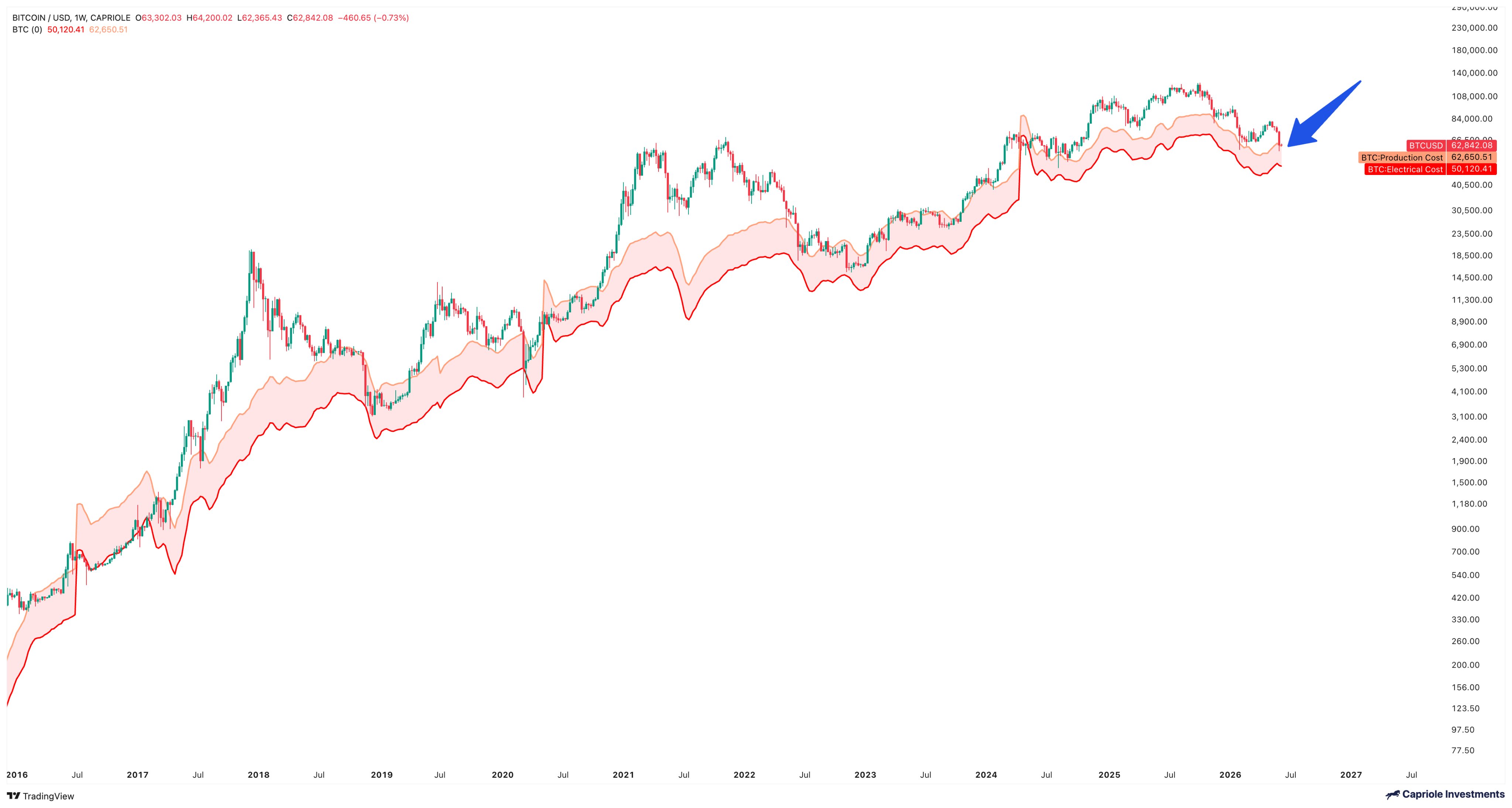
BTC/USD weekly chart vs. production cost. Source: Capriole Investments
This zone has historically served as a crucial long-term value area. In past bear-market corrections, Bitcoin typically found solid buying interest when the price dropped into the range between production costs and the lower electricity cost estimate.
That lower boundary currently stands around $50,120, based on the chart.
In essence, BTC is already testing the upper boundary of a significant miner-cost support range. If sellers manage to push the price decisively below the current production-cost zone, the next major valuation floor would likely emerge near the electricity-cost level around $50,000.
BTC realized price metric points to a $37,500 low
Bitcoin’s realized price—the average cost basis of all BTC holders—is currently around $53,600, according to a chart shared by analyst Follis.
Historically, Bitcoin has never established a major cycle low without first trading below the realized price. BTC dropped about 58% below realized price in 2011, 49% in 2015, 47% in 2018, and 34% in 2022.
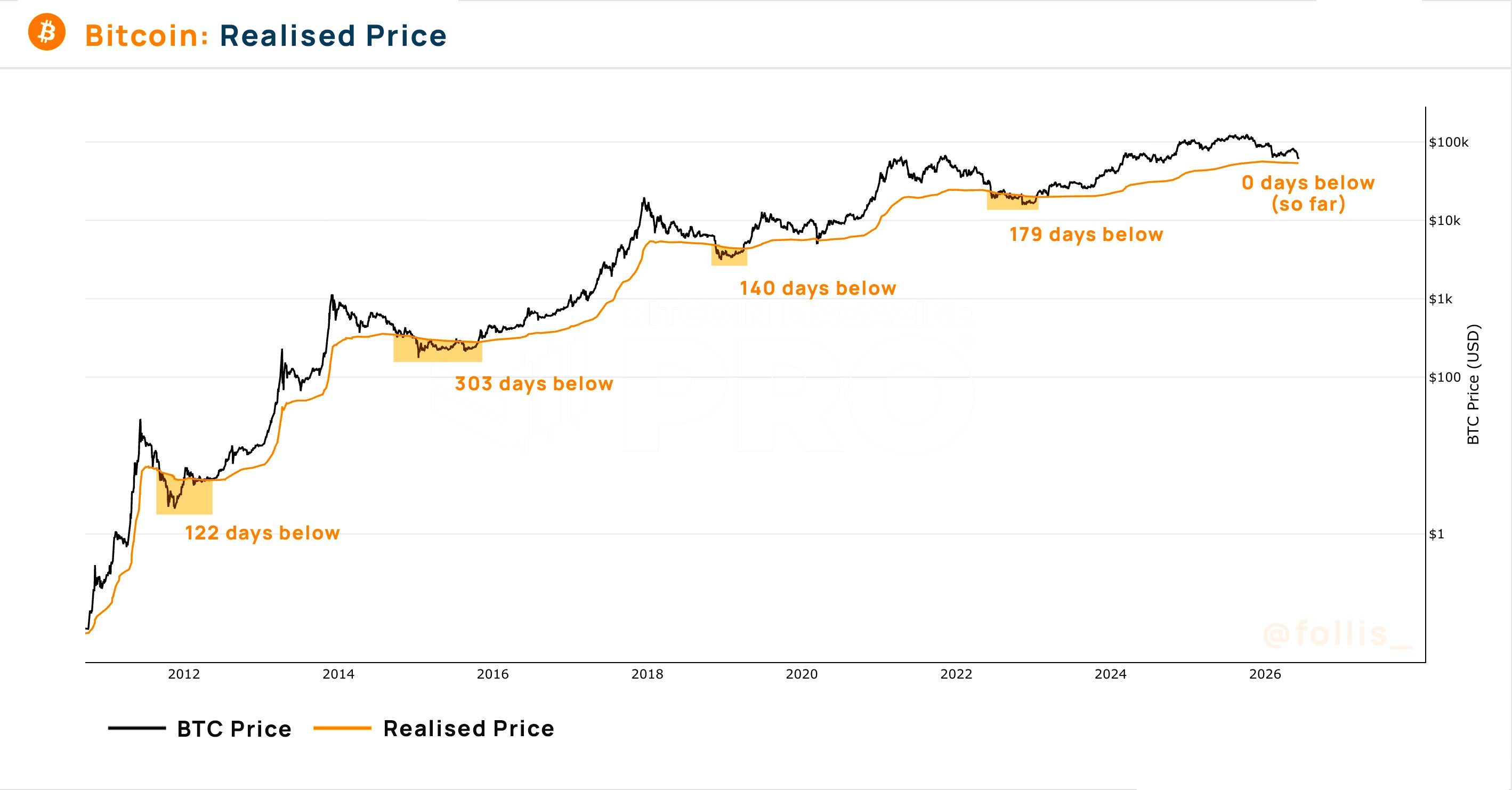
Bitcoin realized price vs. spot price. Source: TradingView/Follis
These drawdowns have grown less severe over time, but even a modest 20%–30% decline below today’s realized price would suggest a bottom range between roughly $37,500 and $42,800.
So far, Bitcoin has spent zero days below the realized price in this cycle, compared with 179 days in 2022, 140 days in 2018, 303 days in 2015, and 122 days in 2011.
Related: BTC price bottom not due until Q4? Five things to know in Bitcoin this week
This keeps the possibility of a bottom forming in Q4 2026 alive. A decisive break below $60,000 could first send BTC toward the realized price near $53,600, before potentially opening the path to a deeper capitulation zone below $50,000.
Bitcoin MVRV bands indicate a drop to $50,000 is feasible
Bitcoin’s MVRV pricing bands also suggest a potential deeper correction toward $50,000.
The model compares BTC’s market price with valuation zones that reflect how expensive or cheap Bitcoin appears relative to its long-term average. Historically, these bands have acted as price magnets during major market cycles.
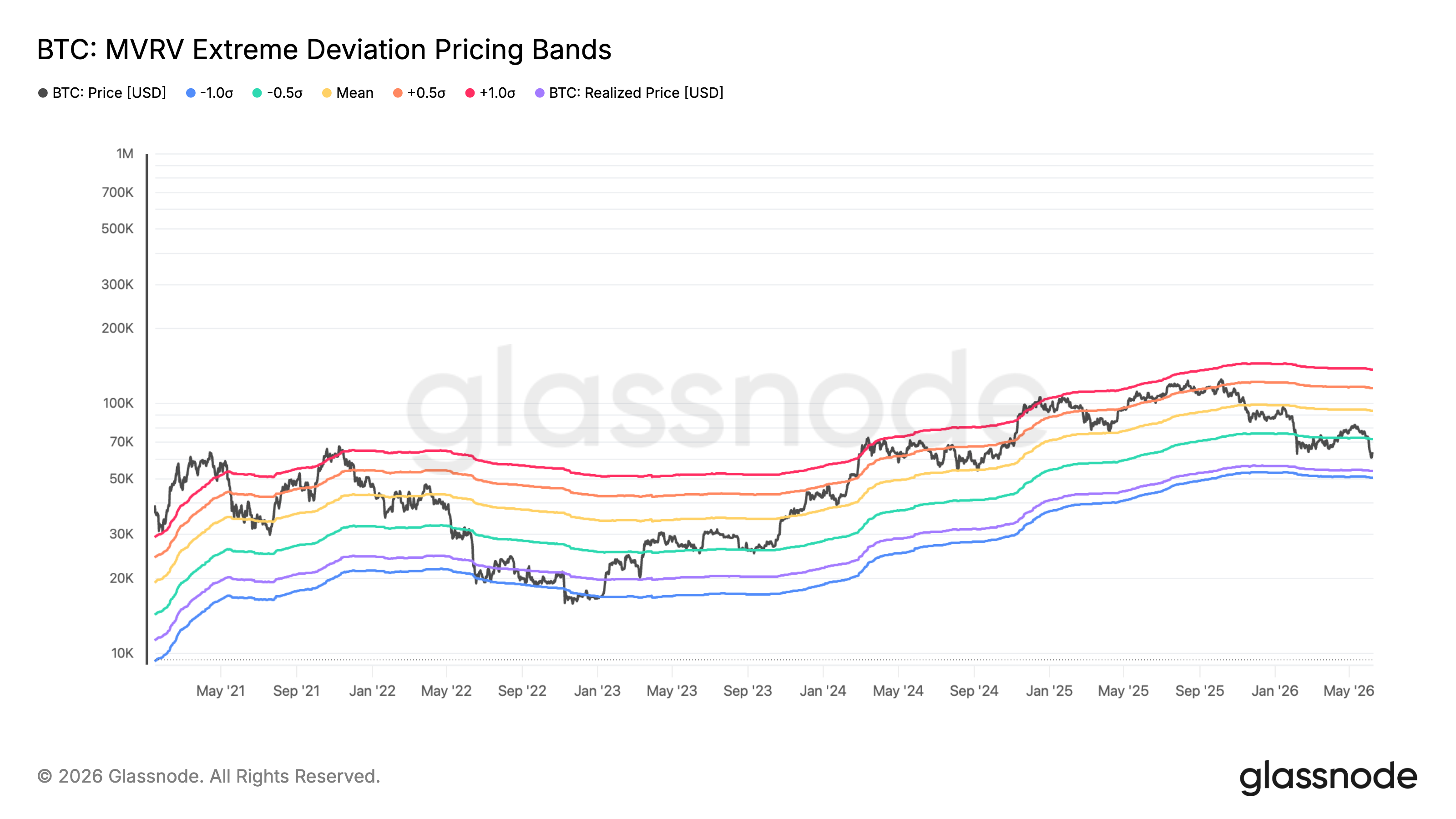
Bitcoin MVRV extreme deviation pricing bands. Source: Glassnode
During the 2021 bull market, Bitcoin repeatedly peaked near the upper valuation bands. In the 2022 bear market, the price eventually fell through the average band and moved toward the lower bands before forming a bottom.
A similar pattern emerged during the 2024 correction, when BTC cooled off toward lower valuation zones before bouncing back.
Currently, Bitcoin is trading near $63,000, already below the model’s lower valuation band around $72,035. The next significant magnet lies near the deep-value band around $50,000.
This level also aligns closely with Bitcoin’s realized price near $53,600, making the $50,000–$53,600 range a key on-chain support cluster.
A decisive break below $60,000 would therefore strengthen the case for BTC to revisit this deep-value zone before attempting a lasting bottom.
Bitcoin bear flag breakdown keeps $50,000 on the table
Bitcoin’s weekly chart reveals a potential bear flag breakdown, with BTC slipping from its rising consolidation range after failing to hold above the 50-week SMA near $91,700.
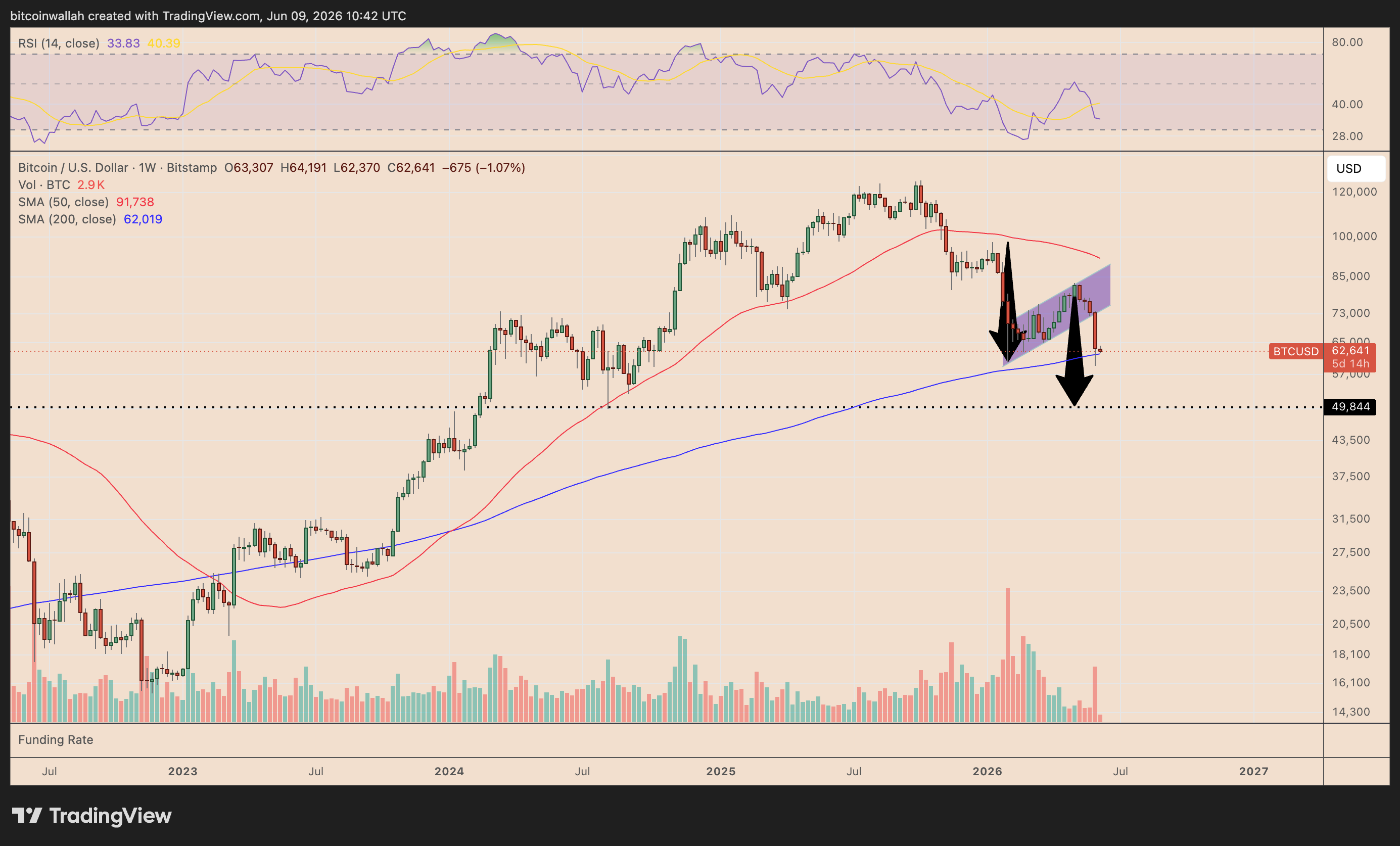
BTC/USD weekly chart. Source: TradingView
The price is now testing the 200-week SMA near $62,000, a critical long-term support level. A decisive weekly close below this level would confirm the bearish pattern and open the door to a measured downside target below $50,000.
Weekly relative strength index (RSI) readings near the oversold threshold of 30 also reflect weak momentum, reinforcing the view that sellers remain in control unless BTC quickly reclaims the flag support.
