



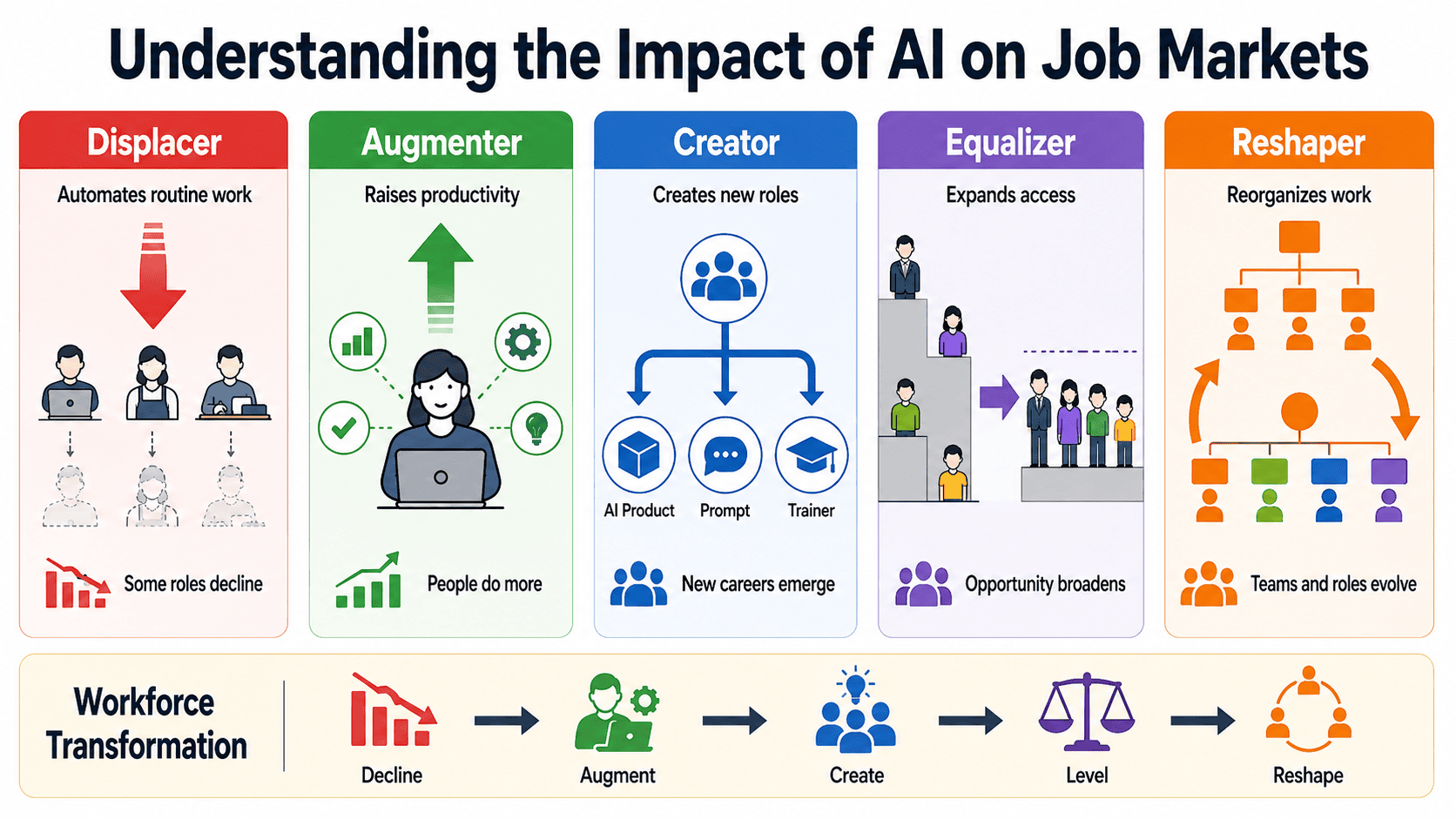
# How AI Is Reshaping the Job Market: Five Forces Every Professional Should Understand
For years, the dominant narrative around artificial intelligence in the workplace has centered on a single, anxiety-driven question: will machines replace human workers? While understandable, this framing is overly simplistic. AI is not a monolithic force that simply eliminates or preserves roles — it is a convergence of multiple, simultaneous dynamics that affect different jobs in fundamentally different ways. Understanding these dynamics is essential for anyone navigating today’s labor market.
AI can strip certain tasks from a role, supercharge others, generate entirely new lines of work, flatten decades-old skill hierarchies, and even restructure the very path from entry-level hire to seasoned expert. To make sense of where the job market is heading, it helps to examine each of these forces independently and see what the available data tells us.
—
## The Displacer: When Routine Work Fades
The most widely feared effect of AI is the outright automation of repetitive, predictable tasks. AI systems excel at pattern recognition, processing massive data sets, and executing structured instructions without fatigue or error. Where work follows a clear, repeatable pattern, software increasingly handles the day-to-day components that once required a human being.
According to a major global workforce outlook report covering the next several years, approximately 92 million jobs could be displaced by 2030 due to a combination of technological adoption, shifting demographics, and broader economic pressures. Among employers surveyed, more than two in five reported plans to downsize parts of their workforce specifically because AI can automate certain tasks.
The roles most vulnerable to this trend tend to involve routine information processing — think data entry, basic administrative support, bookkeeping, and first-tier customer service. In practice, entire positions rarely vanish overnight. Instead, organizations decompose jobs into individual tasks, assign the predictable and repeatable components to software, and retain human workers for the ambiguous, judgment-intensive, and creatively demanding portions of the work.
—
## The Augmenter: AI as a Professional Collaborator
On the other side of the displacement story lies a very different reality. For a significant number of knowledge workers, AI functions less like a threat and more like a highly capable partner. Rather than eliminating roles, it absorbs the slow, tedious portions of professional work — summarizing lengthy reports, generating initial drafts of code, producing first-pass marketing copy — so that people can redirect their energy toward higher-order thinking, strategy, and creative decision-making.
Research from a leading global investment bank suggests that around 300 million jobs across the world are exposed to some level of AI-driven automation, with roughly two-thirds of all occupations experiencing at least partial exposure. Notably, the research projects that the majority of this exposure will translate into a meaningful productivity boost rather than mass job elimination. The same research estimates that AI could contribute roughly seven percent to global economic output over the course of a decade.
Professionals in software development, content creation, financial analysis, design, and middle management are among the groups experiencing this effect most directly. Their daily work is shifting from building everything from scratch to curating, directing, and refining output produced with the help of intelligent tools. A writer becomes more of an editor of AI-generated drafts. A developer transitions toward system architecture and code review while an assistant handles the initial coding pass.
An important nuance is that augmentation can, over time, begin to resemble displacement. A professional who leverages AI effectively can outperform a peer who does not, creating competitive pressure that rewards adaptation.
—
## The Creator: Entirely New Categories of Work
History shows that major technological revolutions consistently destroy some jobs while inventing others — often in fields that simply did not exist before. The rise of the internet gave birth to roles like web developer, SEO specialist, and social media strategist, none of which had clear definitions a generation ago. AI is following a similar trajectory, and at a striking scale.
The same global workforce outlook projects approximately 170 million new jobs will be created by 2030, yielding a net gain of roughly 78 million positions even after accounting for the roles that are displaced. Some of the fastest-growing titles include specialists in big data, AI and machine learning, and information security. Beyond the digital realm, the enormous computing infrastructure required to power AI systems is driving a physical expansion of data centers, which in turn is boosting demand for electricians, HVAC technicians, construction crews, and other tradespeople.
Alongside the obvious engineering and technical roles, entirely new specializations are emerging. Professionals focused on AI ethics, bias mitigation, regulatory compliance, and governance are becoming essential as organizations navigate the responsible deployment of intelligent systems. Many of these roles were virtually nonexistent on job boards just a few years ago, underscoring how rapidly the landscape of work is evolving.
—
## The Equalizer: Shrinking the Experience Gap
For most of the last three decades, new technology has disproportionately benefited those who were already highly skilled, widening inequality in wages and opportunity. Generative AI appears to be breaking this pattern in many professional contexts, and the evidence is compelling.
A landmark study of thousands of customer support agents at a large technology company found that access to an AI assistant increased average productivity by roughly 14 percent. However, the benefits were strikingly unevenly distributed. Less experienced and lower-skilled agents saw productivity gains of approximately 34 percent, while the most seasoned performers experienced almost no measurable change. The AI essentially studied what the top agents did and replicated that expertise for everyone else. Workers who had been on the job for only a couple of months began performing at the level of peers with substantially more experience.
This dynamic is reshaping expectations in roles where there is a relatively clear, objective right answer — customer support, technical writing, routine data analysis, and similar fields. The practical consequence is a narrowing of the performance gap between the strongest and weakest members of a team. For organizations, this raises questions about hiring criteria, the length of training programs, and the traditional link between seniority and compensation, since years of experience confer less of an advantage than they once did.
—
## The Reshaper: A Shorter Path Up the Ladder
The equalizer effect is encouraging for individual newcomers trying to ramp up quickly. But it introduces a troubling structural problem when viewed at the level of the broader economy. Helping a junior worker reach competence faster does not guarantee that a junior job still exists for them to fill in the first place.
A comprehensive 2025 study examining payroll records for millions of workers found that early-career professionals aged 22 to 25 in the occupations most exposed to AI — including software engineering and customer service — experienced an approximately 13 percent relative decline in employment after generative AI became widespread. Meanwhile, older workers in the same roles remained largely unaffected. A follow-up analysis in the subsequent year showed this trend intensifying rather than stabilizing.
The broader picture for recent graduates is similarly concerning, with a significant portion of new entrants struggling to find work that matches their qualifications.
The deeper issue is about the pipeline of expertise itself. Much of what makes a senior professional invaluable was built during years of performing the very junior tasks that AI is now absorbing. Organizations that lean heavily on AI to skip entry-level hiring may solve a short-term cost problem, but they risk depleting their own reservoir of experienced talent over time. Several years from now, a company that never invested in developing junior staff may discover it no longer has the seasoned experts it needs to lead its teams.
—
## How These Forces Interact
In practice, most roles are shaped by several of these forces at the same time. A software developer, for example, experiences augmentation in their day-to-day coding work, benefits from the equalizer if they are relatively new to the field, and simultaneously faces reshaping pressure at the junior end of the profession. A financial analyst might see routine reporting automated away (displacement), use AI tools to sharpen their forecasting (augmentation), and notice that the entry-level analyst position they once held is now being filled by AI (reshaping).
The table below summarizes how these five forces compare across key dimensions:
| Force | Core Mechanism | Roles Most Affected | Recommended Response |
|—|—|—|—|
| **The Displacer** | Automates predictable, routine tasks | Data entry, clerical support, basic customer service | Transition toward complex, strategic, and human-centered work |
| **The Augmenter** | Acts as a collaborative intelligence partner | Developers, writers, analysts, managers | Develop skills in directing, editing, and applying AI output |
| **The Creator** | Generates entirely new industries and roles | Technology, infrastructure, consulting, ethics and governance | Commit to continuous learning and technical adaptability |
| **The Equalizer** | Compresses the gap between novices and experts | Support, writing, routine analysis | Adopt AI tools early to accelerate the learning curve |
| **The Reshaper** | Thins the entry-level rung of career paths | Early-career workers in AI-exposed fields | Cultivate judgment and skills that AI cannot yet replicate |
—
## Frequently Asked Questions
**Is AI going to destroy more jobs than it creates?**
The available data suggests a net-positive outcome in terms of total job count, though the transition will be uneven. One major workforce projection estimates 170 million new roles by 2030 against 92 million displaced — a net gain of roughly 78 million jobs. However, the specific individuals and industries affected will vary dramatically, and the skills required for newly created roles may not align with the skills of those displaced.
**Which jobs are safest from AI disruption?**
Roles that demand complex physical manipulation in unpredictable environments, deep interpersonal connection, advanced strategic judgment, and creative originality tend to be more resistant. However, most jobs are not fully safe or fully vulnerable — they contain a mix of tasks, some of which will be automated and others that will be enhanced.
**How can workers prepare for these changes?**
The most effective strategy is to identify which of the five forces is having the strongest impact on your specific role and then direct your development efforts accordingly. For someone facing displacement, that might mean building skills in complex problem-solving and human interaction. For someone experiencing augmentation, it means learning how to effectively direct and leverage AI tools. For those in early-career stages, investing in judgment, critical thinking, and adaptability becomes especially important.
**Will AI widen or narrow inequality?**
The evidence points in both directions. Inside individual roles, AI appears to narrow the gap between high and low performers, which can be equalizing. But at the macro level, workers who fail to adapt, early-career professionals whose entry points dry up, and communities dependent on industries that are rapidly automating face the risk of deepening inequality.
**How should companies respond?**
Organizations that thrive will be those that match the right AI capabilities to the right tasks, invest in reskilling their existing workforce, and maintain entry-level hiring pipelines even when AI can temporarily absorb junior responsibilities. Treating AI purely as a cost-cutting tool risks undermining the very talent pipeline a company depends on for long-term growth.
—
## Conclusion
The transformation of the labor market by artificial intelligence is not a question of “if” but of how — and the answer is complex, multi-layered, and different for nearly every profession. Rather than asking the broad and ultimately unproductive question of whether AI will take jobs, the more useful approach is to examine specific roles through the lens of the five forces at play: displacement, augmentation, creation, equalization, and reshaping.
Workers and organizations that can clearly identify which force is most actively reshaping their situation are far better positioned to respond strategically. Whether that means pivoting toward more complex responsibilities, learning to collaborate with intelligent tools, acquiring skills in emerging fields, or advocating for sustained investment in early-career development, the path forward demands awareness and action.
The scale of this shift is arguably the largest since the widespread adoption of computers, and its full effects are still unfolding. What is clear is that passivity is the worst strategy. Mapping your role against these dynamics today is the single most practical step you can take toward thriving in the years ahead.
Thank you for reading
