



# How AI Is Accelerating Attack Loops — And Why Defense Needs to Keep Pace
Cybersecurity is entering a paradoxical era. The tools that empower defenders are the same tools empowering adversaries, but the symmetry ends there. Attackers have discovered that artificial intelligence dramatically compresses the timeline between a failed attempt and a successful one, turning what used to be a high-cost, high-skill dead end into a low-cost, rapid experiment. The question for defenders is no longer whether AI-powered attacks exist — it’s whether their own operations can match the speed of the threat.
—
## The Quiet Revolution in Failed Attacks
Most people imagine a cyberattack as a single dramatic strike — a zero-day exploit, a sophisticated phishing campaign, or a ransomware deployment that makes headlines. The real work of intrusion happens in the unglamorous middle: the research, the trial-and-error, the endless troubleshooting between “I have access” and “I have what I need.”
Consider a common scenario. An attacker gains a foothold on a low-privilege cloud account. The first attempt to escalate privileges fails. Historically, that failure meant hours — sometimes days — of poring over documentation, testing scripts, and guessing at permission structures. Many attackers simply abandoned the attempt at that point. AI changes the equation entirely. A model can interpret the error, suggest a corrected script, propose a new enumeration path, and have a fresh attempt running within minutes.
None of these individual capabilities are new. What has changed is the combination: the elimination of time, expertise, and cost from the tedious middle phase of an intrusion. The attack lifecycle has always been iterative. AI has simply made each iteration dramatically cheaper.
—
## The Evidence: AI Moving Into Attacker Workflows
The trajectory is unmistakable if you follow the public security landscape. In early 2025, major threat intelligence groups documented state-affiliated actors using generative AI for translation, script assistance, and research — essentially treating it as a productivity multiplier. By late 2025, the same intelligence teams were flagging malware that contacted AI models during execution, and underground marketplaces for illicit AI tooling had begun to mature. Major AI providers also disclosed disrupting operations where adversaries used AI at virtually every stage of an attack, from initial reconnaissance and credential theft through to crafting ransom demands.
By mid-2026, threat intelligence analysts were reporting that cybercriminals had found authentication bypasses in open-source management tools and built working exploits for them. Analysis of the exploit code indicated with high confidence that AI models had assisted in both discovering the vulnerability and developing the exploit.
These examples share an important nuance: they represent assessed AI assistance, not necessarily confirmed large-scale deployment in live environments. Attribution remains difficult, prevalence is uncertain, and no single report constitutes a comprehensive picture of global activity. What matters is the direction: AI is moving from the periphery of attacker operations into the core of their workflows.
—
## Why Provider Guardrails Aren’t Enough
AI companies have implemented safety classifiers, abuse detection systems, and disruption campaigns that raise the cost of misuse. These efforts deserve recognition — they demonstrably work to slow abuse and have led to the disruption of several malicious operations. But a critical structural problem remains: a guardrail lives outside the enterprise perimeter.
An operator determined to misuse an AI system can reframe requests to slide past safety filters, switch to open-weight models that lack corporate policy controls, decompose a single malicious task into dozens of seemingly innocent queries, or build wrapper tooling that routes around the policy layer entirely. This friction slows misuse, but it does not stop it. Relying on a provider’s terms of service as a security boundary is substituting reassurance for actual defense.
—
## The Attack Loop vs. the Defense Loop
Traditional security textbooks depict an attack as a straight line: reconnaissance, initial access, privilege escalation, and impact. Reality looks nothing like that. A real attacker operates as a closed loop: observe the environment, form a hypothesis, take action, read the result, and adjust. AI compresses the time between each of those steps, meaning novices can stay in the game far longer and experts can run far more experiments per day.
Defenders are supposed to operate on the same principle. An alert fires, context is gathered, a hypothesis forms, scope is validated, action is taken, and the outcome feeds back into detection rules. In practice, this loop is shattered by queues and handoffs. Alerts sit unassigned. Identity context lives in a separate console. A telemetry gap becomes a backlog item, and the reasoning behind a closed false positive dies inside a ticket, never reaching the person who maintains the detection rule.
The attacker’s feedback loop runs in seconds. The defender’s feedback loop runs in hours or days. Mean time to acknowledge and mean time to remediate metrics obscure this reality — an alert can be acknowledged in minutes but then spend hours being reconstructed from multiple systems. That reconstruction period is decision latency, and remarkably few security operations centers measure it.
—
## What Gets Lost at Every Handoff
Security operations are commonly broken into five functions: threat intelligence, threat hunting, detection engineering, investigation, and remediation. In a well-staffed team, these functions spread across different roles, teams, and sometimes different organizations. In a small team, a single person might wear several of these hats simultaneously.
The functions themselves rarely cause problems. What causes problems is the transfer between them.
Threat intelligence understands why a technique matters in the broader threat landscape. Threat hunting knows where a technique would surface in the environment. Detection engineering carries the rule’s unstated assumptions and known limitations. The investigator holds the evidence trail that led to the conclusion. The team responsible for remediation understands what actions might break business processes.
Each time knowledge passes from one function to the next, it gets compressed into an indicator, an alert, or a ticket — and compression is inherently lossy. Five critical pieces of context are particularly vulnerable:
1. **Entity identity** — the actual user, device, workload, or business process at the center of the case.
2. **Evidence and provenance** — the observations behind the conclusion, where they came from, and when they were recorded.
3. **Hypothesis and confidence** — the leading explanation, competing alternatives, and the certainty behind the choice.
4. **Telemetry sufficiency** — which claims the available data can support, which it cannot, and which missing data source limits confidence.
5. **Decision ownership and constraints** — who holds authority to act, what approvals stand in the way, and what the proposed action might break.
Lose the entity identity, and two teams end up investigating the same user under different names. Lose decision ownership, and a sound recommendation sits in a queue while the intrusion progresses. Evidence without provenance is merely decoration — it looks convincing but cannot be trusted or retraced.
—
## A Worked Example: The Finance Employee Incident
Imagine a finance team member logs in from a hosting provider the account has never used before. Multi-factor authentication succeeds. Within ten minutes, a new mailbox forwarding rule begins sending messages to an external address, and the account starts pulling files from a finance SharePoint site in a pattern it has never exhibited before. No single event proves compromise. The sequence demands attention.
Threat intelligence has been tracking a wave of adversary-in-the-middle phishing designed to steal authenticated sessions. This context explains why an MFA success alone cannot clear the account. But that contextual reasoning rarely survives the handoff — it typically gets reduced to a short advisory with indicators and technique tags, while the behavioral sequence and the local conditions that make it significant are left behind.
A threat hunter translates the advisory into queries and discovers two things the advisory never mentioned: device compliance data covers only part of the environment, and SharePoint audit records arrive hours late. The hunt produces a list of suspicious accounts, but the caveats about coverage gaps get dropped in transit.
Detection engineering builds a correlation rule that fires when the unfamiliar network location, the MFA success, and the new forwarding rule cluster within a short time window. The rule’s authors know it lacks device-state visibility for a portion of the user base, but that assumption travels no further than the design document. The alert that reaches an analyst shows a sign-in event and a mailbox rule — without any of the reasoning that connected them.
The analyst rebuilds the picture across four different consoles. Two explanations remain viable: the user might legitimately be traveling and trying a new service, which explains the unfamiliar network but not the forwarding rule or unusual access patterns. Or an authenticated session was stolen, which explains the entire sequence. The second explanation fits the evidence better, but endpoint visibility remains unknown because the device is unmanaged and there is no process or network telemetry to examine.
The case closes with a recommendation to disable the account. Meanwhile, the identity team receives a one-line task: disable this account. What the identity team knows — and the SOC does not — is that the account is mid-payroll-run. A blunt disable interrupts a time-sensitive business process. The correct response involves multiple coordinated steps: revoking active sessions, stripping the forwarding rule, suspending the account under incident policy, arranging for a backup operator to handle the payroll run, and later confirming that credential reset and MFA re-enrollment are complete on a managed device.
Every function did its individual job. The system as a whole forced each team to reconstruct the incident from scratch, and handed the one team with critical business context nothing more than a task, not a decision.
—
## The Myth of the Unicorn Analyst
When organizations feel the weight of this information loss, the instinct is to hire: find someone fluent in identity, endpoint, cloud, email security, malware analysis, detection logic, and executive communication, and assign them to the alert queue. This mythical “unicorn analyst” is not a talent strategy — it is a workaround for missing system state.
The senior analyst who appears to succeed at this work is actually relying on knowledge no dashboard shows. They know which log source is unreliable, which service account must never be touched, which application owner answers calls at two in the morning. The organization’s real operational playbook lives inside that one person’s head, and it walks out the door when the person resigns. A significant portion of analyst burnout stems from exactly this: continuously re-deriving knowledge the organization already possessed but failed to preserve.
The most expensive loss arrives after an incident closes. If the truth turns out to be benign — the employee was legitimately traveling, and the forwarding rule had been approved — someone needs the evidence that led to the initial verdict. The telemetry owner needs to hear that device coverage was partial. But what the system retains is a closure reason. The verdict survives; the lesson evaporates. This is why noisy detection rules remain noisy for years, and why each new analyst independently rediscovers the same blind spots.
—
## Building a Stateful SOC: Five Kinds of Memory
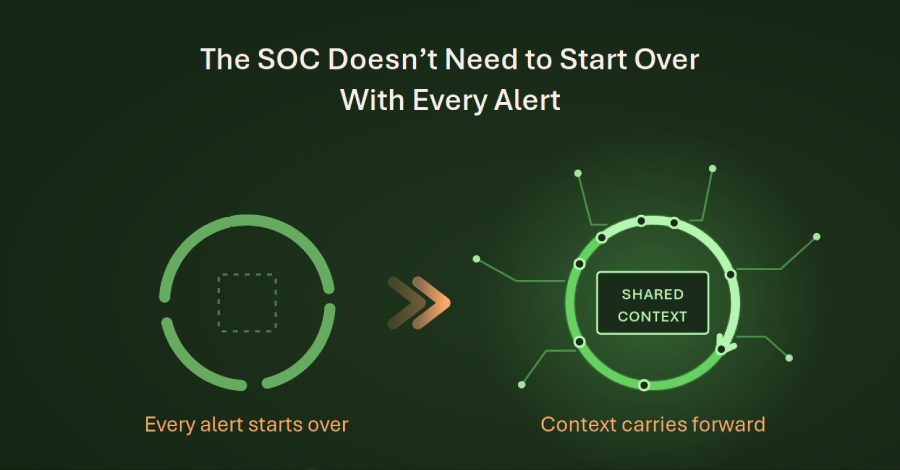
The solution is architectural. The security operations center needs to become stateful. SOCs are not amnesiac — they retain evidence and case histories, often for years. What does not survive a handoff is the reasoning behind the evidence, the uncertainty that qualified it, and the constraints on who could act. Those details stay buried in whatever system produced them instead of informing the next decision.
The alternative is shared operational memory, structured around five categories of state that every workflow reads and writes:
– **Environmental state**: the identities, devices, workloads, and business services that exist, their relationships, their owners, and which of them are privileged, exposed, or unmanaged.
– **Evidence state**: each observation, its source, its timing, and a traceable path back to the original event.
– **Decision state**: the current hypothesis, competing alternatives that were weighed, the evidence for and against each, and what new information would change the answer.
– **Control state**: the actions under consideration, the approvals they require, the owner of the affected system, and any dependencies that must be preserved before containment.
– **Learning state**: the corrections analysts made, the assumptions that proved wrong, whether the fix held over time, and what should change in a threat hunt, detection rule, or playbook as a result.
A shared model organized around these categories allows the SIEM, endpoint detection platform, identity provider, and case management system to all contribute to a single, coherent decision. None of those tools gets replaced — they become richer participants in a common operational fabric.
The most difficult discipline in this framework is treating “unknown” as a legitimate, honest answer. When endpoint telemetry is missing because a device is unmanaged, a weak system files the finding as “no malicious process activity was observed.” That sentence is technically true but operationally misleading. A stateful system records that the endpoint could not be checked at all, reduces its stated confidence in endpoint scope accordingly, and routes the coverage gap to whoever owns device management. The gap becomes a visible part of the case rather than disappearing into a reassuring sentence.
—
## AI Agents: Jobs and Boundaries
Agentic AI is the next frontier, and it should be introduced with deliberate care. Bolting autonomous agents onto a stateless security operations model simply gives a broken process more speed. The value proposition changes entirely when agents operate on top of shared, structured memory.
In a well-designed stateful system, threat intelligence determines whether an outside threat matters in the local environment and shows its reasoning. Threat hunting reports the populations it covered alongside the populations it could not observe. Detection engineering verifies that the environment can actually feed a rule the data it needs before that rule goes live. Investigation packages timeline, competing explanations, evidence, and confidence as a single structured object. Remediation maps the decision onto concrete actions, owners, and required approvals.
Authority must remain separate from confidence. A practical framework distinguishes four modes for any proposed action:
1. **Observe and gather further evidence** — the system continues to collect data without taking action.
2. **Recommend** — a suggested action and its reasoning are presented to a human who holds the authority to decide.
3. **Execute after explicit approval** — the action proceeds only after a designated approver confirms.
4. **Execute automatically** — allowed only when policy conditions, confidence thresholds, entity type, and potential-impact assessments are all satisfied.
The chosen mode lives in control state, versioned and auditable. A confident-sounding narrative earns an AI agent nothing in execution rights.
The same discipline applies to learning from mistakes. A single false-positive verdict from one analyst is insufficient evidence to alter production detection logic. Analysts make errors, and some cases are genuine exceptions. A stateful system captures the evidence behind any correction, gathers similar cases, drafts a proposed change, and routes that proposal to the rule’s owner for review. That review step is what separates genuine learning from self-corruption.
—
## The Analyst’s Role Is Shifting Upward
The evidence-assembly portion of an investigation is increasingly handled before the analyst ever touches a case. When the analyst arrives, their first task is to challenge the structured case that has been assembled: Does the hypothesis hold together? Was a competing explanation properly considered? Is the proposed action proportionate to the evidence? Does the business context change what containment should look like?
Measurement should evolve alongside this shift. Rather than counting completed agent tasks — a metric that flatters the software — organizations should ask four more meaningful questions:
1. Does the analyst open a case that already contains the relevant context from earlier stages?
2. Does the case explicitly record what could not be seen alongside what was concluded?
3. Does a corrected verdict reach the rule’s owner while the correction still matters?
4. Did every automated action stay within policy, with a complete audit trail behind it?
This direction aligns with evolving federal guidance. Updated incident response frameworks now treat response as part of an organization’s broader risk management posture rather than a self-contained security operations activity.
—
## FAQ
**Why is AI making cyberattacks cheaper rather than creating entirely new attack types?**
AI is not introducing fundamentally new attack techniques. Instead, it is dramatically reducing the time, skill, and cost required to iterate on failed attempts. The research, troubleshooting, and experimentation phase between initial access and achieving objectives — which previously required significant human effort — can now be automated and compressed, making it economically viable to pursue attacks that would have previously been abandoned.
**What is the difference between AI assisting attackers and AI being deployed in attacks?**
AI assistance refers to situations where AI tools were used as productivity aids during the planning, scripting, or research phases of an operation. Confirmed deployment in the wild refers to AI being actively used in live, production-stage attacks against real targets. Intelligence assessments often identify the former with high confidence while the latter is harder to prove, and the distinction is important to avoid overstating the current state of the threat.
**Why can’t AI safety guardrails from model providers serve as a defense?**
Provider guardrails operate outside the enterprise perimeter. Skilled operators can circumvent them through request reframing, switching to open-weight models, decomposing malicious tasks into innocuous sub-queries, or building wrapper tooling that routes around policy layers. Guardrails raise the cost of misuse and slow it down, but they do not create a security boundary that an organization can rely on for protection.
**What does it mean for a SOC to be “stateful”?**
A stateful SOC maintains structured, persistent memory of not just what happened and what was concluded, but also the reasoning behind those conclusions, the uncertainty involved, and the constraints on who can act. This contrasts with the current norm where investigative reasoning, coverage gaps, and business context are lost at every handoff between teams. The five categories of state — environmental, evidence, decision, control, and learning — form the backbone of this approach.
**What happens if an AI agent makes a wrong decision in a stateful SOC?**
In a properly designed system, AI agents do not execute actions autonomously without governance. Actions are governed by a control state that specifies the required approval level, the authority holder, and the policy conditions that must be met. Incorrect decisions are captured as learning-state entries, and the evidence behind the correction is gathered and routed to the appropriate rule or playbook owner for review before any production changes are made.
**How does this relate to the shrinking gap between attackers and defenders?**
Attackers already operate as tight loops — observe, hypothesize, act, learn, repeat — and AI is compressing the time between each step. Defenders have traditionally operated on the same principle but have been hampered by organizational silos, handoff losses, and slow feedback cycles. Closing the gap requires architectural changes that give defenders the same kind of rapid iteration capability, rather than simply adding AI tools to a broken process.
—
## Conclusion
The threat landscape is not waiting for defenders to catch up. Attack loops are tightening, AI is lowering the barrier to persistent experimentation, and the information losses inherent in handoff-heavy security operations are becoming exploitable at scale. The path forward is clear: invest in architectural changes that preserve reasoning, uncertainty, and context across the entire incident lifecycle. Move from treating security operations as a series of isolated functions to treating them as a continuous, stateful process. The organizations that make this transition will be the ones capable of matching the speed and adaptability of the adversaries they face.
The alternative — continuing to patch a broken handoff model with more tools and more people — leaves the most critical gap unfilled: the gap between what security tools know and what the humans operating them can act on.
Thank you for reading.
