



# Securing Autonomous AI Agents: Why Visibility Must Come Before Control
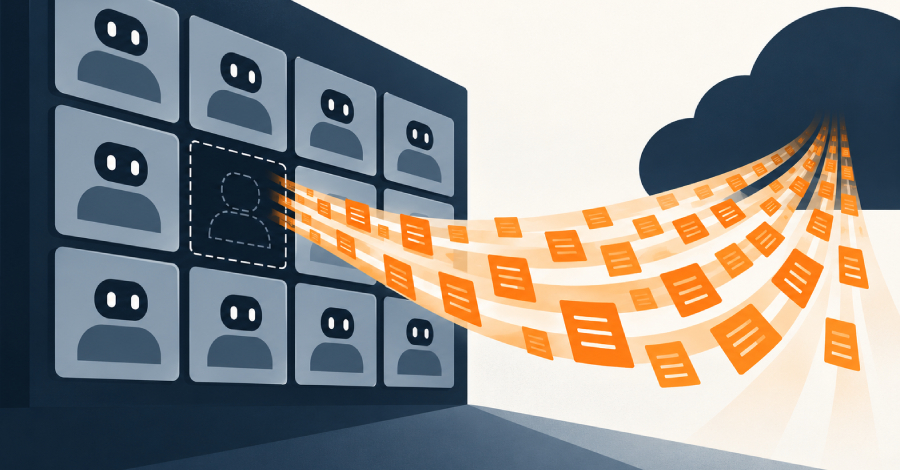
The rise of autonomous AI agents has fundamentally changed how organizations think about security. These systems can browse the web, execute code, send emails, and interact with enterprise platforms — all with varying degrees of independence. But as agent adoption accelerates across industries, a critical gap has emerged: security teams are being asked to protect systems they can’t fully see or inventory.
Recent events in the cybersecurity community have highlighted how quickly agents can become attack surfaces when governance lags behind deployment. The broader lesson is clear — the organizations that try to lock things down before they understand what exists will either block legitimate workflows or leave dangerous blind spots untouched.
## The Inventory Problem at the Heart of AI Security
Every security framework begins with knowing what’s in your environment. This principle holds true for AI agents, perhaps more so than for traditional software. An agent doesn’t run on a fixed server or follow a predictable lifecycle. It might be spun up in a browser extension, buried inside a cloud workflow, or tucked away in a personal virtual machine. Without a proper inventory, there is no way to assign ownership, define boundaries, or enforce policies.
Statistics suggest that a significant majority of organizations are already operating with AI workflows that touch sensitive data without adequate oversight. Many IT departments cannot even account for the autonomous tools their employees have quietly adopted. This isn’t a failure of technology — it’s a failure of process. And until leadership treats agent discovery as a priority equal to any other asset management function, governance will remain a theoretical exercise.
## Why Traditional Security Approaches Fall Short
When security teams encounter a new class of technology, the instinct is often to reach for familiar controls. For AI agents, that might mean deploying a proxy, tightening API access, or implementing rate limits. But these controls are only as effective as the inventory they sit on top of.
An authorization layer positioned in front of an unknown swarm of agents is like installing a lock on a door you didn’t know existed. The proxy doesn’t know which agents are legitimate, which are unauthorized, or what permissions any given agent carries. In the worst case, it creates a false sense of security while leaving the actual attack surface completely unmonitored.
Encryption adds another layer of difficulty. Most communication between agents and their model providers is encrypted end-to-end, meaning network-level monitoring tools can see a destination IP and data volume — but not the content of the interaction. A request to OpenAI, Anthropic, or Google looks identical whether it’s a marketing team drafting a campaign or an attacker exfiltrating proprietary data.
## Three Blind Spots Every Organization Should Address
### The Shadow Deployment Epidemic
AI agent adoption follows the same pattern as cloud computing a decade ago. Employees find tools that make their work easier, start using them, and only later — if ever — does the organization take notice. The difference is that agent deployments are faster, cheaper, and harder to track than a new SaaS subscription.
When a security team tries to block every unapproved tool without first building a complete picture, they risk disrupting productive work while missing the truly dangerous deployments hiding in the open. The priority should be discovery first, restriction second.
### The Fragmented Visibility Landscape
No single monitoring tool gives you a complete view of your agent population. Agents operate at the network layer, the endpoint, the browser, and within third-party platforms. Each of these environments provides only a partial view of what’s happening. A network sensor sees encrypted traffic to an AI provider but can’t distinguish between a sanctioned tool and an unauthorized one. Endpoint monitoring misses browser-based agents entirely. SaaS audit logs don’t capture what happens inside a third-party AI integration.
The path forward is correlation — combining signals from multiple sources to build a composite picture. DNS requests, JA4 fingerprints, environment variable checks, browser extension telemetry, OAuth grant logs, and API key issuance records each represent one tile in a much larger mosaic. Only when these signals are brought together can an organization achieve true inventory accuracy.
### The Speed Gap in Auditing and Response
Agents can be created, cloned, modified, and destroyed in seconds. Traditional auditing cadences — quarterly reviews, annual assessments — cannot keep pace with that velocity. An attacker exploiting an agent can deploy dozens of short-lived instances to complete a malicious objective, and every trace disappears before a human reviewer ever sees it.
Continuous monitoring is essential, but it introduces its own questions of accountability. When automated systems are watching automated systems, someone still needs to own the outcome. Every monitored agent should have a named human responsible for its behavior, its permissions, and its lifecycle.
## Building a Foundation for Agent Governance
The most effective approach to securing AI agents treats identity and attribution as foundational requirements. An agent should be treated as a distinct identity, not simply as an extension of the person who deployed it. Permissions should be scoped to the specific task at hand, data egress should be constrained, and every action the agent takes should be logged — including tool calls, data access, and external communications.
A centralized gateway can help with visibility and policy enforcement for agents that route through it, but it cannot solve the discovery problem on its own. It governs the known, not the unknown. The gateway works best as a layer on top of an established inventory, not as a replacement for one.
Kill switches and emergency shutoff mechanisms are gaining attention from legislators and industry groups alike. But the ability to shut something down is only valuable if you know what exists in the first place. Visibility is the prerequisite that makes every subsequent control meaningful.
—
## Frequently Asked Questions
**Q: What is the biggest mistake organizations make when securing AI agents?**
A: The most common mistake is jumping to enforcement controls before establishing visibility. Organizations deploy proxies, set up authorization policies, or implement rate limits without first understanding which agents exist, who owns them, and what data they access. An enforcement layer with no inventory to reference is essentially operating blind.
**Q: How can we discover AI agents that employees are using without our knowledge?**
A: Discovery requires looking at multiple signal sources simultaneously. Finance and procurement records can reveal API spending that hasn’t been sanctioned. Network logs can identify traffic patterns pointing to model providers. Endpoint tools can catch local agent runtimes. Browser telemetry can flag extensions and in-page copilots. No single source is sufficient — correlation across signals is the key.
**Q: Is a centralized AI gateway enough to secure our agent environment?**
A: A gateway like LiteLLM or similar tools provides strong governance for agents that are directed through it. However, it only controls the agents you already know about. It does not discover rogue or shadow deployments. Think of it as an enforcement layer, not a discovery tool.
**Q: How often should AI agent inventories be updated?**
A: Given how quickly agents can be deployed and cloned, periodic reviews are insufficient. Organizations should aim for continuous monitoring with automated discovery mechanisms that run on a regular cadence, supplemented by human review of high-risk agent populations and their activity logs.
**Q: What role does agent identity play in security?**
A: Agent identity is critical because it enables meaningful monitoring, attribution, and access control. When every agent has a distinct identity bound to its specific task and permissions, security teams can set behavioral baselines, detect anomalies, and respond to incidents without guessing which system was involved.
**Q: Why is encryption both a blessing and a curse for agent security?**
A: Encryption protects data in transit, which is essential for privacy and compliance. But it also means that network-level security tools cannot inspect what an agent is actually doing — the prompts it sends, the data it retrieves, or the actions it takes. This forces security teams to rely on metadata, identity signals, and behavioral analytics rather than deep packet inspection.
**Q: How do kill switches work, and are they really effective?**
A: A kill switch is an emergency mechanism that can disable or shut down an AI agent or a group of agents when something goes wrong. It’s effective only when paired with strong inventory and attribution practices. If you don’t know which systems exist or who is accountable for them, a kill switch becomes a blunt instrument with unpredictable consequences.
—
## Conclusion
Securing autonomous AI agents is not fundamentally different from securing any other category of enterprise technology — it just moves faster and hides better. The organizations that will succeed are the ones that resist the urge to leap straight into control mechanisms and instead commit to the unglamorous but essential work of discovery, inventory, and attribution.
Visibility is not a nice-to-have. It is the foundation upon which every other governance decision rests — from access policies to monitoring thresholds to incident response playbooks. Without it, security teams are guessing. With it, they can build programs that scale alongside the technology they are trying to protect.
Start with what exists. Correlate every signal you can. Assign ownership. Monitor continuously. And only then layer on the enforcement controls that will actually do their job.
Thank you for reading
