



# South Korea’s KOSPI Sounds the Alarm: AI Chip Trade Becomes Central Risk Factor for Global Markets
South Korea’s benchmark stock market index, the KOSPI, triggered its second circuit breaker in a single week as turmoil in the AI chip sector sent shockwaves through equities worldwide, dragging down Wall Street, Tokyo, and Tokyo-listed SoftBank in a cascading global selloff.
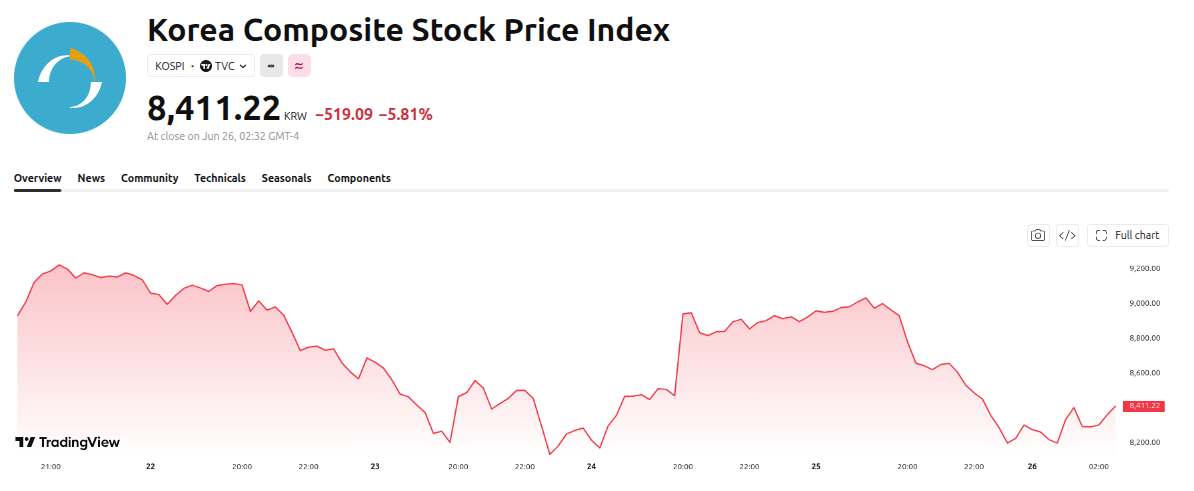
Friday’s dramatic 8.19% intraday plunge forced a 20-minute trading halt and marked the clearest signal yet that exposure to AI chip stocks has become the dominant risk factor driving global equity markets.
## What Triggered the Latest KOSPI Halt
A circuit breaker is an emergency mechanism designed to temporarily pause trading when an index drops too sharply within a compressed timeframe. The Korea Exchange activated the halt on Friday at 12:10 p.m. local time after the KOSPI remained more than 8% below the previous session’s close for at least one full minute.
The benchmark index plummeted 731.97 points, reaching 8,198.33 at the moment of suspension. This marked the fifth circuit breaker event of 2026 for the KOSPI and only the second time in a single session that both a sell-side sidecar and a circuit breaker were activated simultaneously.
When trading resumed and the session concluded, the KOSPI settled at 8,411.21, registering a 5.81% decline for the day. Samsung Electronics, the country’s most valuable company, fell 5.30% to 339,500 won (~$248), while SK Hynix dropped 8.36% to 2.673 million won (~$1,950). Together, these two semiconductor giants account for roughly half of the index’s total market capitalization, meaning their movements disproportionately amplify the broader index’s swings.
Capital outflows intensified the downturn. Foreign investors sold a net 4.62 trillion won (~$3.4 billion) over the course of the session, while institutional investors followed with an additional 3.78 trillion won (~$2.8 billion) in sales. Retail investors, however, took the opposite approach, purchasing a net 8.19 trillion won (~$6.0 billion) as they doubled down on the long-term AI infrastructure investment thesis.
The episode unfolded just three trading days after Tuesday’s staggering 9.99% crash, which had triggered the first circuit breaker of the week and sent both Samsung and SK Hynix tumbling more than 12% each. As a result, KOSPI volatility has now reached levels rarely seen since the index’s inception.
## How the AI Chip Trade Is Driving Global Risk
The catalysts behind Friday’s selloff were multifaceted and centered squarely on memory chip concerns. Worries about slowing demand and pricing tensions between Apple and Micron drove early selling pressure. Renewed concerns about the escalating costs of AI infrastructure and a potential delay in OpenAI’s IPO further fueled the cascade.
Profit-taking compounded the move sharply. The KOSPI had bounced 5% on Wednesday and another 3% on Thursday following Tuesday’s initial crash. Passive funds tracking semiconductor-heavy indexes rotated out aggressively in response, generating waves of forced selling across every chip-related name listed in Seoul.
The ripple effects extended far beyond South Korea’s borders. Japan’s Nikkei 225 plunged 4.15% on Friday to 69,360.83, completely erasing Thursday’s gains and surrendering the critical 70,000 level. SoftBank dropped more than 12% in Tokyo, pressured by reports circulating across global wires regarding the OpenAI IPO timeline.
Wall Street absorbed the blow as well. The Nasdaq Composite closed Friday with its fifth consecutive losing session, falling 4.6% over the week. The S&P 500 lost almost 2% across the same period, while the Philadelphia Semiconductor Index extended a global rout that had already swept through Asia and Europe.
Analyst commentary has increasingly framed the situation as a concentration problem. With Samsung and SK Hynix representing more than half of the KOSPI, every movement in memory chips becomes an index-level event. As a result, KOSPI-linked financial products now behave less like a traditional Korean equity gauge and more like a pure proxy for AI chip sentiment.
The broader structural takeaway is clear: AI infrastructure spending, memory pricing dynamics, and the timing of major technology IPOs now drive the entire global risk environment. Until the AI chip trade finds a steadier footing, circuit breakers in Seoul will continue to serve as the first warning signal for every downstream market around the world.
—
*This article is based on the original post: “South Korea’s Stock Market KOSPI Just Flashed a Global AI Warning,” which appeared first on BeInCrypto.*
