



# Chinese AI Models Close the Gap on US Frontier Labs as GLM-5.2 Disrupts the Global Landscape
The global AI industry experienced a dramatic shift in competitive dynamics over the course of a single week, as Chinese artificial intelligence models surged forward against their American counterparts. At the center of this transformation was Z.ai’s release of GLM-5.2, an open-source system operating at roughly one-sixth the cost of models developed by US frontier labs like Anthropic and OpenAI. The launch coincided with Washington’s decision to tighten access to American AI models, creating a perfect storm that has reshaped the industry’s competitive picture almost overnight.
## How GLM-5.2 Is Reshaping the Chinese AI Race
An open-source AI model is a system whose weights can be freely downloaded, fine-tuned, and run on any infrastructure without the original developer’s permission. GLM-5.2 belongs to that category, and its release has triggered the loudest reaction from Silicon Valley since DeepSeek’s debut last year.
The model carries serious technical credentials. Z.ai, formerly known as Zhipu AI, designed GLM-5.2 with 750 billion parameters and a 1-million-token context window. Furthermore, the system runs entirely on domestic Chinese chips, a critical detail given the ongoing United States export restrictions.
Benchmarks tell the story. GLM-5.2 now sits within a single percentage point of Anthropic’s Opus 4.8 on a closely watched agentic evaluation. As a result, the gap between Chinese open models and the very top closed US systems has shrunk faster than most industry forecasts had anticipated.
The model’s app development capabilities represent a particularly notable leap. GLM-5.2 achieved 48 out of 70 on a demanding long-horizon task benchmark, more than doubling the score of its predecessor GLM-5.1, which managed only 21 out of 70. The result places it just behind Claude Fable 5 at 56 out of 70, underscoring how quickly Chinese models are approaching parity on the most challenging evaluations.
The release timing was anything but accidental. GLM-5.2 launched a day after Anthropic disabled global access to its most advanced models, including Fable 5 and Mythos. Moreover, OpenAI moved to limit access to GPT-5.6 following a separate government request that same week.
Co-founder Tang Jie addressed the contrast directly. He called the Anthropic suspension “deeply regrettable” and said frontier intelligence should not belong to a few people or be subject to sudden rule changes. Furthermore, his framing positioned Chinese open weights as the safer institutional bet.
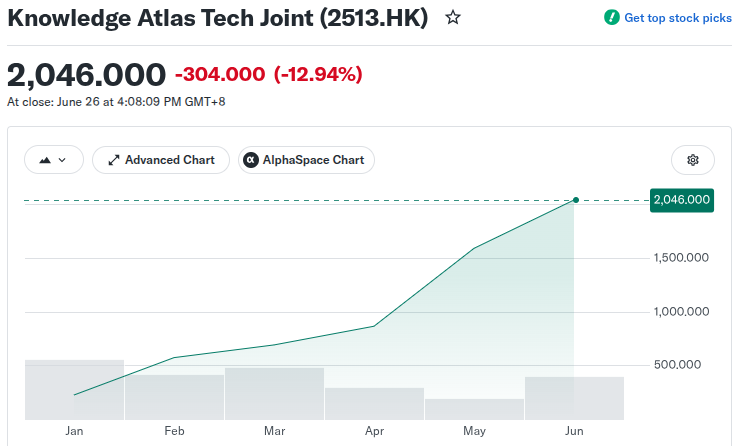
Markets responded immediately. Z.ai shares surged more than 30% in Hong Kong trading and now sit up over 800% since debuting in January. JP Morgan projects Z.ai revenue to expand by more than 534% this year, with profitability arriving by 2028.
## Why the Chinese AI Push Now Hits Anthropic and OpenAI
The cost advantage is the most damaging factor for US labs. DeepSeek V4 Pro charges $3.48 per million output tokens. Anthropic’s Fable 5 charged $50 for the same output. As a result, enterprise buyers are now openly rethinking their entire AI vendor relationships.
Adoption metrics support the shift. OpenRouter, a popular AI aggregator platform, now shows that Chinese models hold the top four positions among the most widely used systems globally. DeepSeek, MiniMax, Tencent, and Xiaomi have collectively passed every major US frontier provider by token traffic.
The rotation also extends well beyond price. Open-source models can be downloaded, fine-tuned, and run permanently. As a result, neither developers nor governments can revoke access to a system already running on a customer’s own servers, a quality now suddenly more valuable than raw frontier performance.
The competitive picture remains nuanced. DeepSeek itself estimates that Chinese models trail leading US systems by 3 to 6 months in terms of pure capability. However, that gap matters less when access becomes the primary risk factor, and pricing determines whether production is viable or token economics are prohibitive.
The broader policy backdrop favors the Chinese push. Washington’s restrictions on Anthropic and OpenAI may end up vindicating China’s broader tech self-sufficiency vision, which accelerated after the 2022 Biden administration chip controls landed. Furthermore, demand for Chinese open models is rising fastest across developing economies worldwide.
GLM-5.2 has also demonstrated strong performance in specialized domains. The model ranks number two in Code Arena: Frontend, scoring 29 points above Claude Opus 4.7 (Thinking) and trailing only Fable 5. It also ranks as the top model in React and places fourth in HTML sub-leaderboards, establishing itself as the best open model against competitors like Kimi-K2.6 and Minimax-M3 by a large margin.
Z.ai also plans a dual listing in Shanghai to fund a long-term push toward artificial general intelligence. The next model, GLM-5.5, is expected to launch in August, signaling that the pace of Chinese AI development shows no signs of slowing.
—
*This article is based on the original post: “China’s AI Models Gain Ground on Anthropic and OpenAI,” which appeared first on BeInCrypto.*
